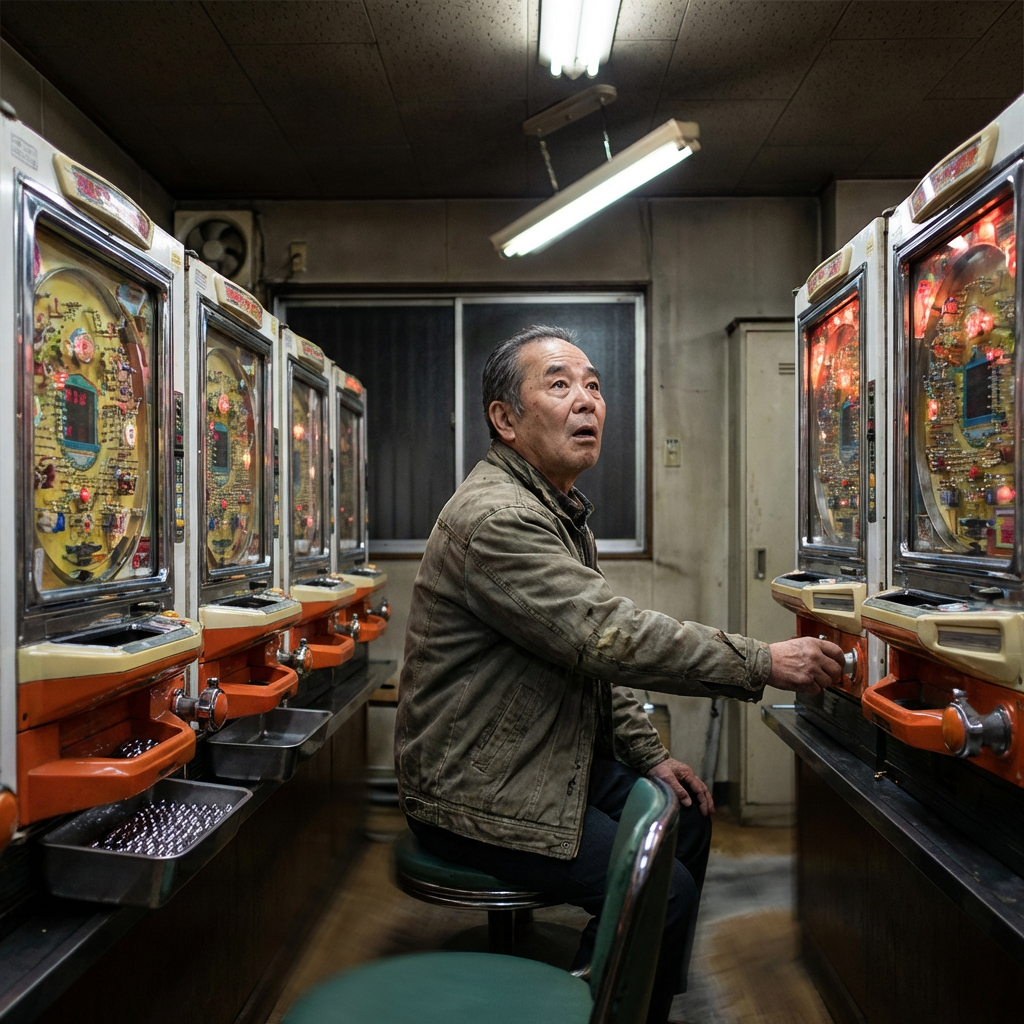
On an otherwise unremarkable Tuesday in Tokyo’s Shinjuku district, the most profound messages are not delivered by smartphone or broadcast; they are embedded in the shuddering of the earth. While the city collectively braces for the rhythmic dance of its tectonic plates, an almost forgotten question lingers: what if the tremor is meant not for the city, but for you alone? This is not the premise of a supernatural novel, but a rare psychological and philosophical event experienced in an environment wholly dedicated to distraction—a pachinko parlor. In the discordant, neon-soaked heart of this city, a single, violent shudder can feel less like a shared natural event and more like a direct, unspoken communication from a universe grown impatient.
The Solitary Tremor: A Sign to Me Alone
At its core, the Japanese pachinko parlor is a monument to communal solitude. Hundreds of people sit elbow-to-elbow, yet they are islands; the only sounds shared are the roaring cascade of silver balls, a pre-recorded frenzy of jingles, and the universal hum of air conditioners battling the heat of countless machines. It is within this atmosphere of concentrated isolation that the tremor hits.
It begins not as the general shaking reported on the news later, but as an intensely personal disturbance. The Parallax Effect, a key term for this phenomenon, becomes immediately apparent: your machine shudders violently, the cascade of balls momentarily chaotic, while the person to your left seems only to pause, mildly annoyed by the vibration. You lock eyes with a stranger across the aisle, but their expression reads as confusion, not terror. The immediate, chilling conclusion forms: This wave of the earth was calibrated for me.
- Sensory Disconnection: The booming soundscape masks the initial rumble. You feel the shake through the seat, the machine, your bones, before you truly hear it.
- Perceptual Narrowing: Focus funnels to your immediate surroundings—the shuddering steel, the frenzied lights of your machine—while the rest of the hall blurs into a disinterested background.
- The Immediate Question: Not “Is everyone okay?” but “Why can I feel this so acutely when others don’t seem to?”
Cacophony of Neon Demons in the Shaking Void
A pachinko hall during an earthquake is an assault on every sense, transforming chaos into a theological spectacle. The machines, those dedicated Neon Demons, do not go silent; they escalate. Loss jingles blare incongruously, celebratory tunes clash with the grinding sound of the building’s frame, and the thousand flickering screens create a dizzying light-show against the moving floor. There is no reverent stillness here, only a fever-pitch dissonance that makes the event feel surreal and profane.
> In this space, the divine—if we are to sense it—does not speak in a still, small voice. It shouts through the malfunctioning orchestra of chance and distraction.
The environment actively works against communal confirmation of the event. The very ingredients of the parlor heighten the feeling of a personalized, almost staged, intervention.
- Visual Noise: Flashing lights disorient and prevent a clear assessment of others’ reactions.
- Auditory Overload: The constant noise drowns out the cries, shouts, or instructions that might normally bond people in an emergency.
- Physical Anchoring: Players are literally latched to their machines, their focus physically tethered to the source of their hoped-for fortune, making disengagement feel like a personal sacrifice.
Divine Isolation in a Temple of Chance
It is in this environment that the event sheds its geological skin and dons a metaphysical one. Pachinko parlors are not just arcades; they are secular, fluorescent Temples of Chance, where modern supplicants seek favor from the erratic gods of randomness and luck. To be inside one when the ground shifts is to feel the architecture of your own superstitions crack open.
Was the tremor a critique of this devotion? A suspension of the house rules by a higher authority? The isolation transforms the natural event into a Divine Audit, a silent, pointed query about the investment of your time, focus, and spirit in this glittering void. The question hangs in the smoky air: Is this proximity to fortune—this numbing engagement with possibility—a form of spiritual poverty?
> The true gamble in a pachinko parlor may not be for tokens, but for meaning. The quake interrupts the first game to propose a second, far more consequential one.
An Unshared Judgment Echoes Through the Racks
As the tremor subsides, the most profound moment arrives: the silence of the aftermath, but not as one expects it. The machines do not stop. The buzzers keep buzzing, the balls keep falling. The staff do not announce an evacuation over the PA. No one rises as one to head for the exits.
This lack of a collective script is its own form of quiet terror. In an office, a home, or a park, there is a shared ritual—the checking-in, the nervous laughter, the collective sigh. Here, there is none. The Echo of Judgment is personal and unvalidated. The suspicion that the event was a message for you solidifies in the face of everyone else’s swift return to normalcy. You are left alone with the memory of the shake, a secret alarm that went off in your soul while the world kept spinning its reels.
- Social Verification Fails: When you whisper “That was a big one,” your neighbor might shrug. “Felt pretty normal to me.”
- Resumed Ritual: The swift return to play by others makes your lingering disquiet feel foolish, almost sacrilegious in this space of continuous, unquestioned participation.
- The Private Aftermath: You carry the experience out the door, into the unnervingly calm Tokyo street, a solitary witness to a personal omen.
Interpreting the Warning Left in the Silence
So what remains when the soles of your shoes meet stable pavement again? The interpretation is, by necessity, a personal endeavor. Yet, the intensity of the experience in that specific venue suggests certain paths for reflection. The warning may not be about impending doom, but about immediate, quiet decay.
Possible interpretations of the ‘divine warning’ include:
- A Call to Attention: The universe shaking you literally, to shake you figuratively from a pattern of low-stakes distraction.
- A Mirror of Instability: The trembling ground reflecting an internal state of uncertainty or aimlessness that the pachinko parlor’s false stability was temporarily masking.
- A Lesson in Impermanence: Even the most solid-seeming foundations—of a building, a routine, a life philosophy based on chance—can shift without notice.
- The Burden of Sensibility: A reminder that sensitivity to such ‘messages’ is both a gift and a weight, separating you from a comfortable, unquestioning crowd.
The event is real—the seismic reading exists on a chart somewhere. But its meaning is forged in the silent space between the initial shudder and the world’s immediate, disinterested continuation. It lives in the decision that follows: to walk back into the neon hum, or to carry that unique, personal vibration out into the world and listen for what it truly was trying to say. The divine, it seems, does not shy away from garish, noisy places to deliver its quietest and most urgent memos.
Leave a Reply