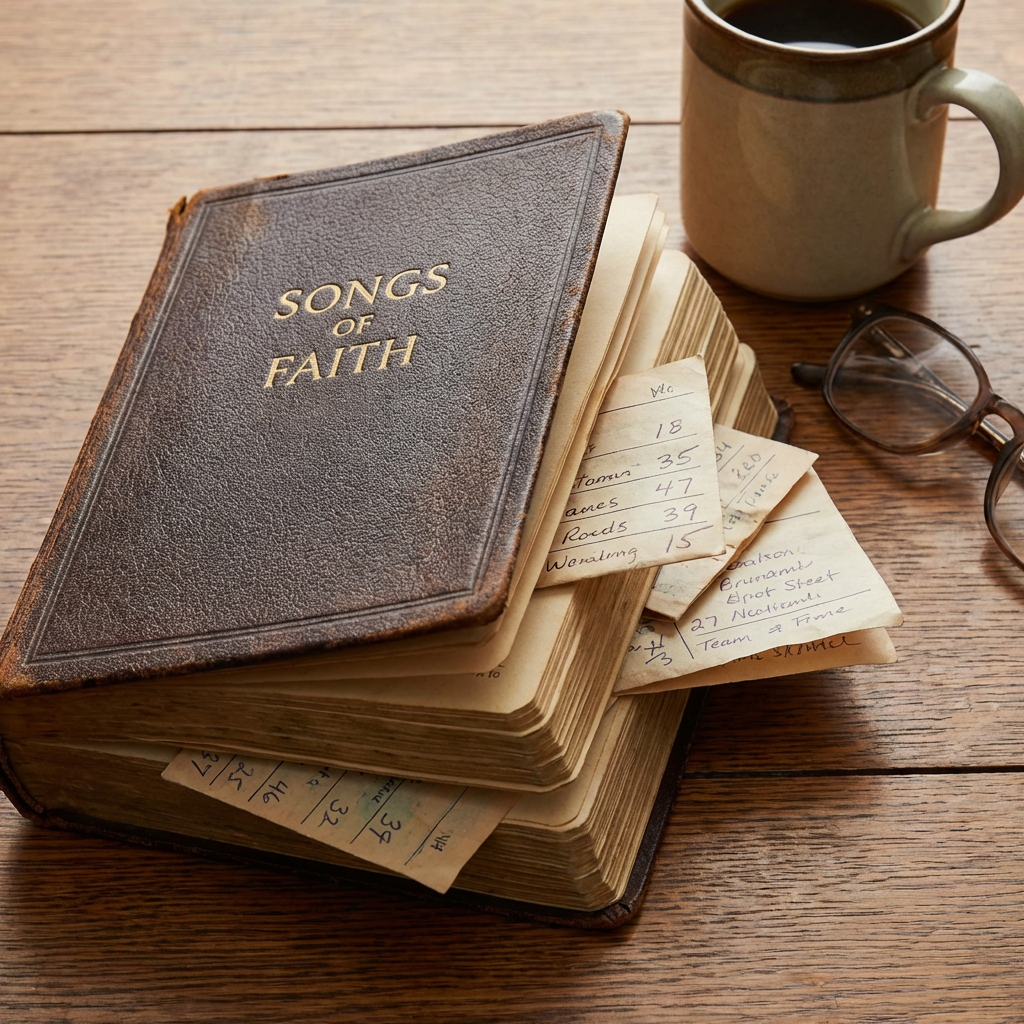
The space between faith and failing can be as thin as the paper of a hymnal. For my family, the church was our bedrock, the source of all our joy and community. Every Sunday, without fail, we took our place in the third pew, my mother’s soprano voice ringing clear beside my father’s steady baritone. To an outside observer, we were the picture of devotion. But faith, I’ve learned, can be a bright light that casts the deepest shadows. Our story is one of harmony and dissonance, where the very songs meant to uplift the spirit became the first clues to a hidden life—a life where hymns masked the despair of my father’s secret gambling addiction.
Divine Tension Between the Pews and the Casino
There was a palpable friction that only a child attuned to their parents’ unspoken language could sense. On Sunday mornings, my father was a pillar: ushering, praying, robustly singing “Amazing Grace.” Yet, by Tuesday evening, a subtle shift occurred. The same hands that lifted the offering plate would nervously check his phone, screen angled away. The jovial, expansive man of the congregation would sometimes retreat into a tense, preoccupied shell.
Key patterns began to emerge, a silent schedule that ran counter to the church calendar:
- Saturday night absences were explained as “meeting a friend” or “running an errand for work.” He’d return late, smelling of smoke and cheap coffee, a scent utterly foreign to our home.
- Monday morning gloom was often attributed to a “tough week ahead,” but the despair seemed too deep, too personal, for mere workplace stress.
- His sudden, intense interest in sports statistics was odd for a man who never watched a game, his commentary filled with terms like “point spread” and “the underdog.”
He lived in two worlds: one of light and community, the other of risk and isolation. The church was his stage, but the casino was his secret theatre.
Every Psalm a Veiled Judgment on His Luck
My awakening began not with a confrontation, but with lyrics. Sitting in the pew, hymnal in hand, I started to hear the words through the imagined lens of his secret life. It was as if the hymns were written not just for the faithful, but for the fallen.
> “Rock of Ages, cleft for me, let me hide myself in Thee.”
The plea for refuge struck me. Was my father seeking a hiding place, too? The classic hymn “Come, Thou Fount of Every Blessing” became particularly haunting. The line “Prone to wander, Lord, I feel it, prone to leave the God I love” felt like a direct confession he was silently making. I’d watch him sing it, his eyes closed in what I once thought was reverence, but now wondered was it shame? Each Sunday service became a layered performance, where the congregation sang of redemption, and my father, I believed, sang of his need for it.
Choir Practice Became a Silent Interrogation
My mother was the choir director. Our home was often filled with sheet music and harmonies. My father, though not in the choir, loved to listen. After his losses—though I didn’t yet know that’s what they were—he’d ask her to play specific hymns.
- He’d request “It Is Well With My Soul”, a hymn born from profound tragedy, and sit silently, listening as if trying to speak the words into existence over his own turmoil.
- He’d hum “What a Friend We Have in Jesus”, especially the verse about taking “everything to God in prayer.” The irony was a sharp, private pain I carried alone.
- His avoidance of joyful, triumphant hymns like “Victory in Jesus” on certain weeks spoke volumes. The music was a mirror to his emotional state, a coded language of despair and fleeting hope.
Choir practice was no longer just about music; it was my silent interrogation room. His song requests were the closest he could come to an admission.
When Beloved Melodies Revealed the Debt
The abstraction of suspicion became a concrete, terrifying reality one Tuesday evening. My mother was planning the Sunday service and asked me to fetch an old choir folder from my father’s home office desk. There, tucked between pages of photocopied “Great Is Thy Faithfulness,” was not a musical annotation, but a collection of slips.
They were not holy. They were betting slips, hastily folded and hidden. Scribbled numbers and losses circled in red ink bled through the thin paper. The tally in the margin of one was a figure that stole my breath—a sum that represented more than a car payment. It represented debt, desperation, and a profound double life. The sacred and the profane existed literally within the same sheet of paper. The beloved melody of God’s unwavering faithfulness was now the score to a secret drama of financial ruin.
Congregational Praise and a Secret Confession
The breaking point came on a Sunday we sang “Just As I Am.” The altar call hymn, a gentle invitation to come forward and find grace. As the verses washed over the congregation, I saw my father’s shoulders begin to shake. Not with the spirit of worship, but with silent, heaving sobs he could no longer contain. The weight of the secret, sung into existence week after week, finally shattered him.
He did not go to the altar that day. He walked out of the sanctuary, and my mother and I followed. In the empty, echoing fellowship hall, surrounded by tables where we’d shared countless potluck meals, his confession tumbled out between the echoes of the still-playing hymn. The losses, the lies, the second mortgage, the sheer terror of being discovered. The congregational praise outside became the backdrop to our family’s most raw and painful moment. It was the hymn that broke him, and in doing so, began the long, difficult road toward healing.
Faith, music, and human frailty are intertwined in the deepest parts of our story. The church hymns did not cause my father’s addiction, but they became the unexpected spotlight that exposed it. They were the veiled judgment, the silent interrogation, and ultimately, the catalyst for confession. In their ancient, enduring words, he found both the mirror for his failing and, eventually, the language for his hope. Our family’s journey toward recovery began not in a therapist’s office, but in the aftermath of a Sunday service, proving that sometimes grace finds its way through the most unexpected cracks—even those hidden between the notes of a familiar song.
Leave a Reply