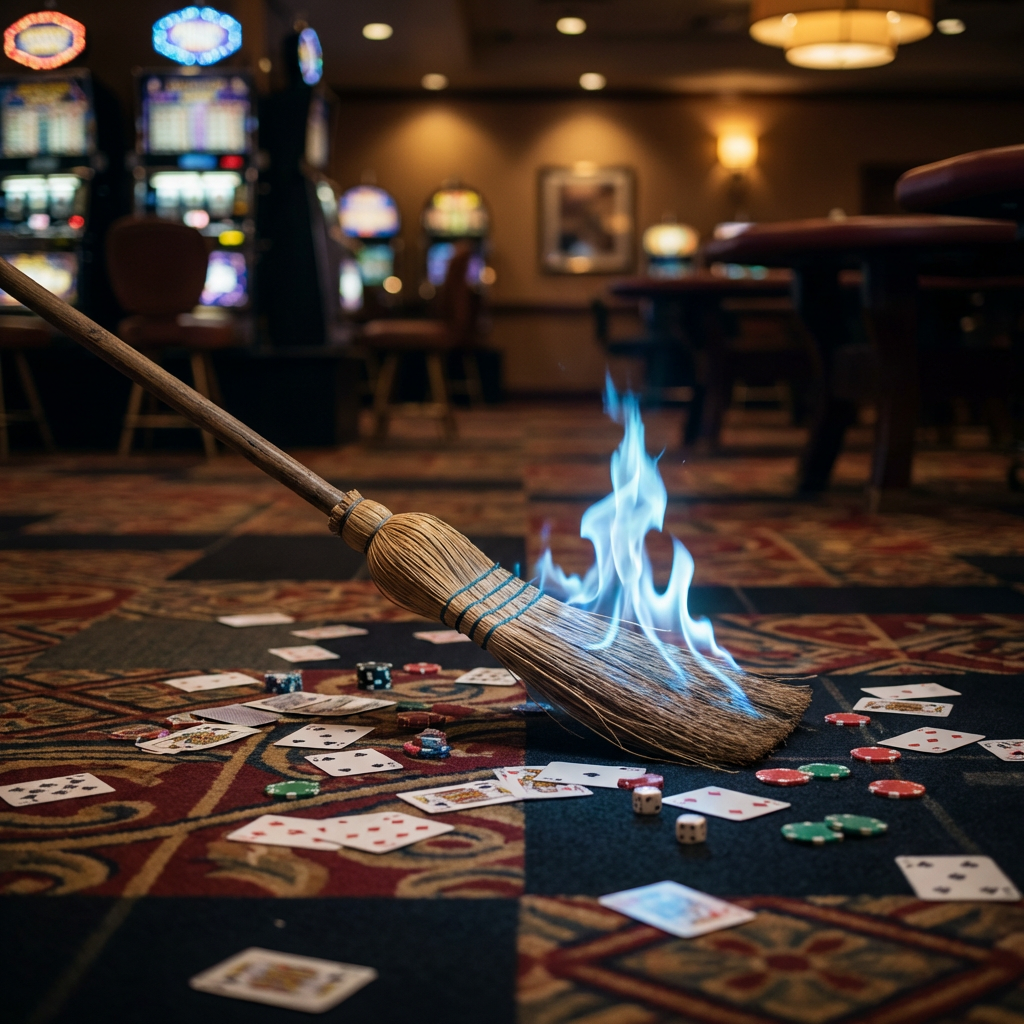
In a city defined by its refusal to sleep, where every story is told in blinking neon and whispering blackjack deals, there exists a single, persistent legend. It’s not of a high roller’s impossible luck or a showgirl’s tragic romance. It’s about a janitorial tool and the spectral fire it bore. This is the story of the Broom That Burned Blue, a phenomenon glimpsed by harried cleaners in the dead hours before dawn—a whisper, a flicker, and a warning. It speaks not to the monetary debts on the casino floors, but to the moral ledger of the city itself. It asks us to look past the rhinestone dazzle and see the deep, foundational rot that truly defines Sin City.
Sweeping the Glitter From Sin City’s Floors
The real work begins when the last chip is cashed and the final spotlight dims. Armies of cleaners emerge, armed with mops, vacuums, and brooms. Their task is Herculean: to erase the physical evidence of the night’s excess. They sweep away:
- Cigarette butts by the thousand, each a tiny monument to a bet placed or a heart broken.
- Shattered glass from dropped bottles, glinting like cruel diamonds under the fluorescent maintenance lights.
- Torn betting slips and crumpled drink tickets, the confetti of broken dreams.
- A fine, persistent dust of glitter, makeup, and desert sand—the city’s tired skin, sloughing off.
This nightly ritual of physical cleansing is a poignant metaphor. The city believes that by sweeping the debris into a bin, it can present a fresh, untarnished face for the next cycle of consumption. Yet, the residues left behind are far more permanent than glitter.
> The most stubborn stains are not red wine or cigar ash on the carpets, but the residue of desperation and fleeting joy soaked into the very air.
The Blue Fire of a Broom’s Divine Warnings
The legend, as passed between graveyard-shift crews, is always the same. A worker, alone in a long, empty corridor or a cavernous, darkened theater, sweeps the same patch of floor. With a sudden, silent whoosh, the broom’s bristles erupt in a cold, cerulean flame. It doesn’t burn the wood; it doesn’t produce heat. It simply hovers, an ethereal, silent fire for a few ghostly seconds before vanishing.
This blue fire is interpreted not as an illusion of tired eyes, but as a divine or spiritual rebuke. In folklore, blue flames often signify sacred presence, purgatorial souls, or a stark supernatural truth breaking through the veneer of reality. In the context of Las Vegas, the burning broom is seen as:
- A marker of hidden sin—revealing a spot where a particularly cruel deception or a moment of true human suffering occurred, unseen by revelers.
- A judgment on the act of cleansing itself, suggesting the superficial tidying is a futile attempt to erase what is indelibly etched in the city’s spiritual ledger.
- A moment of brutal clarity, a flash that illuminates the transactional emptiness lurking beneath the ritual of nightly renewal.
Neon Lights Masking the Rot They Depend On
Vegas is a master of misdirection. The neon lights are its greatest trick, painting a vibrant world of possibility and excitement. Yet, that very light serves to obscure the structural decay—both moral and physical—that the spectacle requires to function. This isn’t just about old wiring or tired facades. The rot is foundational.
- The Ecology of Addiction: The city’s economy is meticulously calibrated to exploit psychological vulnerabilities. The free drinks, the lack of clocks, the hypnotic sounds of slots—all are architecture designed to mask the rot of addiction until it’s too late.
- The Illusion of Newness: Constant demolition and reconstruction (the “implosion”) create a false narrative of perpetual new beginnings, obscuring the historical and human costs buried beneath new resorts.
- The Labor Behind the Glamour: The dazzling shows and impeccable service are powered by a workforce often living on the city’s fringes, dealing with the very consequences of the industry they serve. The neon blinds us to their struggle.
Cleansing Aisles of Laughter And Loss
For those who work the dawn patrol, the casino floor is a theater of aftermath. Aisles between slot machines are not just pathways; they are cleansing aisles where the emotional spectrum of the night is laid bare. In a single sweep, a cleaner might pass:
- A VIP booth still echoing with the raucous laughter of a bachelor party that won big.
- A lonely stool at a penny slot, where an elderly visitor quietly lost her month’s pension, the chair still holding the shape of her despair.
- A discarded wedding ring, left on a blackjack table as a final, dramatic bet on a new life.
These workers are the city’s unofficial chaplains, bearing witness to the raw, unfiltered humanity that the daytime marketing never shows. They perform a secular last rites, sweeping away the tangible remnants of decisions made in the gilded dark.
Can a City’s Moral Decay Be Swept Away?
This brings us to the legend’s ultimate, haunting question. If the blue fire reveals a sin too deep for a broom to clean, can moral decay be swept away? Las Vegas, in its existential core, grapples with this daily. Its entire existence is a bet that it can—that yesterday’s losses are forgotten with today’s free buffet coupon, that ruin is just a prelude to a miraculous jackpot.
The burning broom suggests otherwise. It posits that some actions leave a permanent psychic stain, a spiritual debt that no amount of physical renovation or promotional spectacle can erase. The city’s true conflict isn’t between luck and loss, but between its professional dedication to cultivated vice and its desperate, unspoken yearning for absolution.
The myth endures because it speaks a truth the neon cannot drown out: you can sweep a floor spotless, but you cannot sweep a soul clean. The blue fire is that truth, flickering for a moment in the pre-dawn silence—a reminder that beneath the city’s frantic cycle of sin and sanitization, the rot remains, waiting, watching, and demanding to be seen not with eyes dazzled by light, but with the sober clarity of the morning after.
Leave a Reply