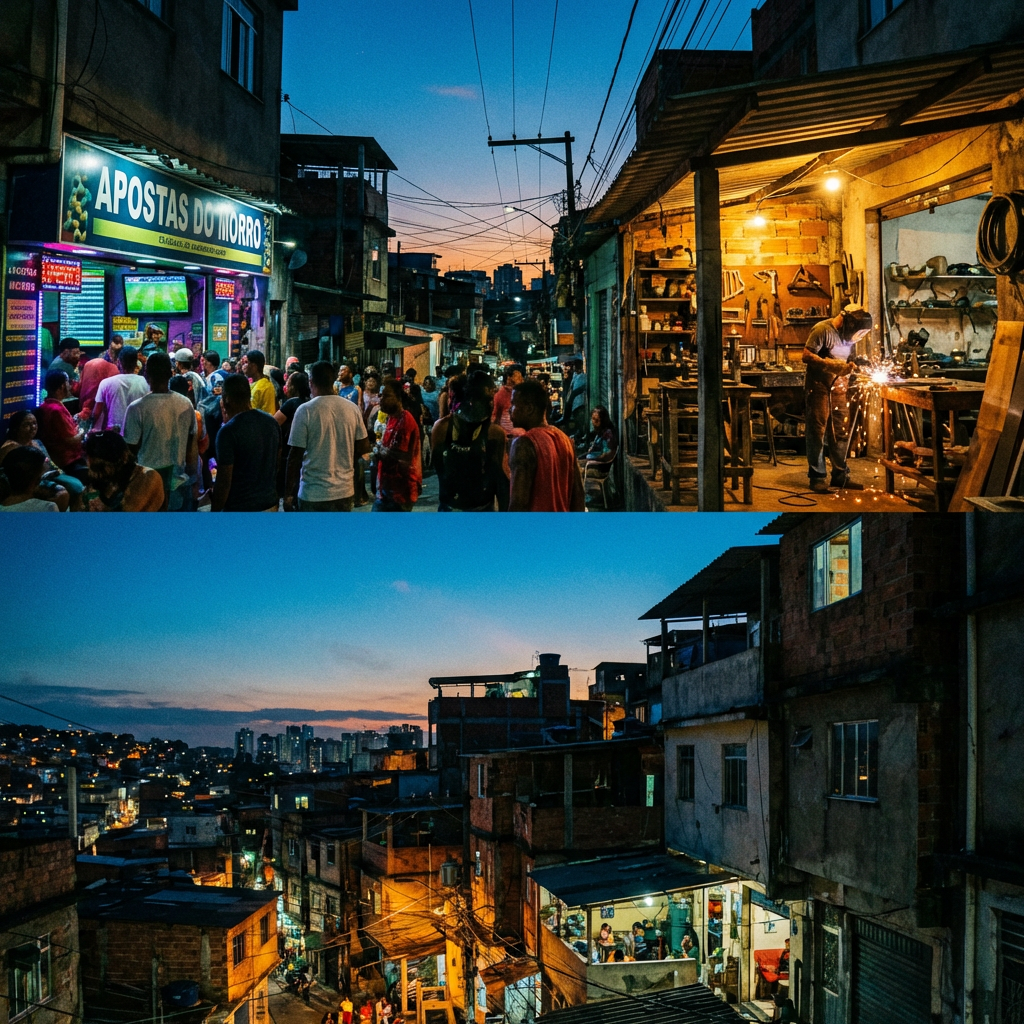
Growing up where I did, you learn to read the landscape. From our homes, perched on the hillside, you see two very different games being played. Below, the city pulses with commerce and polished promise. Up here, the alleys are steep, but the view is sharp. It has given me a front-row seat to two powerful forces shaping my community: one that extracts, and one that builds. This is the story of two choices—one disguised as a shortcut, the other as a grind—and the vastly different futures they create. I’ve seen how sports gambling takes, and how true investment gives.
From The Hillside: Witnessing Two Contrasting Games
My favela is a place of profound duality. There’s vibrant energy in the sounds of samba, children playing football with a deflated ball, and neighbors sharing what little they have. Yet, there’s also a constant, quiet tension—the struggle against a system that often feels rigged. In this environment, two parallel economies operate.
- On one corner, you have the local betting shop (casa de apostas). It’s always buzzing, especially on game days. Screens flash with odds, and the air is thick with hope and anxiety.
- On another, you might find someone like Dona Maria, who used a micro-loan to buy a second fridge, turning her front room into a small store selling cold drinks and snacks—a slow, steady investment in her family’s stability.
From above, the pattern is clear. One activity pulls money, attention, and dreams into a vortex. The other, though humble, lays a single brick for a foundation.
Betting’s Trap: The Cycle That Takes and Never Replaces
The lure of sports gambling isn’t just about money; it’s about the intoxicating idea of instant transformation. For people feeling trapped by circumstance, a bet feels like a legitimate strategy—a way to hack the system. But the mechanics of this game are designed to benefit the house, always.
The cycle is vicious and predictable:
- The Hope Injection: A small win, or the story of someone who hit it big. This creates the illusion of accessibility and skill.
- The “Near-Miss” Fuel: Losing a bet because of a last-minute goal or a controversial call doesn’t feel like loss; it feels like bad luck, encouraging the next try.
- The Chasing Phase: This is where the real damage happens. Money meant for groceries, bus fare, or a child’s school supplies gets redirected to “chase losses” and recapture that initial hope.
- The Silent Extraction: The money lost doesn’t just disappear. It permanently leaves the community. It flows out to distant corporate headquarters, funding dividends and executive bonuses, never reinvested in our hillside.
> Important Tip: If you find yourself rationalizing a bet by saying, “I’ll just win back what I lost,” you are already in the trap’s deepest phase. Stop. That money is gone. Protect what you have left.
All That Glitters: The Hollow Allure of a Sure Win
Why is this trap so effective? Because it expertly mimics the language of opportunity. It talks about “odds,” “analysis,” and “playing the system,” dressing up chance in the clothes of strategy. It sells a narrative that is profoundly seductive: that you can solve complex, structural poverty with a single, clever transaction.
But the “sure win” is a myth. The excitement of the potential payoff deliberately overshadows the near-certainty of long-term loss. This hollow allure doesn’t just drain wallets; it drains ambition. It subtly teaches that the way out is through luck, not through cultivating one’s own skills, community, or long-term plan. It replaces the slow, steady confidence of building something with the nervous, addictive high of guessing an outcome.
The Long Investment: Planting Seeds in Hard Ground
Investment, in our context, has nothing to do with stock tickers or Wall Street jargon. It’s a different philosophy entirely. It’s the act of redirecting resources—time, money, effort—into something that grows, even if imperceptibly at first.
True investment here is tangible and human:
- Investing in a skill: Paying for a welding course, a hairdressing certificate, or a driver’s license.
- Investing in a micro-business: Buying a used sewing machine to take in repairs, or a bulk bag of rice to resell in smaller units.
- Investing in the community: Contributing to a communal savings pool (vaquinha) to repair the neighborhood’s water tank or to help a family in crisis.
> A Quote from My Grandmother: “A bet is a seed you throw on concrete. It might sprout, but it will never take root. An investment is a seed you plant in your own yard. You water it, you protect it, and one day it gives you shade.”
This process is not glamorous. It lacks the instant thrill. The returns are delayed, and the path is full of setbacks. But the key difference is ownership and multiplication. The value created stays here. It employs a cousin, feeds a family, and inspires the kid next door.
A New Vision: Betting on People, Not Just Outcomes
The ultimate shift we need is a shift in what—and who—we wager on. The future of my favela won’t be found in a parlay ticket. It will be built by betting on the people within it.
This means:
- Supporting local savings and investment clubs instead of frequenting betting shops.
- Mentoring young people to see their own potential as the best asset they will ever have.
- Demanding that policies protect vulnerable communities from predatory gambling advertising, just as they would from any other public health threat.
We must become investors in our own narrative. The goal is to build a community where capital—financial, social, and human—is circulated within, gaining strength with each pass, rather than being siphoned off into a corporate vacuum.
In the end, the most profound view from the hillside isn’t of the city below, but of the choices we make right here. One path, lined with flashing lights and promises, is a short walk to a dead end. The other, a steep and rocky trail, leads upward. It asks for patience, faith, and hard work. It is the path of the investor—the planter of seeds. And from where I stand, it’s the only game in town truly worth playing.
Leave a Reply