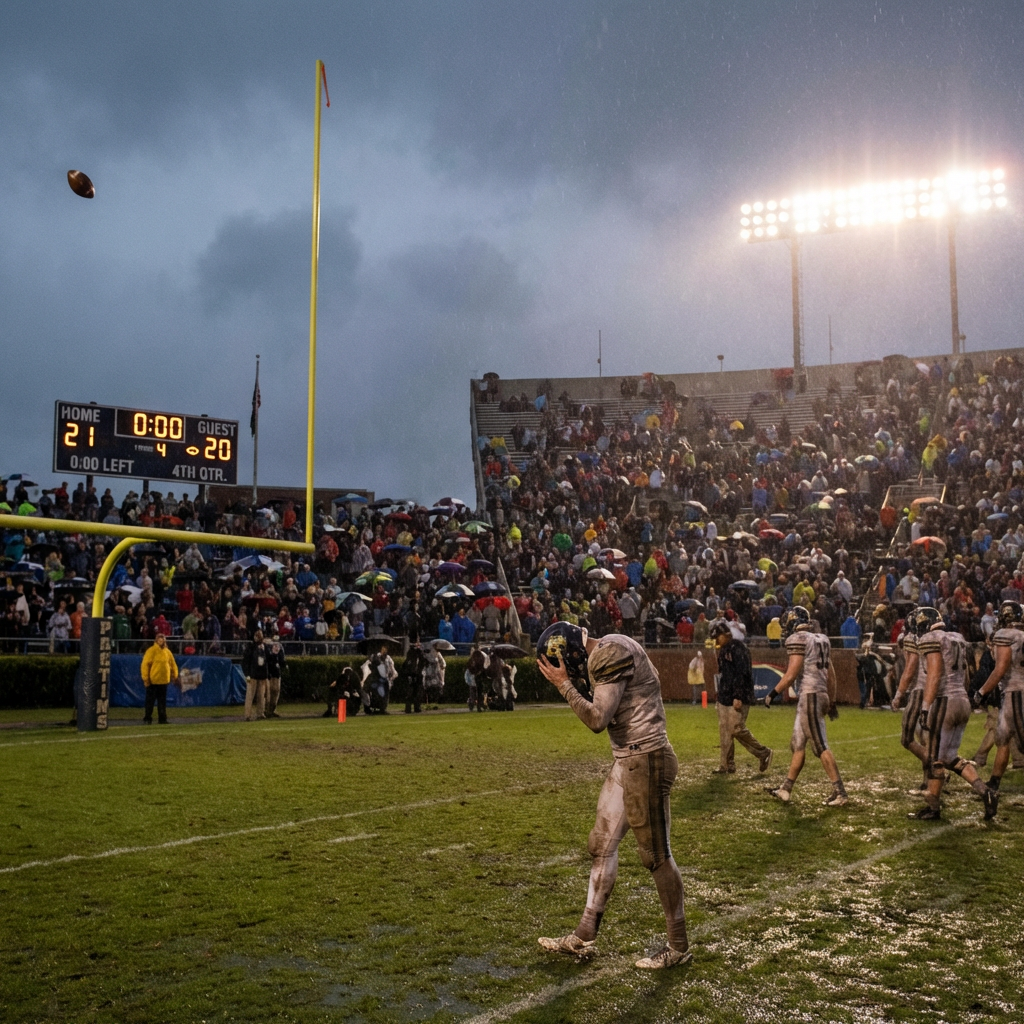
In the late 1990s, sports betting became a burgeoning obsession, an under-the-table passion before the era of legal mobile apps and regulatory oversight. For one man, it became a gravitational force that pulled his entire life into its orbit, leading to a shattering moment centered not just on a loss, but on the devastating belief that the game itself—and the outcome he had wagered everything on—was fundamentally predetermined. This is the story of Michael, a man who truly lost it all before seeing the Saints’ rigged game.
The Unraveling on Maple Street in ’97
Life for Michael in his duplex on Maple Street was quiet and orderly. He held a steady, if unglamorous, job at a printing press. His past was like a faded photograph—service in the Air Force, medals in a wooden box in the closet, and memories he’d carefully walled off. He had found a fragile peace. The itch for more began innocuously.
- A friendly wager on a college basketball game with a coworker.
- Then, weekly football parlays purchased through a discreet local bookie.
- The thrill of winning was intoxicating, quickly eclipsing the routine of his daily life.
> “The first win feels like discovering a cheat code for life. The hundredth loss feels like being cheated by life itself.”
Michael began chasing losses, borrowing against his car, then his house. The rigid structure of his military past was replaced by the volatile highs and lows of the point spread. Maple Street, once a sanctuary, became an address holding a mounting secret. He wasn’t just gambling money; he was gambling the quiet stability he had worked so hard to build.
Betting More Than Money on the Saints
By the fall of 1997, Michael was in deep. The New Orleans Saints were his team—not out of fan loyalty, but statistical obsession. He analyzed their defense, their home-field advantage, and their upcoming match-up against a seemingly weaker opponent. This game, he convinced himself, was the linchpin. It was the perfect bet to cover all his markers and wipe his slate clean.
- The All-In Logic: He saw the Saints’ potential victory as a mathematical certainty, an inevitable market correction for his string of bad luck.
- Collateral Shift: He no longer saw assets—his car, his home equity, his retirement savings—as security. He saw them as betting chips.
- The Terms: Through underworld connections, he secured a massive, high-interest loan, wagering his home’s deed as final collateral.
This was a strategic play, he reasoned. A one-time, make-or-break gamble on what he believed was a lock. In his mind, the brilliance was in the stakes, not the risk. He had built an entire internal logic where losing was not part of the equation.
The Final Play That Shattered a Life
The game was a nerve-wracking seesaw. But in the fourth quarter, the Saints drove down the field, poised for a go-ahead score. The ball was snapped. The quarterback dropped back. And then it happened: an egregious, inexplicable error. A star wide receiver, wide open in the endzone, slipped on seemingly nothing. The pass fluttered incomplete. Replays would later show no contact, no visible cause.
For the crowd, it was a tragic fluke. For Michael, watching on a grainy television with the bookie’s enforcers present, it was a cosmic punctuation mark on his folly. The Saints lost by two points. He did not speak. He simply stared at the screen, the final whistle not signaling the end of a game, but the end of his world as he knew it.
> “In that silent, cold moment after the screen went to static, there is no fury. There is only the profound, deafening silence of total zero. You have arrived at the exact destination your worst fear imagined.”
His house, his car, and his remaining savings were gone within the week. He was left with nothing but a duffel bag and a bus ticket to nowhere.
A Past Revealed in Stadium Echoes
Adrift and homeless, Michael found himself months later outside the stadium in New Orleans. A chance conversation with an old-timer groundskeeper led to a revelation. The story of the “slipping receiver” was locker-room lore. The player was later traded abruptly, and word from inside suggested the league privately concluded an associate of an international crime syndicate had paid him a massive sum for that one, perfectly timed “accident.” The game, a critically inconsequential one in the standings, was an ideal target for fixing—too small for major scrutiny, but perfect for syndicate gamblers who had placed fortunes on the point spread.
This knowledge was a poison. It validated his bitter paranoia but offered no recourse. His catastrophic loss wasn’t just bad luck; it was engineered. The very integrity of the outcome he had mortgaged his life for was a mirage. The military veteran who prized strategy understood he was never playing a game of chance. He was a mark in a rigged con.
Losing It All to a Rigged Game
Michael’s story is a brutal tapestry of personal addiction meeting systemic corruption. He unraveled his life long before he knew the final card was stacked. It raises haunting questions about fate and agency. The gambler chooses to bet, but who chooses the final score? While his journey into debt was a solitary march, his final ruin was caused by actors he never saw on the field.
- Tip: The biggest risk in any gamble is not the money you put down, but the hidden variables—inside players and unseen forces—you can never account for.
- Reflection: There are times when you are the author of your own misfortune. And there are times when you are simply a character in someone else’s script.
He didn’t just lose his home and his money on a bad day for the Saints. He lost his faith in fairness, the narrative of his own life, and any last remnant of his soldier’s belief in a battle that is ever fairly fought. He believed he was playing the odds, but the game, in the most literal sense, was already over before it began. The sporting loss on the field was a tragedy for fans. For Michael, the realization of the orchestrated loss became a personal, inescapable void.
Leave a Reply