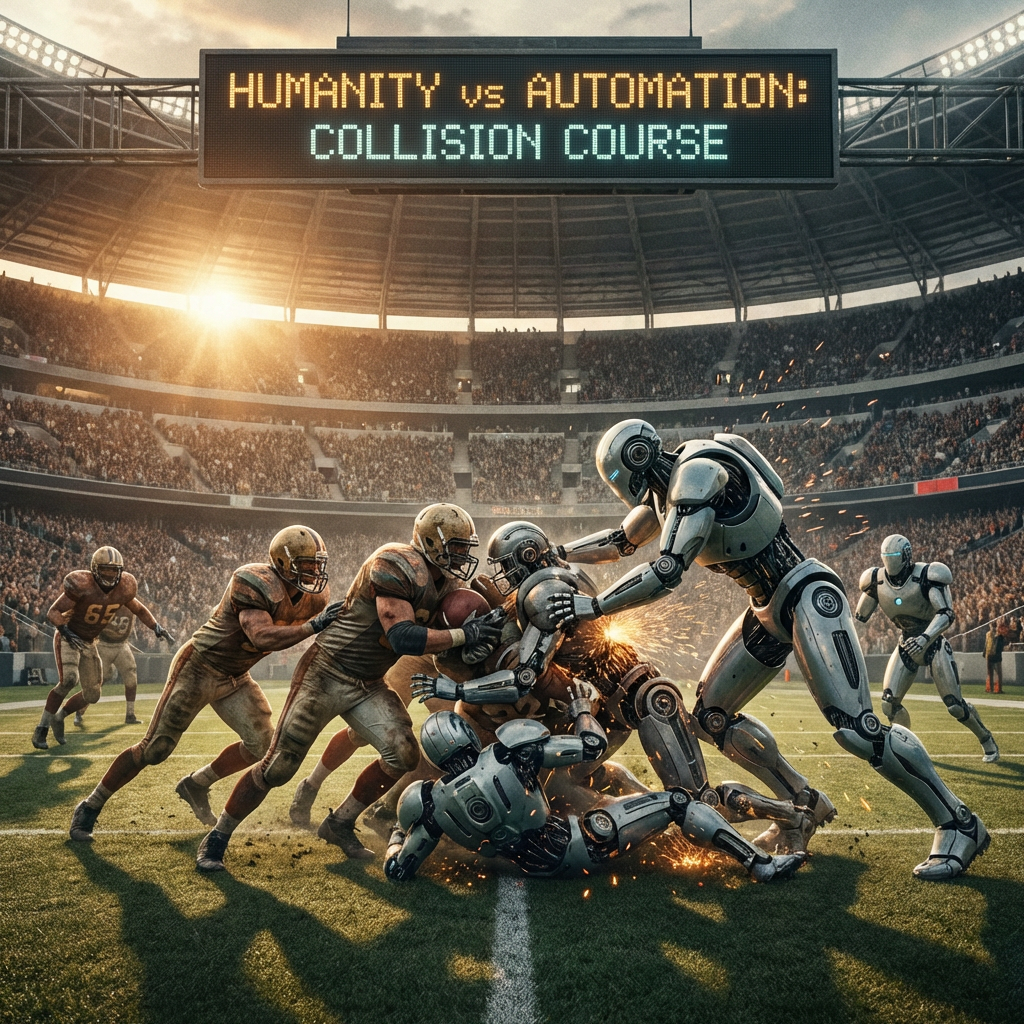
For years, the halls of the World Economic Forum in Davos have echoed with a distinct, daunting prediction: a future of work radically reshaped by artificial intelligence and automation. While AI’s potential for progress was a consistent headline, an equally potent theme—the threat of widespread job displacement and deepening economic inequity—cast a long shadow. Yet, a novel and surprising counter-narrative is emerging. It suggests that the most resilient economies of tomorrow may be built not on the cold calculus of machines, but on the powerful, predictable passion of people, with inspiration drawn from an unlikely quarter: the world of sports.
The Davos Forecast: Automation’s Stark Disruption
The discourse around the future of work has long been dominated by two related forces: profound opportunity and profound disruption. While generative AI promises new frontiers in creativity and efficiency, experts at gatherings like Davos persistently warn of its darker twin.
- The projected elimination of millions of roles in administrative, clerical, and even creative fields.
- The widening skills gap, where the pace of technological change outstrips the ability of education systems and workforce retraining programs to keep up.
- The dangerous concentration of capital and power, where the gains from automation accrue to a shrinking group of technology owners and investors.
This scenario presents a fundamental question for economic stability: how do we distribute wealth and maintain meaningful engagement in an economy that requires fewer human workers? The old models of shareholder primacy seem insufficient to address this coming wave.
A Surprising Solution from the Stadium
Paradoxically, an answer is being crowdsourced from the terraces and bleachers. Across the globe, a powerful model of economic participation is thriving in professional sports: fan ownership. Teams like Germany’s FC Barcelona (historically) and, more broadly, the 50+1 rule in German football Bundesliga, along with a growing number of lower-league and community-centric clubs worldwide, operate on a principle where supporters hold a controlling or significant stake.
> “A football club is not a normal company. It is a community asset with emotional equity that standard financial metrics fail to capture.”
This model creates a remarkably stable and passionate economic entity. Fans are not just consumers; they are invested in the long-term health of the club. Their loyalty is not fickle, driven by quarterly results, but generational, weathering both sporting and financial storms. This provides a level of resilience that purely profit-maximizing models often lack.
Fans as Shareholders: The New Economic Engine
Translating this stadium logic to the broader economy involves reimagining the very structure of a company. Here, “fans” become employee-owners, community shareholders, or loyal customer co-operatives. Instead of automation’s dividends flowing solely to distant institutional investors, they would be shared with the human stakeholders who built the company’s value and whose lives are intertwined with its mission.
- Employee Stock Ownership Plans (ESOPs) on Steroids: Broad-based equity grants, not just for executives, could turn every worker into a beneficiary of productivity gains from AI tools they use.
- Customer Co-operatives: Imagine a platform where the most loyal users of a service hold governance rights and share in its profitability, aligning the company’s incentives directly with user satisfaction and data dignity.
- Community Investment Vehicles: Local communities could hold collective stakes in the businesses that operate in their areas, ensuring that economic benefits—from a new logistics hub powered by robots, for instance—are reinvested locally.
In this model, technology augments human work and distributes the surplus more broadly, transforming automation from a threat into a shared asset.
From Spectators to Stakeholders in Growth
The shift from spectator to stakeholder fundamentally changes behavior and drives sustainable growth. A shareholder-fan doesn’t abandon their team after a bad season. Similarly, an employee-owner is more likely to invest in innovation, mentorship, and quality. A community-shareholder will advocate for sustainable practices that ensure long-term viability over short-term extraction.
This creates a powerful feedback loop of engaged capitalism:
- Shared Purpose: Stakeholders are united by a mission beyond profit maximization.
- Reinvestment: Profits are more likely to be reinvested into the business, its people, and its community.
- Resilience: This deeper connection provides a buffer against market volatility and predatory competition.
- Innovation: A secure, invested workforce is more empowered to suggest improvements and adapt to change.
Building an Economy Powered by Passion
The Davos vision of a fully automated future risks being cold, efficient, and exclusive. The alternative model emerging from the world of fandom offers a warmer, more human-centric template. It proposes that the most valuable asset in the 21st-century economy may not be a proprietary algorithm, but cultivated loyalty; not passive consumers, but active participants.
Building this economy requires conscious effort:
- Policy Innovation: Governments can incentivize broad-based ownership models through tax structures and procurement policies.
- Financial Tooling: New platforms are needed to facilitate small-scale, liquid community investment.
- Corporate Governance Reform: Rethinking fiduciary duty to include the interests of employees, customers, and communities as primary stakeholders.
Ultimately, the message is clear: we cannot automate our way to shared prosperity. But we can own our way there. By learning from the fans in the stadium, we can design an economy where people have a real stake in the game, ensuring that the future of work is not something that happens to us, but something we build and benefit from, together.
Leave a Reply