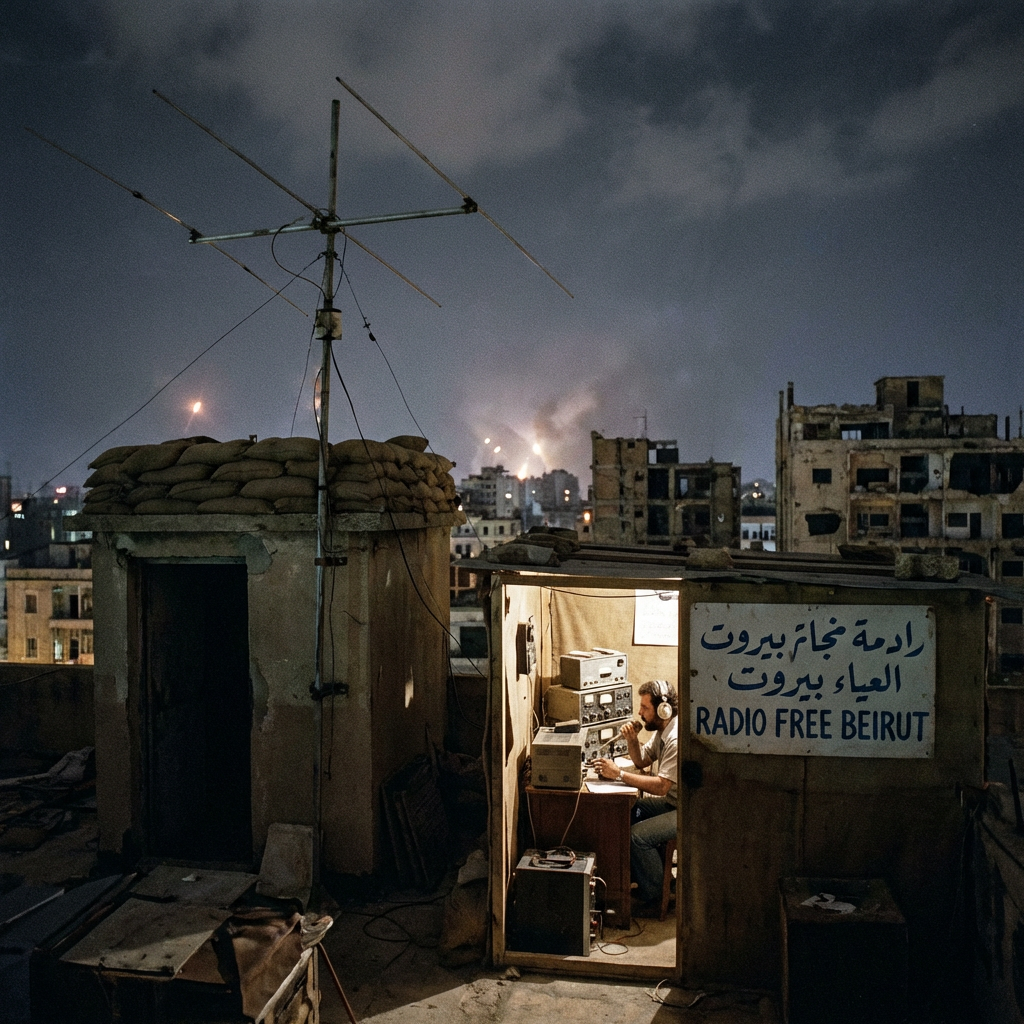
Power doesn’t always flow through power lines. In Lebanon’s capital, a new kind of current emerged during the worst of the daily, state-enforced blackouts—a crackle of static, a hum of a generator, and a voice threading through the dark, speaking of odds, politics, and survival. This is the story of an unlikely wartime wager that transcended money, turning a pirate radio station into the city’s most subversive and necessary whisper.
The Oddsmaker in the Dark: A Wartime Monopoly
Before the economic collapse and the port explosion shattered Beirut’s normalcy, Joseph “Joujou” Haddad was a small-time bookmaker. His trade was in football matches and horse races. But as the Lebanese pound plummeted and infrastructure crumbled, leaving the city in darkness for up to 23 hours a day, traditional bookmaking became absurd. People weren’t thinking about the derby; they were trying to predict the pattern of their own lives.
- The Collapse of Currency: With banks locked and savings vaporized, the Lebanese lira was no longer a trusted unit of account. Bets shifted to real value: generators, gasoline, medicine, and food staples.
- A New Market of Misery: Joujou, an avid ham radio enthusiast, saw an opportunity. He began taking, and crucially, setting odds on events central to survival in a blacked-out city. His operation became a grim monopoly on forecasting reality.
- The Commodification of Chaos: His odds weren’t just predictions; they were a shadow price-list for the crisis, quantifying the uncertainty everyone lived.
As one of his early partners noted: > We weren’t betting on the collapse anymore; we were learning to trade inside of it. Joujou’s odds became our most reliable economic indicator.
Syndicate’s Secret: Profits Written in Gunfire
For such a venture to succeed in a city of militias and factions, protection was not optional—it was the primary asset. Joujou was no fool. He understood his operation needed the tacit approval, or at least the benign neglect, of the very powers creating the mayhem. This led to the formation of the “Blackout Syndicate.”
Key figures were brought into a silent, profit-sharing arrangement:
- The Neighborhood Strongman: A local enforcer whose territory included Joujou’s hidden transmitter, ensured physical security and “license” to operate.
- The Fuel Cartel Lieutenant: This connection guaranteed the diesel needed to run the pirate transmitter’s generator, the single most valuable commodity in the dark.
- The Political Fixer: An intermediary with ties to a major political party, providing an umbrella of impunity. No one would raid a station broadcasting criticism if the profits flowed upstream.
Their cut wasn’t taken in cash, but in favors, fuel coupons, and, most importantly, information. This unholy alliance insulated the station, but also ethically compromised it from the start—a fact its listeners would later force it to confront.
In Static and Shelling, A Voice Cuts Through
The broadcast began unassumingly: a thirty-minute slot, 9 PM sharp, on a frequency just outside the jammed mainstream bands. The host, a former voiceover artist named Leila whom Joujou had recruited, didn’t sound like a revolutionary. Her voice was calm, almost melodic, cutting through the static and distant shelling.
What they broadcast was revolutionary in its banality and brutal honesty. It wasn’t propaganda; it was a community bulletin from the apocalypse.
- Verified reports on which neighborhoods had generator fuel and for how long.
- Odds on the next ministerial resignation, followed by sharp, satirical commentary.
- Lists of pharmacies with specific medicines in stock.
- Readings of poetry and passages from novels sent in by listeners, a shared moment of culture in the dark.
> We are not giving you hope, Leila would often say in her sign-off. We are giving you a shared reality. Hope is something you must build from that.
The station’s slogan, “The Odds Are With Us,” became an ironic mantra for a populace that had long stopped believing in a fair game.
The Blackout Bet: Spinning Truth on Pirate Airwaves
The pivotal moment came during a particularly tense political standoff that led to armed clashes. The state media parroted the official line, while partisan channels screamed propaganda. The pirate station did something different. It broadcast “The Truth Bet.”
Joujou and Leila announced they were accepting wagers on the actual casualty count, with odds set against the government’s official numbers. They crowdsourced information from nurses, ambulance drivers, and residents, creating a rough, real-time tally. To bet, you simply had to call in with a piece of verifiable information.
- It weaponized information. The bet wasn’t about winning money; it was about constructing and broadcasting a counter-narrative the powerful could not control.
- It created accountability. By quantifying the lie (“Government says 5; we have odds of 10-1 against that being true”), they stripped the authorities of their narrative monopoly.
- It was an act of collective defiance. Placing a “bet” was a tiny, anonymous act of saying, “I do not believe you.”
For the first time, a pirate radio station wasn’t just broadcasting music or dissent—it was running a live, participatory fact-checking operation with the city’s sanity as the stakes.
From Quiet Bookie to a City’s Ghostly Conscience
The station was eventually found and silenced. The generator was confiscated, the transmitter smashed. Joujou, Leila, and their crew vanished back into the darkened city from which they came. But their legacy wasn’t in the bets that were settled or the profits that were made.
They had proven that in the totalizing void of a blackout—political, electrical, and moral—the human need for connection and truth becomes its own powerful signal.
- They redefined resistance. It wasn’t about grand statements, but about the practical, subversive act of sharing reality when those in power demanded delusion.
- They exposed the economy of crisis. By setting odds on misery, they laid bare the mechanisms by which suffering was monetized and manipulated.
- They became a ghost in the machine. Even after going silent, the idea persisted. In subsequent blackouts, people would joke, “What would the odds be on this?” The station had given the city a new language for its despair and its dark humor.
In the end, the pirate radio bet in Beirut was never really about gambling. It was the city’s slow, stubborn, static-filled heartbeat, refusing to be switched off. The final wager, it seemed, was on the people’s own spirit—and against all odds, it was a bet they might just be winning.
Leave a Reply