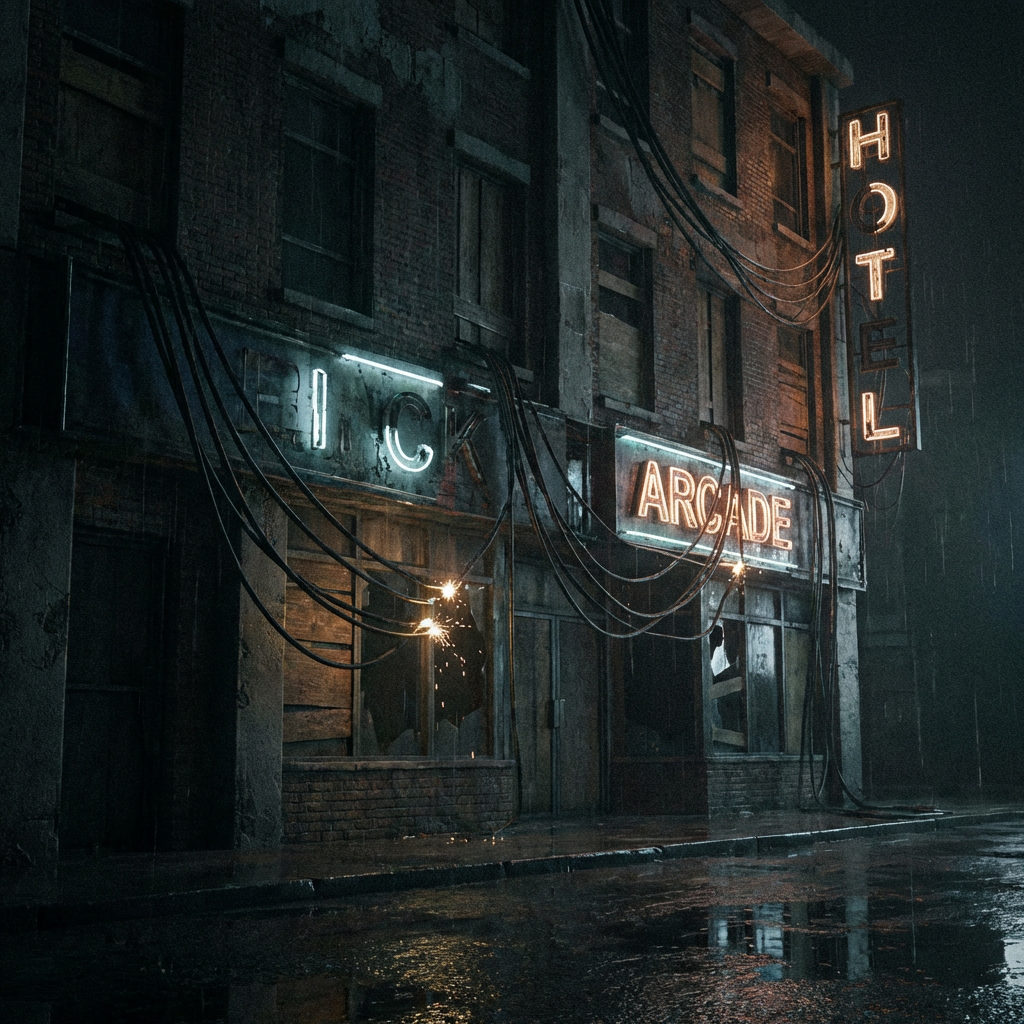
In cities across the globe, legends are born not in palaces, but in the dense, electric thrum of the streets. They speak of influence, prosperity, and the gleaming symbols of success. Yet, these same legends often carry a shadow, a hidden cost woven into their very fabric. This is a tale of one such king, his dazzling domain, and the chilling choice that led its lights to go dark forever.
The King of Lagos Rules in a Kingdom of Light
They called him “The King of Lagos” not for any royal bloodline, but for the empire he had built from sheer will. At the heart of his dominion was “The Kingdom of Light”—a lavish, 24-hour betting shop and entertainment complex that was a beacon in its neighborhood. More than just a place for wagers, it was a community hub, a symbol of escape and possibility.
- Neon-Crowned Palace: Its facade was a spectacle of brilliant, shimmering LEDs and neon signs that turned night into day.
- The Throne Room: Inside, rows of the latest digital betting terminals glowed, presided over by the King himself from a raised, glass-walled office.
- The Court: A steady stream of patrons, from young hopefuls to seasoned regulars, formed his loyal subjects, drawn by the promise of fortune and the air-conditioned refuge.
His rule was defined by a simple, powerful creed: constant, brilliant illumination was synonymous with prosperity, safety, and unquestioned authority. The Light was his crown.
A Betting Shop and a Power-Starved Slum
But the Kingdom of Light did not exist in a vacuum. It was an island of opulence in a sea of scarcity. Directly behind its glittering walls lay the “Power-Starved Slum” of Makoko—a sprawling community of floating homes and cramped alleys where electricity was a rare, flickering luxury.
> “In cities like Lagos, light is not just utility; it is the starkest measure of inequality. It draws a visible line between the haves and the have-nots.”
The contrast was a source of deep, simmering tension. The King’s empire was powered by a symphony of roaring generators and dedicated grid lines, while just a stone’s throw away:
- Families relied on smoky, dangerous kerosene lamps.
- Streetlights were hollow, rusty poles.
- The hum of a single fan was a prized possession during the sweltering nights.
The residents of Makoko watched the garish lights of the betting shop, a constant, mocking reminder of a world that shone brightly for some, but left them in the dark.
A Young Life Falters in the Sweltering Night
The crisis began not with a political clash, but with a personal tragedy. In a cramped Makoko home, a young boy named Chike grew gravely ill. His mother, Nneka, fought a desperate battle against the oppressive heat and his soaring fever. The local clinic, under-equipped and also suffering blackouts, could do little.
- The Critical Need: Chike’s condition required refrigerated medicine and a ventilator—impossibilities without steady, reliable power.
- A Mother’s Plea: Nneka, known in the community for her quiet dignity, exhausted every option. In her final act of desperation, she approached the gates of the Kingdom of Light.
- The Request: She did not ask for money. She begged the King, on her knees, for a connection to just one of his many powerful generators, just enough electricity to save her son’s life.
The Unthinkable Sacrifice for a Dying Child
The King, insulated by his glass walls, heard her plea. The calculation in his mind was cold and swift. Providing power would mean running a cable, acknowledging the need outside his walls, and potentially setting a precedent. It might briefly dim his lights or overburden his system. He saw a risk to his sovereignty, a crack in the foundation of his self-contained kingdom.
> He refused. The light, he believed, was for business, for his kingdom alone. To share it was to weaken it.
Nneka returned to the suffocating darkness of her home, empty-handed. Chike’s condition worsened through the night, his shallow breaths syncing with the distant, relentless hum of the King’s generators. As dawn approached, a fragile life flickered and went out, extinguished in the shadow of a kingdom ablaze with wasted light. Word of the King’s denial and the child’s fate spread through Makoko like a current, transforming despair into a silent, furious resolve.
Darkness Falls on a Gambler’s Kingdom
The reaction was not a riot, not a shouted protest. It was an act of profound, collective symbolism. The following night, as the Kingdom of Light blazed with its usual arrogance, a coordinated silence fell upon Makoko. Then, figures moved in the shadows.
- The Severing: Key cables feeding the complex were expertly, silently cut.
- The Siege: Its giant generators were mysteriously disabled, their fuel contaminated.
- The Crown Snuffed: One by one, the brilliant neon signs hissed and died. The betting terminals blinked off. The glass office went dark.
The King, in a panic, rushed to his window. He looked out not upon his luminous domain, but at a profound, uniform blackness. The slum behind him was dark, as it always was. But now, his kingdom was dark too. In that moment, he understood. The people had not taken his light for themselves. They had simply returned the world to a state of equal darkness, dismantling the very symbol of his betrayal.
His kingdom was not looted; it was nullified. The lawlessness of his inaction had been met with a quiet, devastating justice. The King was left ruling over a hollow, powerless shell. His authority, which existed only so long as the lights shone, had been permanently short-circuited by the cold cost of a single, refused act of grace.
The story of the King of Lagos serves as a modern parable. It reminds us that any kingdom, any empire built solely on its own brilliance while willfully blinding itself to the suffering at its gates, is built on a fragile grid. True power is not just the ability to generate light, but the wisdom to know when it must be shared. Otherwise, the very community you ignore may one day choose, together, to throw the master switch, leaving you alone in the consuming dark you helped to create.
Leave a Reply