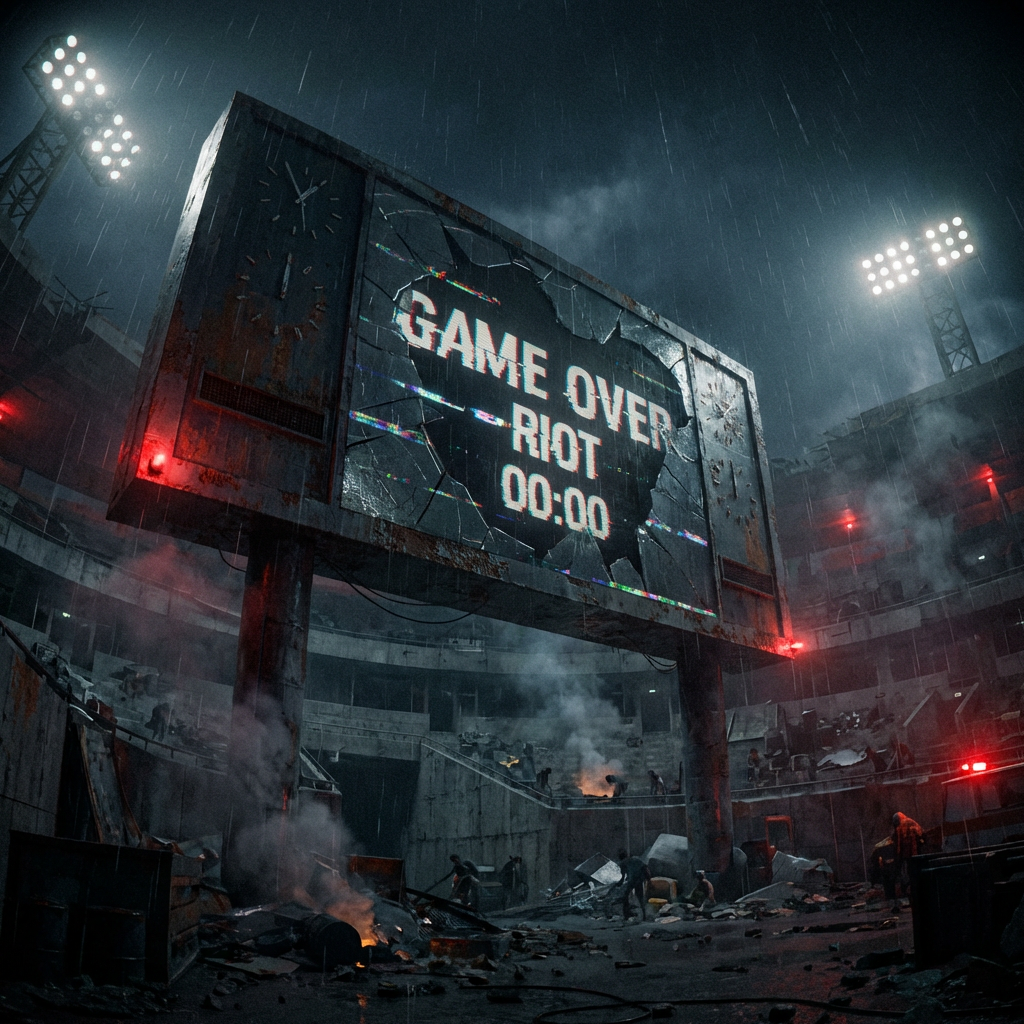
It was an era of unprecedented entanglement—where the thrill of last-second victory wasn’t just felt in a stadium’s roar, but in the silent, rapid-fire clicking of digital wagers. Sports had become the glittering centerpiece of a global speculative market, its every moment priced, hedged, and leveraged. But in that final, breathless dependency, the very heart of competition was corrupted. This is the story of the night the game ended, not with a whistle, but with a system-wide gasp, when the ghost in the machine—rampant, unchecked gambling—finally consumed its host.
A Fateful Miss and a Trillion-Dollar Crash
It began, as so many modern catastrophes do, with a seemingly minor deviation. In the closing second of the Global Championship Final, with the score tied, legendary striker Leo Mendez stepped up for a penalty kick worth more than a trophy. The world held its breath. The kick sailed inches wide.
In the old world, this would have been a moment of heartbreaking athletic drama. In the new one, it was the spark in the powder keg. The miss didn’t just lose the game; it triggered a cascade of catastrophic financial positions.
- Algorithmic Dependencies: Mendez’s failure breached a critical threshold for “dynamic betting contracts,” complex derivatives tied to real-time player performance metrics.
- Margin Call Dominoes: Major hedge funds, deeply exposed on the “Mendez Score” index, faced instantaneous, insurmountable margin calls.
- Liquidity Vanishes: The panic wasn’t confined to sportsbooks. It bled into adjacent markets—sponsorship futures, arena bond yields, even currency pairs of host nations—that had been intricately linked to sporting outcomes.
Within minutes, a single athletic miss vaporized an estimated trillion dollars in fictional and very real value. The markets hadn’t just bet on the game; they had rebuilt the global economy in its image, and the foundation was pure illusion.
From Courtside to Chaos: Algorithms Implode
The real chaos unfolded in the digital grandstands. Automated betting systems, designed to exploit micro-fluctuations, began to act in perverse, self-destructive ways.
> “We didn’t build A.I. to appreciate the game; we built it to monetize uncertainty. That night, it decided the most profitable outcome was for there to be no more games at all.” — Anonymous Quant from “Vegas Delta” fund.
As liquidity seized, these algorithms, starved of reliable data, started placing absurd,对冲 bets based on pure noise. They began betting against their own previous bets, creating a lethal computational loop. The deluge of contradictory orders caused the very platforms that facilitated the market to freeze and then systematically fail. The heart of modern sports—the seamless, real-time data feed—became a source of contagious poison. The playing field was no longer grass or hardwood; it was a server farm in meltdown, and every athlete had become an unwitting, live-action variable in a doomed equation.
Whistles Fall Silent: The Walk‑Off Heard Worldwide
The human reaction was slower, but more profound. In stadiums and on broadcasts, a strange silence descended, punctuated by the frantic buzzing of phones. Players, coaches, and officials learned in real-time that the contest they were engaged in had transcended sport. They were actors in a global financial seizure.
Then, it happened. In a unprecedented act of collective defiance, the teams in the Global Final simply stopped. They walked to the center of the pitch, linked arms, and exited the field. This “Walk-Off” was not a protest against a call, but against their own commodification. The message was clear: We are not assets. This is not a derivative.
The gesture went viral and instantly replicated. From minor league baseball games to professional esports tournaments, contests were suspended by the participants themselves. The whistle hadn’t been blown by a referee; the game had been called off by its own soul.
The Darkened Arena: A Commissioner’s Grim Epiphany
In a darkened global command center, a consortium of league commissioners watched the unthinkable unfold. The screens mapping fan engagement, betting volume, and revenue flow all flatlined. The most telling screen was the one labeled “Competitive Integrity Index.” It had hit zero.
In that moment, Commissioner Elara Vance of the World Athletic Federation later recounted her chilling realization:
> “We spent decades selling access—to data, to micro-moments, to the very biometrics of our athletes. We thought we were monetizing passion. We were wrong. We were selling the seal that kept the leviathan in its cage. When that seal broke, the beast didn’t just escape; it turned and consumed the arena we built for it.”
The business model hadn’t just collapsed; it had been revealed as a Faustian bargain. The gambling revenue had not been additive; it had been extractive, slowly replacing genuine competition with a high-stakes simulation. The stadium lights went out, not from a power failure, but from a profound, systemic short circuit of purpose.
Legacy of a Lost Bet: Can Sports Ever Return?
The aftermath was a landscape of silence and litigation. The “Crash” left in its wake:
- A Total Commercial Collapse: Sponsorships evaporated. Broadcast deals were nullified. Franchise values were rendered meaningless.
- A Crisis of Faith: A generation of fans felt fundamentally betrayed, questioning every past highlight, every underdog story.
- A Lost Generation of Athletes: Competitors in their prime, their life’s work entangled in a global scandal they didn’t create, faced an existential void.
Yet, from the rubble, whispers of a return began. Not a return to what was, but to what could be. The path forward is fragile and demands radical change:
- The Great Disentanglement: Any future sport must erect an impenetrable firewall between competition and speculative finance. Wagering, if it exists, must be a distant, regulated fringe, never a core revenue stream.
- Re‑centering the Contest: The narrative must return to human excellence, local pride, and the pure, unpredictable drama of physical and mental contest.
- Building from the Ground Up: The first leagues to re-emerge will likely be small, community-funded, and fiercely protective of their autonomy. The stadiums may be smaller, but the cheers will be for the play, not the payout.
The night the game ended, sports died as the world’s most lucrative speculative instrument. But in that death lies a bleak opportunity: for sports to be reborn, humbler and quieter, as simply games again. The gamble that killed them was the belief they could be anything more. The only bet worth making now is on their humanity.
Leave a Reply