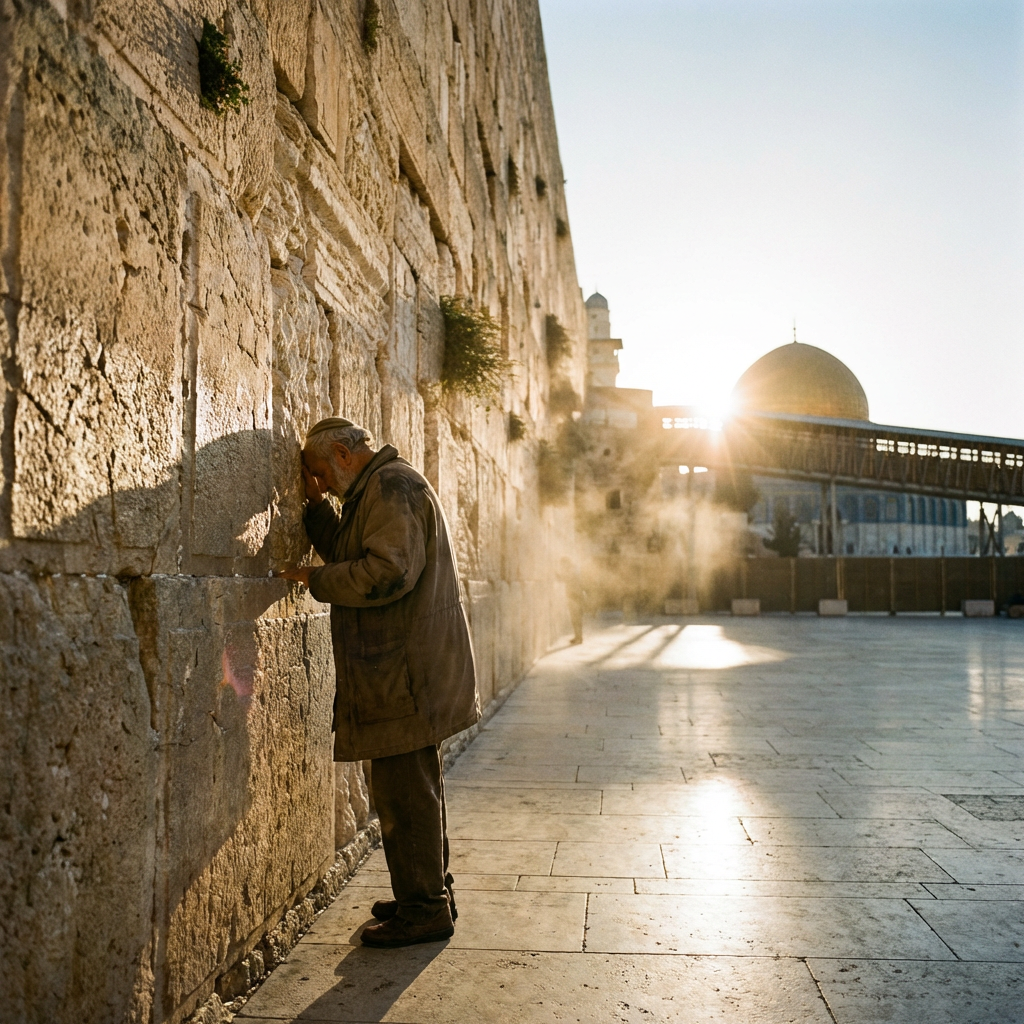
The concept of investing is often confined to boardrooms and financial markets, a domain of ledgers, profit margins, and economic forecasts. Yet, the most profound investments may have little to do with currency, and everything to do with human potential. It is the story of a transformative morning at one of the world’s most contested and sacred sites that offers a fresh, deeply human blueprint for peace. This is not about political negotiation, but about channeling the very principles that fuel our economies and passions towards the work of building a shared future.
A Political Dawn at Jerusalem’s Ancient Wall
The Western Wall in Jerusalem stands not just as a physical remnant of ancient history, but as a powerful modern symbol of identity, faith, and division. At dawn, its massive limestone blocks take on a honeyed glow, a sight that draws pilgrims and tourists alike in quiet reverence. The atmosphere is thick with prayer and politics; whispered hopes intermingle with the weight of centuries-old conflict. This is a place where the past is palpably present, and the future feels fraught. The narrow alley leading to the plaza is a funnel for humanity, where diverse stories, dreams, and animosities converge in a single, charged space. To witness this convergence is to understand that any solution for peace must contend with this profound depth of heritage and pain, yet also find a crack in the stone through which new light can shine.
A Young Voice: From Sports Stats to Shared Futures
Among the crowd one morning stood Avi, a 25-year-old venture capital analyst from Tel Aviv. His world was typically one of pitch decks, scalability, and competitive analysis. A passionate basketball fan, his personal escape was deep-diving into player analytics—assist percentages, defensive ratings, efficiency metrics. To him, these predictive statistics were more than numbers; they were a narrative of potential, forecasting a player’s trajectory and their future value to a team. He understood player valuation as a forward-looking bet on growth, a commitment to developing raw talent into a championship-caliber asset. This framework, which considered a person’s future earning potential as the core metric of worth, was the lens through which he had been taught to see the world. But as he watched the diverse faces at the Wall, he felt a disconnect. The traditional models seemed insufficient here.
The Epiphany: Investing for Peace, Not Division
As the sun crested the walls of the Old City, a realization struck Avi with the force of revelation. The principles he used every day—to fund a promising tech startup or evaluate an athlete’s career—could be applied to people, not as economic units, but as agents of peace. He saw clearly that the prevailing dynamic in the region was one of zero-sum conflict management. > The focus on dividing finite resources—land, water, political sovereignty—inevitably creates winners and losers, fueling the cycle of resentment. Instead, he imagined a model of investing for positive-sum outcomes. What if the primary investment was in the boundless resource of human potential? The key metrics would shift dramatically:
- From body count and territorial losses to educational attainment and job creation rates.
- From political rhetoric to measurable cross-community project success.
- From short-term security gains to long-term economic interdependence. This was not naïve idealism; it was applying a hard-nosed investment thesis to the most challenging of problems. Peace, in this view, becomes the ultimate appreciating asset.
Athlete Portfolios as Blueprints for Prosperity
Avi began sketching his idea, using the “athlete portfolio” as his guiding metaphor. Teams don’t invest in players based on their ethnicity or hometown; they invest based on their potential to contribute to a collective victory. Translating this to communities in conflict meant creating a framework for human capital development. > Key Insight: By investing in individuals and communities as one would in a high-potential startup, you create stakeholders in a prosperous, stable future, making conflict an economically irrational choice. This framework would involve creating portfolios focused on specific, tangible sectors where cooperation yields mutual benefit:
- Shared Environmental Tech: Funding joint ventures in water desalination, solar energy, and sustainable agriculture for the region.
- Cross-Border Innovation Hubs: Establishing neutral-ground incubators where engineers, programmers, and entrepreneurs from all backgrounds collaborate.
- Cultural & Tourism Corridors: Developing infrastructure for heritage tourism that tells a multi-narrative story, creating shared revenue streams. The goal is to create material incentives for cooperation so robust that they reshape the political landscape from the ground up.
Building Bridges, Not Barriers, Across Regions
The vision that began at the Western Wall extends far beyond any single border or conflict. The principle of investing for peace offers a universal strategy. It is about proactive bridge-building in the areas that truly define human prosperity: economics, education, technology, and culture. When young people see a tangible, rewarding future being constructed with their neighbors—not in spite of them—the foundations for lasting peace are laid. This approach doesn’t ignore history or justice; it changes the context. It shifts the narrative from dividing a shrinking pie to cooperatively baking a new, larger one that everyone has a stake in.
Avi left the Wall that dawn not with a political plan, but with a financier’s conviction. The most critical venture capital fund in the world wouldn’t be in Silicon Valley, but dedicated to the human potential currently locked in cycles of conflict. It is a revelation that peace is not merely an abstract ideal to be brokered, but the highest-return investment a society can make. The stones of the Wall have witnessed millennia of human strife; perhaps now they can also inspire a new architecture for human partnership, built not with limestone, but with shared hope and mutual investment.
Leave a Reply