From City Streets to Divine Nightmares
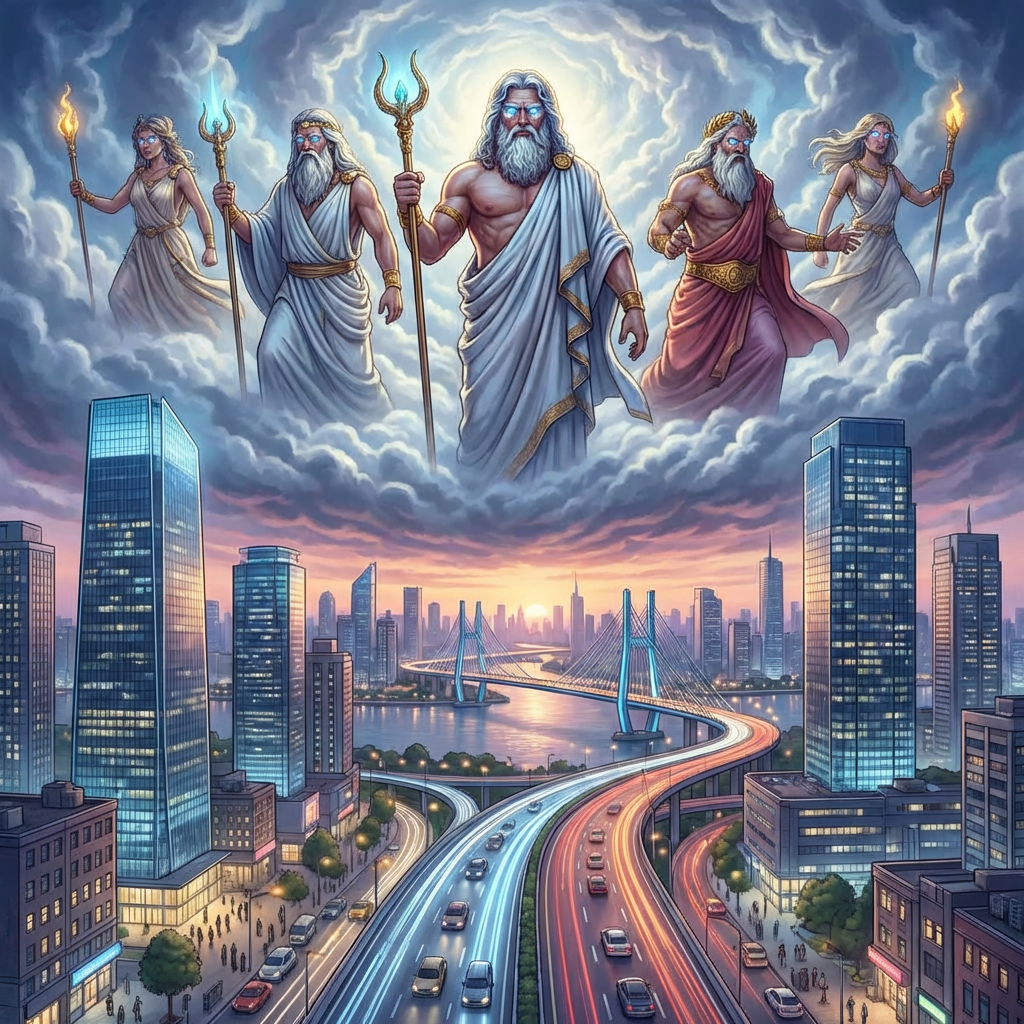
It begins not with thunder, but with silence. In cities accustomed to the din of traffic and commerce, a new growth emerges from cracks in the asphalt. Overnight, wildflowers—oleander, asphodel, and poppy—puncture the pavement in manic, tangled thickets. Across the globe, desperate urbanites find themselves plagued by a new, profound form of hay fever. They weep at stoplights, not from sorrow, but from an unyielding allergic reaction to an airborne pollen with no earthly source. Florists are the first to recognize the language—the violets speak of repentance, the lilies of forgotten oaths, the laurel of a contest yet to be named. Initially dismissed as mass hysteria or a bizarre ecological event, the narrative shatters when humanity shares the same collective dream: the Tetris Dream.
It arrives in the same haunting flashes for everyone, every night. Beyond a colossal arch of woven ivy and cypress, a massive celestial screen looms above. It is not a vision of heavenly fields, but of endless falling blocks in vibrant, divine hues—the simple, orderly patterns of the game Tetris. Crowds of ancient gods hush each other in the background, their anxiety palpable. No one knows how to win, but the dread upon their faces at the thought of the screen filling, the “Game Over” flashing for all creation, suggests the stakes are existence itself.
Olympus Thunders, Humanity’s Folly Exposed
As the flora encroaches and the dream recurs, the divine displeasure clarifies. Myths collide with modernity. The Amazon basin, Earth’s greatest trophy of nature, is wilting under an unprecedented drought, yet torrential storms flood Paris, washing graffiti from the Louvre and depositing silt onto city streets—silt that takes root into majestic oaks overnight. Volcanoes rumble in Hawaii and Etna, not spewing lava, but shooting vibrant jets of bougainvillea and orchids into the stratosphere. The gods are no longer hidden in mist or metaphor; they are through the looking glass, flooding our digital and physical spaces with their archaic icons.
Exploitative and divisive activities on Earth are their apparent trigger. Financial news tickers are momentarily hijacked by glittering Greek script spelling πολυπραγμοσύνη (polypragmosýnē), an ancient concept meaning meddlesomeness. Social media platforms suffer erratic glitches that systematically replace political invective with simple Maxims of Delphi: Know Thyself or Nothing in Excess. It becomes clear the pantheon’s rage is directed not at any single nation, but at humanity’s self-sabotaging nature.
- Greed above the Earth’s limits is met with Thor stripping a diamond mine to bedrock with a single strike of his hammer.
- Endless political theater sees Athena cloaking entire government districts in a literal grey fog of ennui, where speeches turn to echoing murmurs and voting buttons lose all charge.
- War and impending conflict are answered as Ares manifests in the uniforms of commanding generals, not to lead their armies, but to offer competitive chess matches with severed limbs as forfeit. Mars silences drone command centers, replacing their screens with perpetual live-streams of Olympic snowboarding finals from a century past.
The message is decoded by linguists and theologians, echoing not from a burning bush, but across every device as a definitive directive: “On High the Pyre is laid. You will compete in a tournament of games. No more, no less. We favor those who can burn this house down.” Their apocalypse is not fire and brimstone—it’s creative annihilation through peaceful conflict, by decree.
The Starlit Court Above the Mountain
In frantic obedience, United Nations delegates propose a sprawling space station arena, mirrored domes on the moon’s dark side, or a deep-sea coliseum lit by bioluminescent coral. All are dismissed in a singular, terrifying display of divine one-upmanship. On the eve of the March equinox, under a perfectly clear global sky, every cloud on Earth parts. Mount Olympus in Greece glows with an ethereal corona. From it, arcing high above the atmosphere into the void of space, rises the Starlit Court.
It is an impossible, breath-taking biome suspended between worlds. It holds:
> “Not a stadium of stone, but a cosmos in contest: tracks laid on the rings of Saturn, marathon routes through the orbital paths of seven planetary bodies.”
Vast terrains materialize where normal physics shudders. The running track circles the globe, shimmering two meters above the ground across all continents. Lanes become bridges, connecting culture by touch. The discus ring floats in low Earth orbit; a near-miss spins off into a dazzling, doomed, and reoccurring new meteor shower named Nike’s Prodigal.
Ancient Gods Command: “Invest in Athletes”
This celestial declaration inverts the global order overnight. This is not a call to arms, but a desperate imperative to disarm and invest. The priesthoods of capital, nation-states, and warfare are decommissioned. Congress and parliaments enact the Pan-Human Sanctions. The global military-industrial complex is folded with warp speed into a desperate race for expertise and sports science of unprecedented scale. Trillions are funneled not into stealth bombers, but into bobsleds that function at orbital speeds, vaulting poles forged from lunar regolith, and designing javelins that can be thrown into an orbit perfect enough to pitch a celestial tent for other competitors to use.
This is peace enforced by the ultimate higher power:
- Military R&D Labs now measure G-forces for human survivability on the Javelin Run of Jupiter’s Gravity Slingshot.
- International Aero-Space Experts consult with decathletes on the optimal breathing rhythm in zero-G during the Hepathedral Hoop Dive.
- Cultural Annuity Funds, pensions for a shattered human ego, are established for the children of decathletes who demonstrate sportsmanship—a reward for grace under the pressure of godly spectatorship. In this divine economy, the Decaphlete—the master of ten “cosmic decathlons”—becomes our world’s greatest source of survival capital.
Petals of Hope or Ashes of War
The war has already been called off, not by treaty, but by decree. The terrible, wonderful “why” of existence has been placed firmly on a galactic scoreboard. We were chosen to confront the cold calculus of entropy not with destruction, but with the sacred fury of the long jump from Phobos’s Deimos scar. The tournament begins, not as a plea for amity among nations, but as testimony against dark dissolution for all existence.
The prophecy of the street-corner florist proves the most potent of all. The future that blossoms now is not shaped by the sharp orders of generals, but by ancient sovereigns who recognize in the disciplined passion of an athlete a divine spark rivaling their own. These flowers—violets, laurels, oleander—shall not become a victory garland to crown a tired god in eternal victory at their celestial games. Instead, should the human competitors succeed, these vines are promised to transform through time as gentle civil servants, taming our highways with disciplined grace and keeping sidewalks perpetually swept of conflict. Should we lose, the same pollen that made us weep will ignite into the ashen fuel of our final pyre—calling the next experiment, and perhaps unwriting us forever.
Thus, world peace comes not from grace or wisdom, but from necessity. We find ourselves as the smallest Greek city-state, selected under freakish duress to compete for the Universe Trophy for a pre-game round. Our strategy is to not be eliminated. This silent pleading eternity echoes off the petals below and against our competitor gods above. Such is the peace offered: infinite union under divine arbitration with a rulebook we must not only read, but embody with every last scream and gasp in the thin air of celestial competition. The tourniquet, humanity’s last resort, is Olympian one-upsmanship.
Leave a Reply