Introduction
Coastal planning departments are often viewed as bureaucratic backwaters, places of quiet routine far from the pulse of dramatic events. Here, amidst the scent of damp paper and the hum of fluorescent lights, the raw power of the ocean is reduced to zoning codes, elevation certificates, and permit applications. Yet, sometimes, the sea itself seems to file a counter-appeal. This is the story of Elias Thorn, a mid-level clerk in the Harbor City Municipal Office, whose mundane world was shattered not by a crisis, but by a hidden pattern he discovered buried within it—a pattern that spoke of old warnings and a gathering judgment from the deep.
The Permit Desk and the Oncoming Gale
Elias Thorn’s life was governed by order. For twelve years, his domain was Permit Desk Three, a fortress of manila folders and rubber stamps. His job was to process coastal development applications, a task he performed with meticulous, if unenthusiastic, precision. He checked soil reports, verified setback lines, and filed environmental impact assessments. The ocean, visible as a grey sliver from his office window, was just another variable in a formula.
Everything changed during the week of the great autumn gales. A series of powerful storms, “The Triton Sisters,” were forecast to hit the coast. As the city buzzed with preparation, a peculiar trend crossed Elias’s desk. A sudden, frantic wave of “post-facto regularization” applications flooded his inbox. These were requests from property owners seeking retroactive approval for structures—seawalls, deck expansions, even whole foundations—that had already been built, often years prior.
- They all came from the same cluster of neighborhoods: the expensive clifftop villas of Mariner’s View and the redeveloped marshlands of Sundown Cove.
- Each file contained oddly similar, vaguely worded contractor notes citing “minor subsidence” or “seasonal erosion adjustments.”
- The timing was unmistakable: these wealthy applicants, who had previously ignored or bypassed regulations, were now scrambling for the city’s stamp of legitimacy before the storms could reveal their violations.
To Elias, it wasn’t just paperwork; it was the first scent of salt-tinged panic, masquerading as bureaucratic procedure.
A Forbidden File Behind the Storm’s Voice
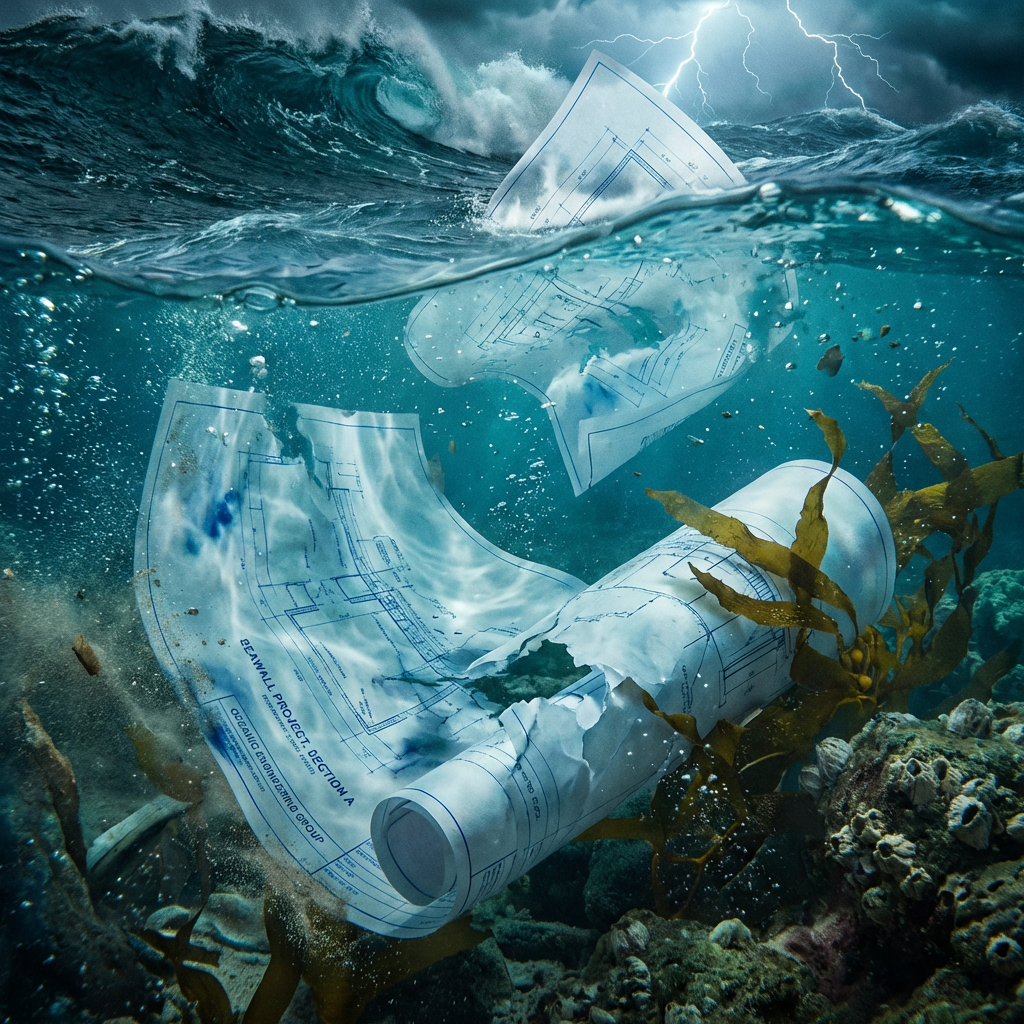
Driven by a nagging unease, Elias began digging deeper, staying late after the office emptied. His investigation led him to the forgotten physical archive—the “Dead Storage” room in the basement. Among water-stained boxes, he found a referenced but never-digitized file: Project: Nereus’ Respite. The cover sheet, stamped “CLASSIFIED – GEOLOGICAL HAZARD ASSESSMENT,” was dated over sixty years prior.
The report was a stark contradiction to the city’s modern promotional brochures. It contained seismic surveys and core samples revealing that much of the “prime real estate” in Mariner’s View was built on a prehistoric, unstable slump block, a giant slab of land prone to gradual, catastrophic slippage. Sundown Cove, meanwhile, was identified not as “reclaimed land” but as a tidal amplification zone, where storm surges were naturally funneled and heightened.
> “The suggested developments constitute a profound misreading of the landscape. The sea will not be bargained with; it will, in time, reclaim its boundary lines with considerable force.” — Dr. Althea Vance, lead geologist, Project: Nereus’ Respite
The report had been shelved, its author marginalized. The city had chosen growth over the warning, hiding the truth behind classification stamps.
The Secret Ledger of Drowned Districts
The Nereus file was the key, but the lock was a different discovery. Cross-referencing old permit logs with property tax records, Elias compiled a private ledger. He mapped every retroactive permit, every violation fine that was quietly reduced or waived, and every council member who owned property in the flagged zones. The pattern was a damning circuit of influence.
He saw that certain developments, clearly in violation of the old geological data, had been approved after “special review” by a now-retired planning commissioner. Insurance claims for minor “wave damage” in these areas over the past decade were suspiciously high and consistent, suggesting a known, ongoing issue that was being medically treated rather than surgically addressed. This was not mere oversight; it was a systemic, willful silence bought and paid for with political capital and property values.
The Oldest Roar: A Warning Unheeded
As the first of the Triton Sisters made landfall, Elias understood the true nature of the hidden truth. The retired geologist, Dr. Althea Vance, hadn’t just been ignored; her voice represented the oldest roar of all—the objective reality of geology and hydrology. The city, in its hunger for progress and revenue, had metaphorically paved over the tide tables. They had treated the ocean’s immutable laws as negotiable bylaws.
The frantic retrofit permits were a last-minute attempt to insure against a consequence that was now inevitable. The sea was not malicious, but it was utterly indifferent to property lines and liability waivers. It would judge the city not on its economic success, but on its failure to heed the fundamental warnings written in the very land it built upon. The storm was not the judgment itself, but the messenger delivering the verdict long ago inscribed in stone and sediment.
Cracks in the Glass: One Man’s Account
In the storm’s aftermath, the damage was severe but selective. A spectacular collapse in Mariner’s View made global news. Sundown Cove was essentially scoured clean, its foundations exposed like rotten teeth. Sitting at his intact Permit Desk Three, Elias looked at the shattered glass of the luxury condominiums across the bay, glittering in the sudden, calm sunlight.
He had compiled a complete dossier—the old report, his secret ledger, the damning chain of permits. He faced a choice: file it away as another historical curiosity, or expose the cracks in the glass pane of official history. He chose the latter. Leaking the documents anonymously to the press was not an act of rebellion, but one of painful alignment. He was simply filing the final permit, the one that acknowledged the true authority: the sea’s eternal jurisdiction.
His account became the crucial footnote in the official disaster inquiry, transforming the narrative from “natural catastrophe” to “institutional failure.” The hidden truths were no longer his burden to carry; they were now public record, a cautionary tale etched not in paper, but in the collective memory of a chastened city.
Conclusion
Elias Thorn returned to his desk, but the routine was forever changed. He now understood that his stamps and forms were not just administrative tools, but the thin, human-made levees holding back a tide of consequence. “The Sea’s Judgment” is rarely a single, apocalyptic wave; more often, it is a slow, relentless pressure that exposes the weaknesses we have built over our own ignorance and greed. In the quiet halls of bureaucracy, far from the crashing surf, the most profound truths are often hidden in plain sight, waiting for a diligent clerk—or a relentless storm—to bring them to the surface. The encounter reminds us that nature keeps its own ledgers, and it always, eventually, balances its accounts.
Leave a Reply