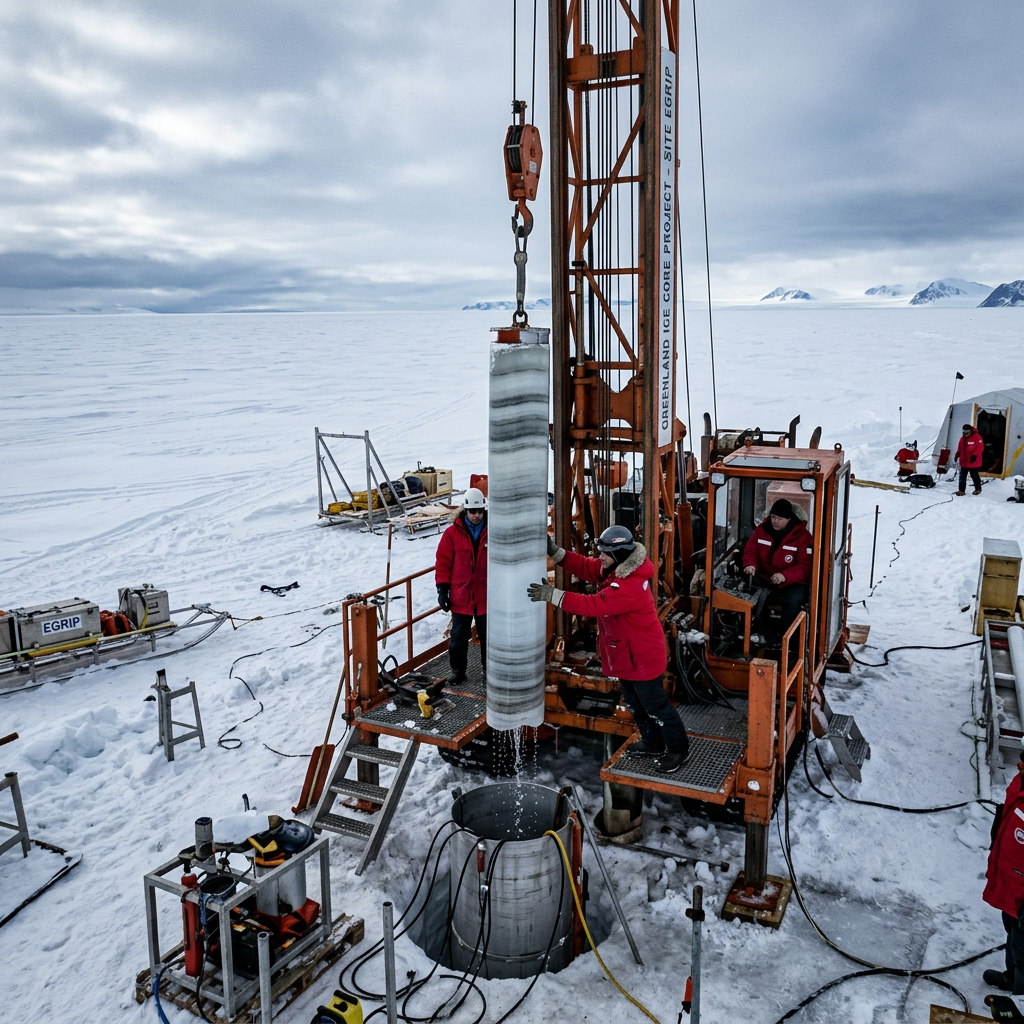
The Ice That Speaks in Contradictions
There is a quiet hum beneath the snow. It is not the sound of wind, nor the crack of shifting glaciers—it is the memory of the Earth, locked in crystalline layers. We call it ice core data, but really, it is a confession from the planet. Every winter, as snow falls and compresses, it traps bubbles of ancient air. Those bubbles hold carbon dioxide levels, temperature proxies, and dust particles from volcanic eruptions long forgotten. And here is the contradiction: the ice tells a story of slow, rhythmic change—warmth advancing and retreating like a tide—but our climate models scream chaos. They project fires that haven’t yet burned, floods that defy historical precedent, and frost in regions that have never tasted snow. So who is lying? The ice, which speaks in centuries, or the models, which speak in seconds?
The truth is, neither is lying. The ice speaks in averages; the models speak in extremes. When we drill into a glacier, we hear the Earth’s slow breath. When we run a simulation, we hear the Earth’s fevered pulse. One is memory, the other is prophecy. And as the ice sheets melt at unprecedented rates, the voice of the ancient world is drowned out by the roar of a future we refused to imagine.
When AI Models Predict Fire and Frost
Modern climate models are not simple thermometers. They are neural networks fed with petabytes of data—satellite imagery, ocean currents, solar cycles, carbon emissions. These algorithms learn patterns invisible to the human eye. They can predict with unsettling accuracy that a drought in the Amazon will trigger a frost in the Alps three years later. It sounds like magic, but it’s mathematics.
Yet here is the dangerous twist: AI models can lie with precision. They create scenarios so vivid that policymakers mistake them for truth. A model might show a 2°C rise by 2050, but that number is a probability distribution, not a destiny. The ice, by contrast, never lies. It simply records. It does not estimate. It does not hedge. When ice melts, it is a fact—not a forecast.
> Key insight: The models are tools for exploration, not truth-tellers. The ice is a historian, not a politician.
This is where human intuition must step in. We need to accept that both sources—ice and algorithm—are speaking in tongues. The language of the ice is slow and cumulative; the language of AI is fast and chaotic. The lie is not in the data, but in our insistence that one voice must be right and the other wrong.
Why Human Motion Still Tells the Truth
Before satellites and supercomputers, humans read the world by walking it. Indigenous hunters in the Arctic watched the sea ice thin under their sleds. Pastoralists in the Sahel noted the pattern of rains by the movement of termites. These are not primitive observations—they are embodied data, recorded in muscle and memory.
Consider this: a shepherd in the Tibetan Plateau knows the snowline is retreating because his flock can now graze at altitudes where only lichen grew before. A fisher in Maine notices the lobster migration is off by three weeks because his grandfather’s logs show a different rhythm. These are human-level truths that no model can replicate, because they come from direct interaction with the environment, not from abstraction.
What makes human motion truthful is its vulnerability. When we walk on the ice and it cracks beneath us, we do not need a peer-reviewed paper to tell us it is thinning. The body remembers. And this embodied memory is the one source that neither models nor ice cores can replace. It is real-time, real-world ground truth.
> Important tip: If you want to know whether a climate model is lying, go outside and look. Not at a screen—at the mud, the leaves, the frost. You might be surprised by what you see.
Drilling into Memory Beneath the Glacier
There is a specific place in Greenland where scientists bored 3,000 meters into the ice. They extracted a cylinder of frozen history spanning 250,000 years. Inside that cylinder are layers of volcanic ash from eruptions that darkened the skies of the Roman Empire. There are pollen grains from forests that grew where there is now only ice. There are methane spikes corresponding to the dawn of agriculture.
Drilling is a violent act against the silence. The bit screeches, the core fractures, and then—the memory is freed. But what happens when that memory is compromised? As glaciers melt, the archive is being erased. The oldest ice, at the bottom, is being flushed out by meltwater. We are literally losing the data faster than we can extract it.
> Quote: “The glacier is a library in peril. Each chapter is a climate epoch, and we are reading by flashlight while the building burns.”
In this race against time, we must drill deeper, faster, and smarter. But we must also acknowledge a hard truth: the ice that speaks to us now is speaking a dying language. Its voice will fade. We will have to reconstruct the past from fragmented records, from trace elements and volcanic signals. And that reconstruction will be an interpretation, not a perfect transcript.
The Last Coherent Record Is in Our Steps
So where does this leave us? The models are flawed, the ice is melting, and our bodies are losing contact with the land. The last coherent record of what is happening may not be in the lab or the satellite—it may be in our steps, our choices, our daily motion.
Every time we choose to walk instead of drive, we leave a small mark in the carbon ledger. Every time we plant a tree, we are writing a footnote in the soil. These actions are not grand enough to appear in any global model, but they are real. They are local. They are immediate.
The final lesson from both the ice and the algorithms is this: complexity does not excuse inaction. Whether the earth warms by 1.5°C or 2°C matters less than whether we listen—to the cracking ice, to the failing models, to the wisdom of our own tired legs.
Conclusion
We live in an age where two different truths speak at once. The ice offers a slow, ancient poetry of climatic stability. The models offer a frantic, algorithmic prose of disruption. Neither is a perfect guide, but together they form a chorus of warning that we ignore at our peril. In the end, the most honest record may not be found in a frozen core or a supercomputer simulation. It may be found in the simple, courageous act of paying attention. When the ice speaks and the climate models lie, the only answer is to trust your senses, honor the past, and move forward with humility.
Leave a Reply