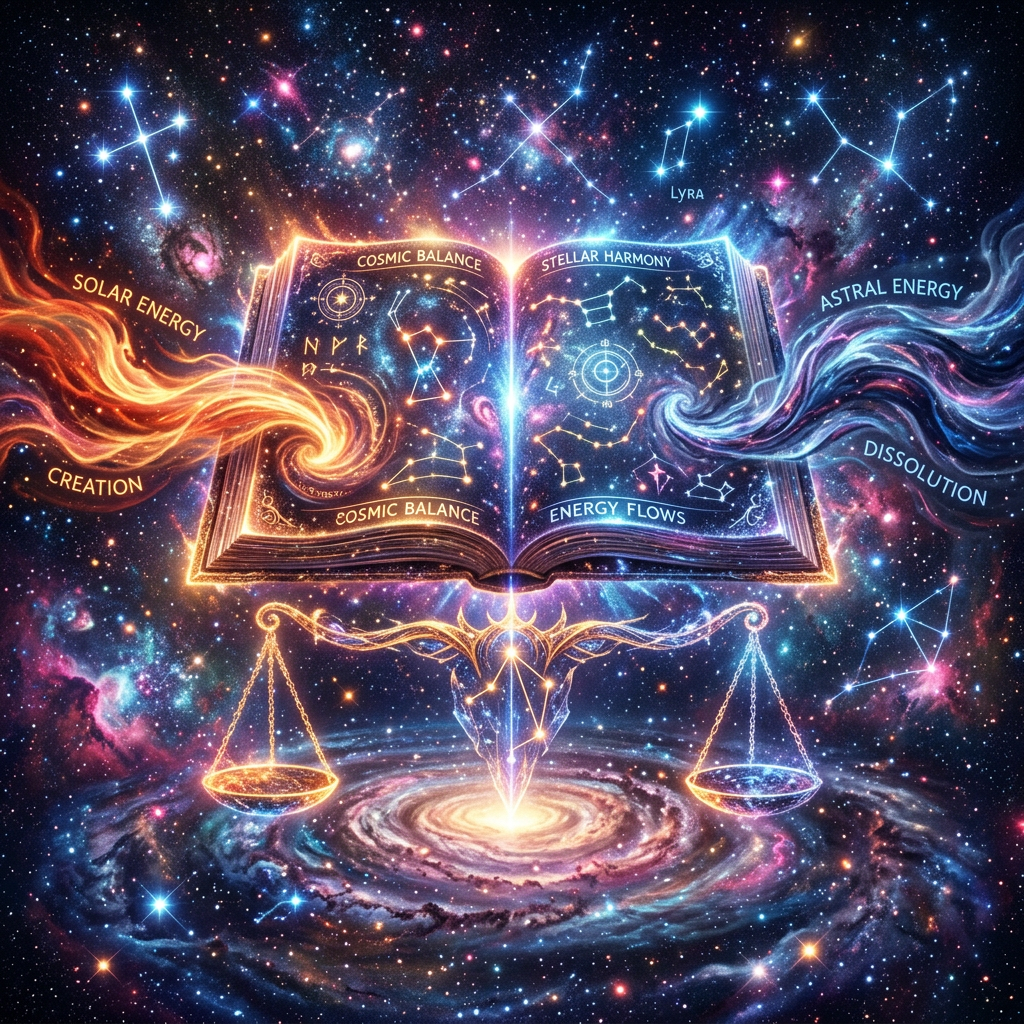
The Silent Field: Before the First Equation
Imagine a canvas with no dimensions. No time, no space, no light—just a vast, absolute potential. Before the first star ignited, before the first atom bonded, there was no “empty” as we understand it. Instead, there was a field of pure, undifferentiated possibility. This wasn’t a void; it was a silent ledger waiting for its first entry.
In this pre-cosmic state, nothing was recorded because nothing had happened. Yet, the ledger existed—an implicit structure capable of holding value, order, and identity. Think of it as a protocol before the internet: a rulebook that had not yet been opened, but whose principles were already absolute.
Where Value Rose Before Stars Existed
If value is defined as anything that can be preserved, exchanged, or measured, then the first act of creation was not the Big Bang—it was the first distinction. A difference. A this versus that. Value emerged when something could be identified against the backdrop of nothing.
- Distinction creates worth: The first particle, the first wave, or the first thought of separation introduced a quantifiable difference.
- Conservation matters: Value only persists if it can be recorded. The cosmos’ first ledger was not stone or clay, but the laws of physics themselves—invariant rules that allowed energy to be stored and released.
- Unfolding potential: Before stars, value existed as compressed possibility. A star’s birth is not the beginning of value, but its conversion from potential to kinetic—a transaction on a ledger older than light.
Entropy and Performance: The Two Cosmic Forces
To understand this proto-ledger, we must look at two opposing forces that govern all systems:
> Entropy is the universe’s tendency toward disorder. It is the tax on every transaction. Without it, nothing would change; with it, everything decays.
- Entropy measures how much energy is unavailable for work. It is the cost of doing business in a finite cosmos.
- Performance is the counterforce—the intentional act of reducing entropy locally. A star performs by fusing hydrogen, creating order from chaos. A mind performs by storing memories, reducing informational entropy.
These two forces are the debit and credit of the first ledger. Every cosmic event—every supernova, every black hole evaporation—is a journal entry balancing these accounts.
The Proto‑Ledger: Measuring Pure Unfolding Potential
If we consider the universe as a closed system, its total value is constant. But value moves. This movement is unfolding—the gradual conversion of potential into actuality.
| Cosmic Account | Debit (What is Lost) | Credit (What is Gained) |
|---|---|---|
| Gravitational field | Potential energy | Kinetic motion, structure |
| Quantum vacuum | Temporary fluctuations | Particle pairs, mass |
| Entropy | Accessible energy | Dispersal, time’s arrow |
> “The universe is not a story being told; it is a ledger being balanced. Every star burns, every life lives, and the numbers add up to zero.”
The proto-ledger is immutable. You cannot rewrite the past. A particle’s spin, a galaxy’s rotation, a thought’s fleeting signature—all are permanent entries. This ledger predates any astronomer, any accountant, any god. It is the first law dressed in numbers.
From Ignition to Eternity: The Ledger Older Than Time
The universe began with an ignition—not of fire, but of information. At the Planck epoch, the ledger opened with a single entry:
- Time = 0: A singularity of infinite density and zero entropy.
- First transaction: The inflation field’s collapse into particles.
- Ledger balance: Every subsequent star, planet, and life form is but a footnote on this original record.
Even stars—those blazing furnaces of fusion—are temporary. They are entries in a ledger that will outlast them. When the last star dies and black holes evaporate into Hawking radiation, the ledger will still be there, showing a final balance of zero.
Key Insights for the Cosmic Accountant
- Nothing is lost: Energy and information are conserved. The ledger is perfectly audited.
- Performance beats entropy temporarily: Life, love, and art are local triumphs against the universal trend. They are high-yield investments on this cosmic balance sheet.
- The ledger is your heritage: You are not a passive observer. Every choice you make is an entry—a tiny but real vote for order over chaos.
Conclusion
The first ledger was not invented by civilization; it was discovered—embedded in the fabric of reality itself. Before stars, before time, value rose not from brightness or mass, but from the simple act of existing in relation. Distinction, conservation, and unfolding: these are the three principles that govern all cosmic accounts.
As you look up at the night sky, remember: those distant fires are not the beginning of the story. They are interest payments on a debt that was never borrowed, drawn from a principal that never changes. The first ledger was written in the mathematics of creation—and you, right now, are adding to it with every breath you take.
Leave a Reply