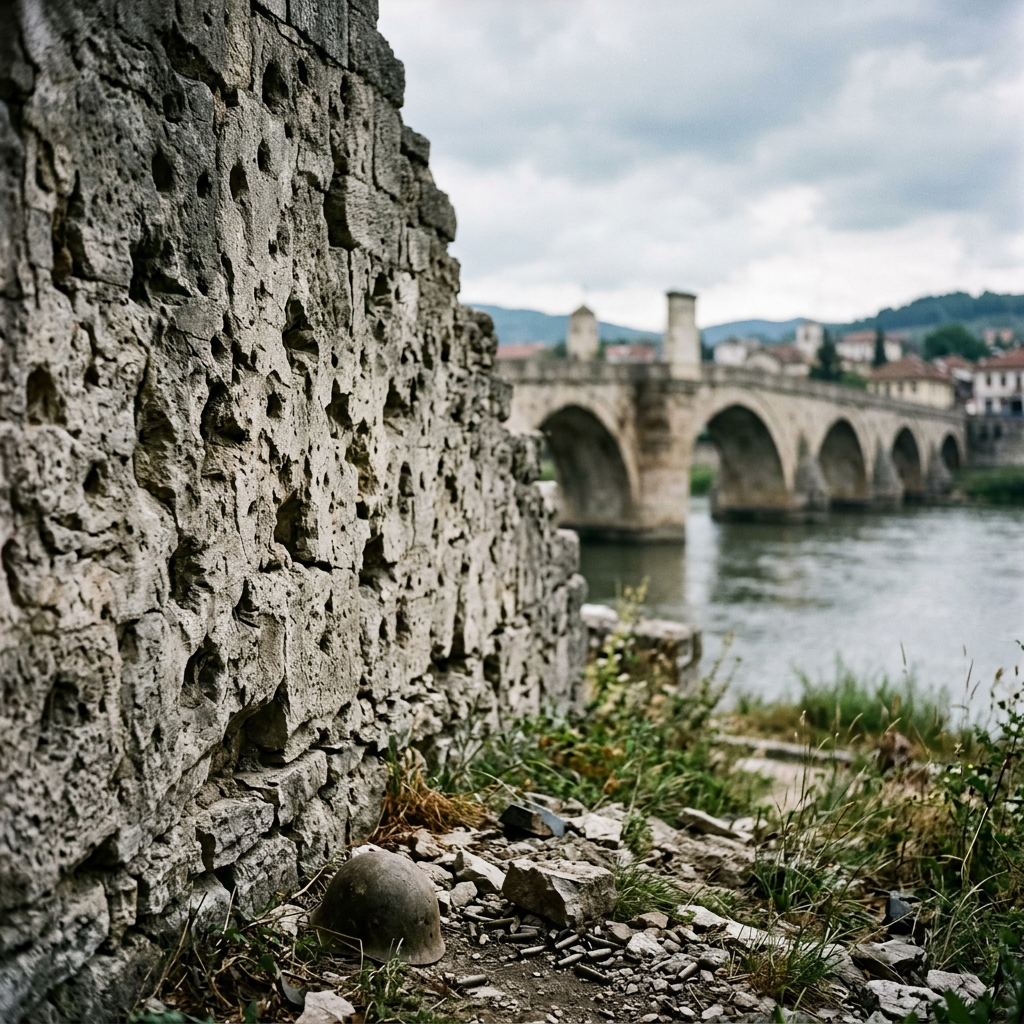
The traveler’s quest is often for beauty, for difference, for a stamp in a passport. My journey to Mostar, however, became a pilgrimage of a different sort. I arrived seeking the picturesque postcard of a UNESCO-listed bridge arching over an emerald river, but I left carrying the profound weight of its tremor—a vibration from the past that shook the very foundations of my carefully planned future. This is the story of how a city, still whispering with the echoes of conflict, challenged my neatly calculated path forward.
The Shimmer of Healing on an Old Bridge
At first glance, Stari Most (“Old Bridge”) is everything you imagine. The limestone arc, a perfect silhouette against the Herzegovinian sky, connects two parts of a city that has been divided for centuries. Tourists crowd its apex, hesitating before making the traditional leap into the Neretva below. The water shimmers a startling, almost unreal shade of green.
- The visible facade: Restored shops selling copper coffee sets and polished war souvenirs.
- The soundscape: A cacophony of languages, the call to prayer from a nearby minaret, and the playful shouts of local youth.
- The surface narrative: A symbol of reconciliation, of a city and its people meticulously rebuilt.
I walked across, feeling the smooth, sun-warmed stone under my feet. It felt solid, eternal. Yet, guides spoke not of its 16th-century origins alone, but of its destruction in 1993. This bridge was not old; it was new-old, a perfect replica standing where rubble once choked the river. The shimmer I saw wasn’t just sunlight on water; it was the gloss of profound and intentional healing over a deep, historic wound.
A Numbers Game in the Shadow of Stari Most
I am, by nature, a planner. My life was a spreadsheet—a calculated trajectory of career moves, savings goals, and five-year plans. I viewed the world through a lens of risk assessment and predictable outcomes. Standing in Mostar, I began to unconsciously apply my personal calculus to the scene.
- Metric 1: Economic viability. How could a city with such a recent, traumatic past sustain a tourist economy? What were the growth projections?
- Metric 2: Social stability. The divisions are still visible, with Croat-dominated west and Bosniak-dominated east. The math of coexistence seemed fraught with unsolvable variables.
- Metric 3: Personal application. This was a lesson in resilience, I thought clinically. A case study in post-conflict recovery. Data points for my own world view.
I took photos, ate ćevapi, and listened to stories. I was collecting information, processing it through my internal framework. The past here was a closed chapter, a historical data set from which the present was being engineered. Or so I believed.
> Important Insight: We often approach history as spectators, forgetting that its tremors are not contained by time. They travel through the ground we stand on today.
The Calculus Was Wrong, but It Was All Mine
The rupture happened unexpectedly. I strayed from the polished riverfront into a side street. There, sandwiched between renovated buildings, stood a skeleton of a house. Its façade was pockmarked with hundreds of bullet and shell holes—a preserved ruin, left as a silent memorial. No plaque was needed. The violence was etched into the very concrete.
My breath caught. This wasn’t a museum piece behind glass. It was a raw, open wound in the everyday landscape. In that moment, the careful calculations of my mind short-circuited. The numbers—of years passed, of buildings rebuilt, of tourists visiting—meant nothing. The past here wasn’t a digested fact; it was a living, breathing presence. It demanded to be felt, not analyzed.
My own future, so meticulously charted, suddenly seemed sterile. It was built on the assumption of continuity, on the naive belief that plans could armor you against chaos. Mostar’s very existence was a testament to the opposite: that life, in all its messy, painful, and beautiful forms, proceeds even when the blueprint is shattered.
When the Past Rises Like Concrete Dust
That encounter with the bullet-riddled house changed the air. Now, as I walked, I saw the scars everywhere: the “Šeher-ćehaja” bridge nearby, still in its war-damaged state as a counterpoint to Stari Most’s perfection; the subtle changes in architecture and atmosphere crossing from one bank to the other; the weary, knowing look in the eyes of an older shopkeeper.
The past wasn’t behind them. It was in the dust, in the slight pause before they answered where they were from, in the careful language used to describe neighbors. My own future anxiety—my fears about career missteps, financial security, wrong choices—began to feel laughably small, yet strangely parallel. I was fearing potential tremors; they had lived through the earthquake.
> “A bridge is not just a crossing over water,” a local poet told me later. “It is a dare to connect what has been torn apart. Every step across is an act of hope, and a memory of the fall.”
Decisions Flicker as Fast as the Old Lights
On my last evening, I sat watching the bridge as the day faded. Spotlights illuminated it, making it glow against the darkening sky. It was breathtaking. But I now saw the light not as simple illumination, but as a nightly act of defiance, a deliberate choice to shine beauty on a symbol of loss and renewal.
My own path forward, my spreadsheeted life, flickered in my mind. The secure job track versus the creative gamble. The safe, planned route versus the uncertain, passionate one. Mostar taught me that resilience isn’t about avoiding collapse; it’s about deciding what you will rebuild, and how, when collapse finds you. The city’s choice was to rebuild the bridge, piece by painstaking piece. It was a choice to face the past daily, to make beauty from rubble.
I left Mostar not with a new five-year plan, but with a dismantled calculator and a heart full of unfamiliar courage. The bridge trembled not from weakness, but from the strength of its own story—and in doing so, it shook my future loose from the rigid grip of fear. The future, I now understood, isn’t a cell in a spreadsheet to be protected. It is a Stari Most of your own making: an arch you build, day by day, across the chasm of the unknown, daring to connect who you were with who you have yet to become.
Leave a Reply