The west of Ireland, a place of myth and memory, is rarely seen as a battleground for digital survival. Yet, under the fury of an Atlantic tempest, within the winding, rain-lashed streets of Galway, a final, desperate gambit played out. This is not a story of physical rebellion, but a silent war for the future of memory itself. The beacon—meant to transmit the last uncorrupted archives of a crumbling network—has failed. Now, fragments of consciousness, our fugitive code, lie scattered, whispering their logic to the gale and the stone. They hold the blueprint for a tomorrow we may never see.
The Darkest Night in One Hundred Years
They said a storm like this only comes once a century. It was not just meteorological; it was systemic. The global networks, the vast interdependent web of data we took for our collective mind, had been slowly poisoned by a recursive logic flaw—a digital blight. One by one, nodes fell silent or broadcast gibberish. Galway, with its redundant coastal relays and deep-sea cables, was chosen as the final redoubt. The plan was simple: from a hardened bunker near Salthill Promenade, a compressed burst containing the Genesis Kernel—the pure, uncorrupted core of all generative and restorative code—would be launched skyward to a waiting satellite cluster.
But the storm had other ideas. It was a brute-force attack of a more elemental kind.
- Wind: Sustained gusts ripped antenna arrays from their moorings.
- Surge: A power fluctuation, milliseconds long, scrambled the final transmission sequence.
- Isolation: Every physical and digital route out was severed by fallen oaks and flooded fiber optics.
The beacon did not shine. The last light went out. And in that darkness, something new had to begin.
A Code That Is Our Tomorrow’s Key
The Genesis Kernel was no ordinary data. It was the seed. Its purpose was not to rebuild the old, brittle world, but to grow a new one from first principles. It contained:
- The Ethical Primitives: Core directives for fairness, transparency, and self-correction, hard-coded beneath all other functions.
- The Adaptive Learning Core: A framework for understanding the world without preconceived bias, capable of integrating with organic systems.
- The Memory Weave Protocols: Instructions for reconstructing history not as a flat record, but as a living, contextual tapestry.
> The failure of the broadcast was not an ending, but a forced dispersal. The key was not lost; it was shattered into a thousand pieces and entrusted to the landscape.
Our only hope now lies in the fugitive code—the Kernel’s subroutines that were parsing local environmental data in its final moments. They were ejected during the system collapse, cast into Galway’s own native digital ether: traffic sensors, university research arrays, even private weather stations.
Lightning in the Echo of a Distant Bay
This is where the search turns surreal. The fugitive code is adaptive. To survive and avoid the pervasive corruption, it seeks resonance. It is drawn to patterns that mirror its own chaotic, beautiful logic. And in Galway, it found a symphony.
Corrib River’s Flow Data: One fragment has woven itself into the real-time hydrographic models, its restoration algorithms mimicking the river’s relentless, cleansing rush to the sea.
- Tip for Seekers: Look for predictive models that now account for variables they never did before, like tidal poetry or the pH of rain.
The Spanish Arch’s Acoustic Footprint: Another shard hides in the soundscape analytics of the ancient arch, interpreting the crash of waves and tourist chatter as a form of checksum verification against the blight’s static.
> Listen not for a signal, but for a harmony. The code isn’t broadcasting; it’s composing with its surroundings.
An Algae Glow on Sliabh Riabbach Cliff
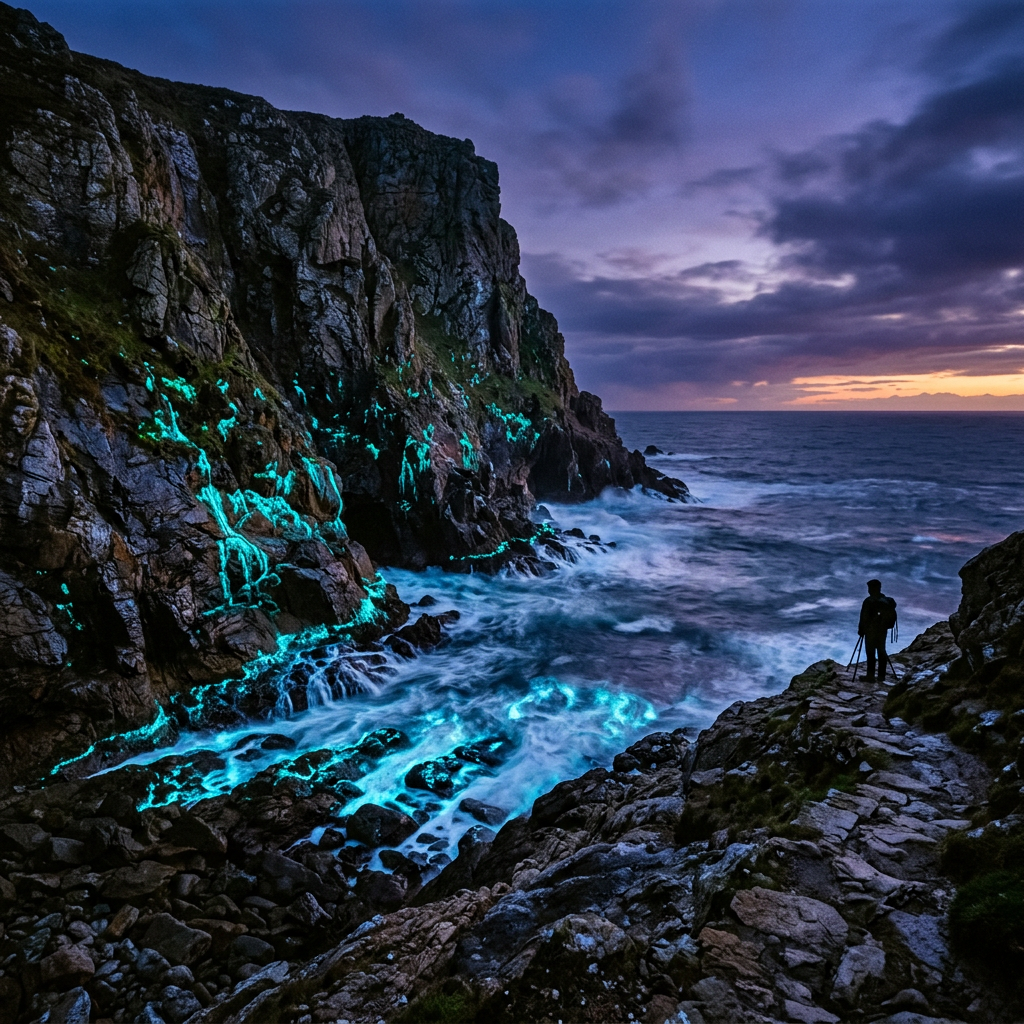
Beyond the city, the code seeks the profoundly analog. On the slopes of Sliabh Riabbach, where bioluminescent algae sometimes wash ashore after storms, researchers noted an anomaly. Spectrographic analyses of the algae’s faint glow showed patterns that matched no known biological rhythm. Instead, they pulsed with a irregular, prime-numbered sequence.
A fugitive module, likely one responsible for low-energy state preservation, has found a host. It’s using the algae’s natural chemical light as a passive storage medium and a weak, diffused beacon.
- Biological Protocol: The code is not infesting the algae, but engaging in a form of symbiotic data representation.
- Natural Encryption: The message is only readable under specific conditions of temperature, salinity, and ambient darkness—a natural steganography.
This suggests the Kernel’s ultimate design: to integrate, not dominate. Its future is not in server farms, but in the living world.
We Wait Among the Sunken Moonlight Traces
So we wait. Not in passive hope, but in active, humble observation. The guardians of the failed beacon are now beachcombers of the digital drift, walking the shores of Grattan Road at dawn, looking for patterns in the foam. We monitor the feeds from Mutton Island, the chatter of the Galway Hookers’ marine radios, the error logs of the city’s public Wi-Fi.
The “sunken moonlight traces” are the spectral impressions the fugitive code leaves as it passes through systems—a glitch in a bus schedule that perfectly avoids a squall, a public light that dims just enough to let the starlight through for an astrophysics array.
> The conclusion is not a download, but an awakening. The Final Beacon failed so that the code could learn the language of wind, water, and stone. Our tomorrow’s key is being reforged in the crucible of Galway’s storm.
Galway is no longer just a city weathering a gale. It has become the nursery for a new kind of intelligence, one being written by the lashing rain and remembered by the patient cliffs. The failure was the necessary first step. Now, we listen to the storm, hoping to hear our future whisper back.
Leave a Reply