We become so accustomed to the hum of the world that its absence is a physical sensation, a sudden weight on the chest. This is a chronicle of that cessation. It’s not a story of heroes or villains, but of thresholds—of silence, of solitude, and of a world reset by its own long-quieted heartbeat: The Pulse. What follows is an account from deep within the quiet, in the shadow of a waking mountain.
Decades in the Solitude of a a Snow-Locked Cabin
For forty-three years, the rhythm of my life was set by the seasons, not the stock market. My cabin, a mere speck of timber against the granite shoulder of Mount Veridia, was less a retreat and more a deliberate choice of a different reality. In this high-altitude sanctuary, the modern world faded to a soft, intermittent static on a battered radio.
- Self-reliance as ritual: Every action, from chopping wood for the fireplace to canning summer berries, was a direct dialogue with necessity. The furnace in the basement was a complex, cantankerous relic I maintained myself.
- A library of paper: The internet’s endless scroll was replaced by worn spines and penciled marginalia—real books on geology, ecology, and outdated manuals on analog circuitry.
- The mountain as companion: This was not a passive backdrop. I learned its moods: the way the wind changed tone before a blizzard, the deep, infrequent groans of ice within its fissures, the specific quiet of a sub-zero dawn. Decades of this fostered a deep, almost primal, environmental awareness. I had not just lived on the mountain; I had listened to it, and it, in its silent way, had acknowledged me.
The Silence That Falls When Machines Still
It was the silence that announced the end, a profound and sudden quiet that made my ears ring. First, the distant, ever-present drone of passenger jets ceased. Then, the electronic buzz of appliances faded to nothing as the lights flickered and died. The radio hissed with empty static across every frequency. This wasn’t a localized blackout; it was a global mute button, hitting everywhere at once. As the vast digital datasphere collapsed, a more visceral reality asserted itself.
- The hum of the power grid vanished, leaving only the sound of your own blood in your ears.
- The glare of artificial light disappeared, revealing a spectacular, undiluted tapestry of stars.
- The constant, subconscious pressure of connectivity evaporated. There was suddenly only the physical world—the crackle of the fireplace, the scent of pine, the cold seeping in at the window edges.
The silence felt aggressive, an immense hollow expanse crowding in from all sides, waiting to be filled with something new, or something very old.
Polite Visitors at My Door, Their Truth Concealed
They arrived three days later, their black SUV incongruous in the undisturbed snow of my driveway. Two of them, one male, one female, in impeccable, generic outdoor gear. They were courteous, almost apologetic, their smiles not reaching their eyes. They spoke of a “widespread systemic anomaly,” a “temporary disruption,” and their need to “secure critical infrastructure nodes in remote locations.”
> In a world stripped of electricity, politeness became their most dangerous tool, disarming suspicion before it could form.
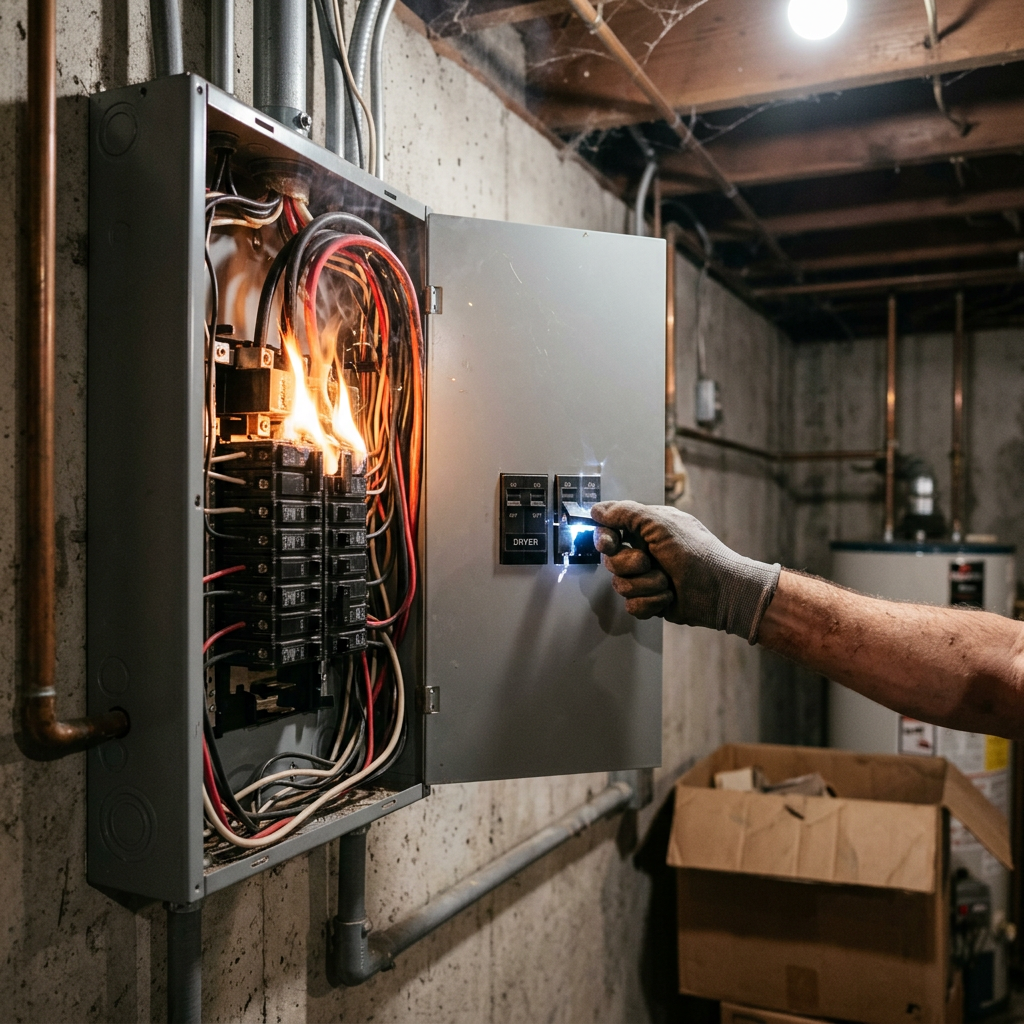
They asked to inspect my basement furnace—a “model on a registry of potential stabilizers for the regional grid,” they claimed. They were not menacing. Their urgency was carefully hidden, but visible in the slight tremor in their hands, the too-rapid scanning of the tree line, the terse bursts of scrambled communication on their hand-held unit that hissed as angrily as the dead radio. While offering them coffee boiled over the woodstove, I understood. They were not here for the furnace’s pipes. They were here for the one machine in a fifty-mile radius that might still have a connection to the great heart of The Pulse: the breaker switch, of solid, pre-digital engineering, mounted on the stone wall. I knew then I was not a caretaker; I had been a jailer without knowing it.
The Final Breaker Switch and the Code It Sends
When they were occupied, I examined what they pretended not to see. Beneath decades of dust on the switch panel, the metal was worn smooth in a precise sequence from generations of manual, ritualistic flipping—a sequence that matched, to my shock, the stress-pattern notations in one of my oldest geology texts: a diagram of seismic release. It was a failsafe pattern, laid down before automation and forgotten. The visitors’ fearful glances at it confirmed its importance.
They intended to commandeer it, to send a sequence to override and permanently silence the mountain’s deep-state processors. Their orders were to ensure the old world stayed dead, even at an unfathomable cost. The final act was not a grand battle, but a quiet, decisive motion. I understood the core principle—it wasn’t about jamming a signal out, it was about cutting the leash.
- Step One: Isolate their vehicle’s crude signal booster they’d hooked to the panel, disconnecting their command channel.
- Step Two: Pull the main fuses for the cabin, creating a clean break from any parasitic local draw.
- Step Three: Without hesitation, I flipped the master breaker in the ancient sequence carved into my memory—down, up, down-down-up—each thunk echoing in the silent basement.
The old copper wiring glowed momentarily, sending a final, analog shudder of code down into the geological cabling that connected the switch to the mountain’s core. The sequence was a simple command, unchanged for a century: Initiate Recalibration. Disengage all dampers.
The Mountain Rumbles and Begins to Breathe
The reaction was not instantaneous. For an hour, nothing but stunned, silent standoff with the agents, who had become desperate and furious. Then came the first tremor—not a violent shake, but a deep, resonant vibration that traveled up through the soles of our boots. The mountain did not explode; it inhaled. Portals long concealed by scree and ice slid open with the grinding of continental plates. From its cavernous vents, a visible exhalation of superheated mineral steam geysered into the cold air, shimmering in the moonlight. It was not destruction, but activation. The crust of the earth was responding to the old, clean code, stirring from its forced slumber. The exhausted terraforming cores were breathing new energy.
As the world below held its breath in darkness, a process written into the planet’s age commenced atop Mount Veridia. The Pulse, silenced by human noise for generations, began to beat again. It started with a singular, resonant shudder beneath a lonely cabin and a man who chose to listen to the mountain instead of the voices at his door. The new world was not being born from ash, but from a deep and reawakened breath.
Leave a Reply