For many of us, the landscape of home isn’t just a collection of streets and buildings; it’s a living memory, a complex tapestry of interactions, work, and community. Today, I am a chronicler of an attenuation, watching the place I grew up in not vanish in a cataclysmic explosion, but dissolve. It’s a slow-motion erasure, where physical spaces and the livelihoods they housed are being quietly replaced, pixel by pixel, algorithm by algorithm, leaving behind a ghost town that still has people in it. In this disorienting shift, I find myself clutching, almost desperately, to the last vestiges of the tangible, the struggle, the real—a quest that has led me to the enduring, gritty truth of sports competition.
As Machines Replace Our Livelihoods, A Slow Erasure
You don’t notice it at first. It begins with quiet closures, not with “Going Out of Business” signs, but with services that simply… digitize away. The local print shop, where Mr. Davies knew every customer by name and could troubleshoot a balky copier with a well-placed thump, was rendered obsolete by PDFs and home printers. The travel agency on the corner, a window to the world filled with brightly colored brochures, vanished as bookings moved entirely online.
The economic pillars of my small town are being hollowed out:
- Automation in Manufacturing: The regional plant, once a bedrock employer, now operates with a skeleton crew of technicians managing robotic arms. The lunch counter diner that served them shuttered last year.
- The Digital Service Takeover: From banking to billing, human intermediaries are now luxury exceptions. The friendly, slightly nervous bank teller is an app. The utility representative is a chatbot.
- The Decline of the “Third Place”: Cafés and pubs survive, but often as remote-work hubs filled with people staring into laptops, their community interaction mediated by screens and headphones.
This isn’t just about job loss; it’s about the loss of tacit knowledge and social collateral. The knowledge held in the hands of a machinist, the trust built over a decade of face-to-face transactions—these intangible assets of community are evaporating, leaving a social vacuum.
Seeking Feeling in the Digital Void of Crypto & AI
In response to this material emptiness, our culture has pivoted hard toward the purely abstract. We’re encouraged to find value and identity in the digital ether. Cryptocurrency promised a new, decentralized frontier of wealth, a realm of pure speculative value untethered from physical labor or local economies. Yet, for all its talk of revolution, it feels like another layer of abstraction, a casino built on consensus and code, miles removed from the sweat and craft that built my town.
Simultaneously, generative AI now offers to create art, write stories, and compose music. It simulates emotion and insight without ever having felt a thing. As I scroll through AI-generated portraits or read its perfectly competent yet soulless prose, I feel a profound hunger for the authentic struggle—for the human hand that falters, revises, and imbues a creation with lived experience. These technologies, for all their brilliance, feel like beautifully rendered maps of places that no longer exist, making the disappearance of the real, messy world around me even starker.
> “When everything becomes a frictionless simulation, we risk forgetting the value of friction itself—the struggle that shapes character and forges real bonds.”
The Unraveling of a Community’s Tangible Threads
A community is held together by threads you can feel. It’s the local hardware store owner who walks you to the aisle and explains why you need a specific type of washer. It’s the high school football game where the fate of the Friday night feels tied to the collective hope of everyone in the bleachers. It’s the summer fair, the volunteer fire department barbecue, the unspoken agreement to shop locally when you can.
These threads are unraveling. As centralized, algorithmic commerce replaces local commerce, our interactions become transactional, not relational. The shared physical experience is replaced by individualized digital consumption. We may live in the same geographic location, but we increasingly inhabit separate, curated realities. The town square is now a comment section, a place of performative anger or shallow connection, lacking the nuanced empathy that comes from sharing actual space.
Grasping for the Solid Ground of Real Competition
Amid this dissolution, I find myself grasping for things that cannot be falsified, streamlined, or fully automated. I seek tangible proof of effort. This is why I’ve returned, with a newfound reverence, to the world of sports. Not the hyper-commercialized spectacles on television, but the local, visceral expressions of competition.
There is an undeniable, brutal truth in sports that resists the digital wash:
- The Physical Reality: A cramp, a gasp for air, the ache of muscle after a hard-fought game. No algorithm can simulate this corporeal truth.
- The Unscripted Outcome: Despite all the data analytics, the game is played by humans on a field. A dropped pass, a moment of sheer individual brilliance, a call by a referee—these introduce the beautiful, agonizing variable of chance and human fallibility.
- The Meritocracy of the Moment: On the field, pedigree and digital clout mean nothing. It’s about what you do, right now, in front of everyone. This immediate accountability is a tonic for a world where consequences are often deferred and diluted.
In a Changing World, Sports Are My Last True Anchor
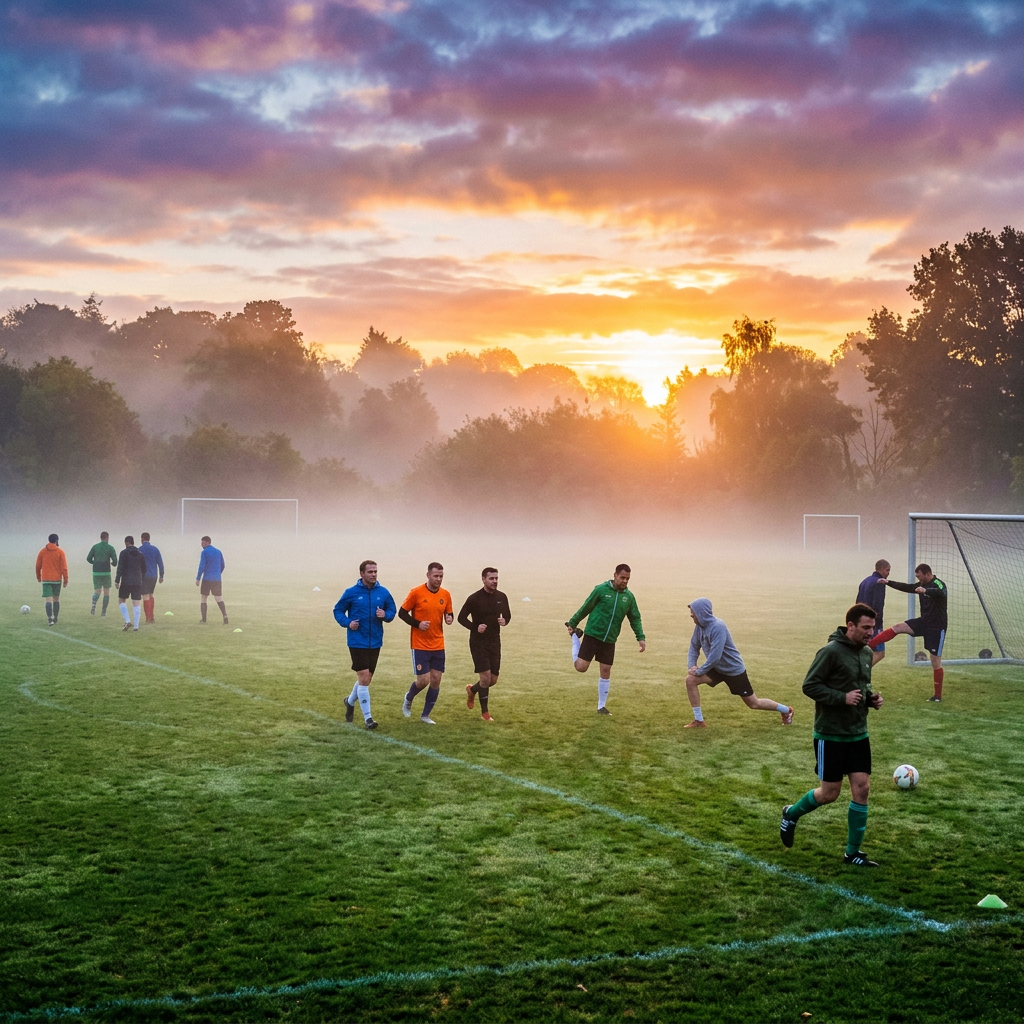
Every Saturday morning, I play in an amateur football league on a patchy public field. The paint on the lines is faded, the goalposts are slightly crooked. It doesn’t matter. Here, I find my anchor. The handshake with a muddy opponent after a tough tackle, the collective groan of a missed penalty, the unvarnished joy of a last-minute goal—these are authentic moments of feeling.
This is my last real thing. In a town where storefronts are becoming fulfillment centers and conversations are migrating to feeds, the sporting ground remains a sanctuary of the tangible. It is where effort is physically manifest, where community is built through shared struggle, not shared data, and where the outcome, for all its triviality in the grand scheme, matters in a way that feels profoundly human.
Watching my town vanish is a lesson in impermanence. But in holding onto this—the smell of cut grass, the burn in your lungs, the raw, unfiltered joy and despair played out under an open sky—I am holding onto a truth. It’s a truth that algorithms can’t compute and digital markets can’t tokenize. It is the truth of the real, the struggled-for, and the deeply, messily human. And for now, that is enough to keep me grounded as the world I knew continues to change.
Leave a Reply