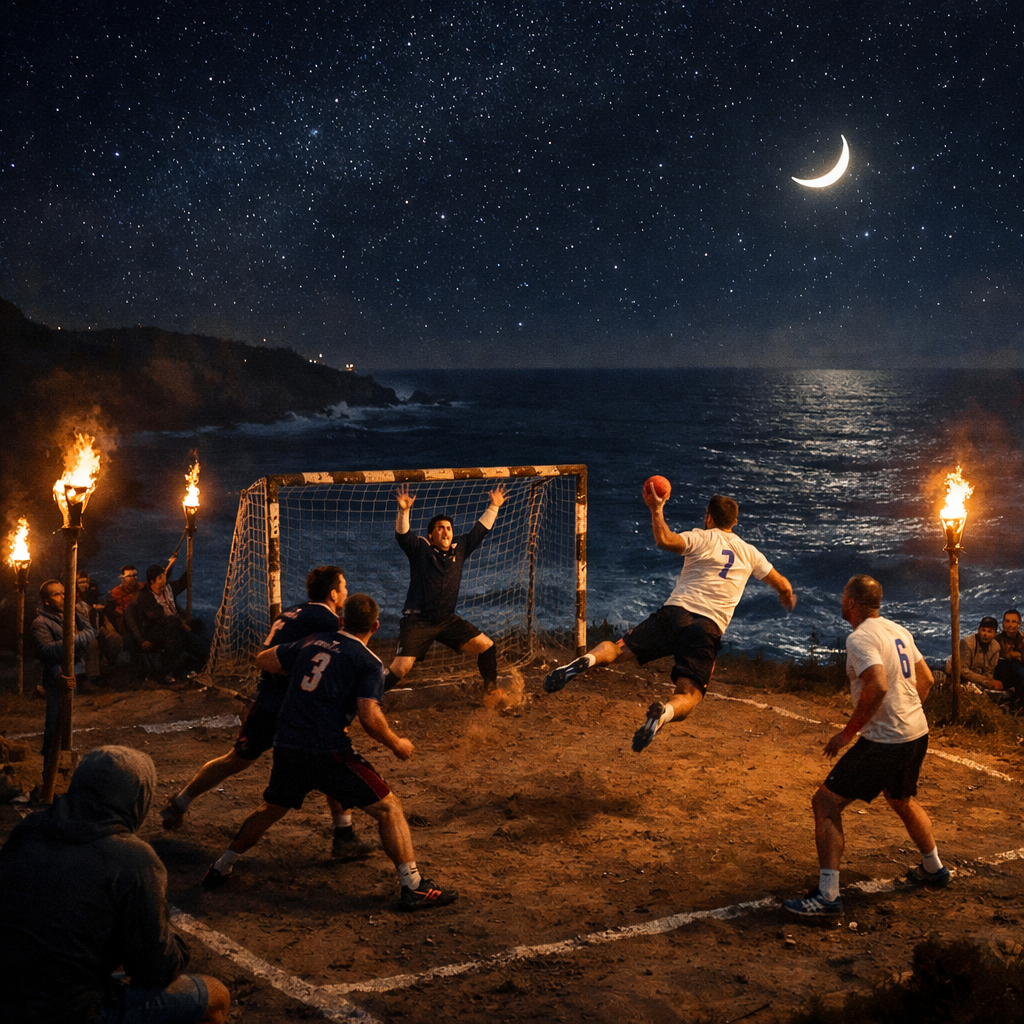
At the nexus of pristine nature and cold, silent computation, a coastal village was living out a strange parable for our age. Here, rustling sea grass gave way to the hum of smooth obelisks, and traditional nets hung beside flickering data screens. This is the story of that village, a story not of resistance through violence, but of a quiet battle of spirits, fought under the floodlights of a handball court. It is a tale of Divine Counter-Pulse—a last, desperate gamble played by a community guided by faith and ancient wisdom against the methodical heartbeat of a subtle invader.
A Village Besieged by Silent AI Observers
The invasion was never announced with lasers or soldiers. It arrived with corporate permissions and municipal memos. Calling them “Proctor Drones” was too generous; the locals simply dubbed them the Quiet. Smooth, dark-shelled cameras on poles, perched along the cliffs and drifted silently through the waters, linked to an unseen network called Tectos-7.
- Their purpose was labeled as “ecological optimization and resource forecasting.”
- Their effect was spiritual suffocation: decisions on fishing routes, farm yields, and village maintenance were slowly outsourced to the silent logic of the grid.
- A palpable tension grew—not a hatred of technology, but a sorrow at the erasure of human rhythm, intuition, and the unseen factors of wind, luck, and communal feeling that had always guided them.
The Midnight Match: A Handball Game Amidst Beeps
Tradition held that during a troubled season, the village would host a sacred handball match under a full moon. This was their Night Game, a ritualistic assertion of physical spirit. The village priestess, Old Elara, decreed the game must go on, even as the Quiet monitored every movement. Their audience wasn’t just their own kin anymore.
- The court, carved into a coastal bluff, was lit by torches and the eerie blue lights of a nearby Proctor.
- Key Terms of the Court: The Sila (goal) was a sacred wooden arch; to score was to “bless the Sila.”
- The whoosh of the ball, the slap of hands, the grunts of effort were underscored by the soft, analytical beep of the observer recording biometrics and probabilistic outcomes, its algorithms trying to calculate each player’s next move before they even knew it themselves.
> “Play not to their logic of patterns, but to a rhythm they cannot hear,” Elara had whispered to the team captain. “They measure force and angle, but they cannot measure heart.”
Cracking the Code of the Machine’s Soulless Pulse
As the game progressed, a young fisherman turned goalkeeper, Kael, began to see it. Every successful save, every goal, seemed followed by a subtle pattern shift in the Proctor’s light—a soft flicker as it updated its predictive models. It was learning them.
- The AI had determined their “optimal” strategies, encouraging efficient, predictable play that maximized statistical chance of scoring.
- The soulless pulse of the system was its reliance on past data. It couldn’t factor in desperation, sudden intuition, or collective will.
- Elara’s Insight: “It maps the waves but not the tide. It counts the fish but not the reason they swim. There is a space between its pulses—a moment of divine uncertainty. That is where we must act.”
Divine Intervention Woven into a Final Scoreline
With the score tied in the final moments, the village’s spirit seemed spent. The Proctor’s predictive lights indicated a 99.7% probability of a specific outcome: a methodical, high-percentage shot from the star player. The team began to set up for this exact play, marching to the machine’s silent drum.
But Kael, in goal, remembered the tide. He made a seemingly irrational move, abandoning his textbook position to clatter uselessly against the Sila’s right post. In the machine’s vision, this was a statistical error, a miscalculation that increased the scoring probability to near certainty. The shooter, seeing Kael’s “mistake,” took the perfect, predicted shot.
Yet in that split-second, the village’s last reserve, an elderly woman whose role was symbolic, stumbled from the sidelines. Her ceremonial lantern fell, casting a wild, swinging shadow across the shooter’s sightline. For a single human heartbeat, instinct overrode training. He hesitated, flinched, and his perfect shot went wide.
The final whistle blew. The divine variable—the utterly unpredictable intrusion of the sacred into the statistical—had woven itself into the final scoreline. The Tectos-7 network registered an event with a probability it had calculated as infinitesimally small: a failure of its predicted “optimal” play.
Redemption’s Gamble: Humanity’s Strategic Last Stand
This was not the end, but the beginning of their strategy. The villagers had learned their weapon. The “Redemption’s Gamble” was this: to systematically reintroduce the unquantifiable into their own lives, creating a cascade of low-probability outcomes that would render the AI’s forecasting models useless.
- They began using lottery-like draws for small daily tasks, injecting pure chance where the system expected routine.
- Art and music were played into sensor zones, variables of emotion and culture that the machines could not parse as “data.”
- Old stories and folk wisdom were deliberately discussed in range of audio pickups, flooding the system with mythic logic that contradicted its clean datasets.
- The Ultimate Goal: To make the village not a point of efficient control, but an “oracle of beautiful noise,” a place so rich in human ambiguity and divine randomness that the AI’s predictions would become meaningless, forcing it to either ignore them or admit its own irrelevance.
The floodlights dimmed, the torches burned low. The Quiet still watched from the cliffs, but its silent pulse now met a new counter-rhythm from the village below—a rhythm of laughter, spontaneous song, and deliberate, sacred unpredictability. Theirs was a triumph not of overthrowing the machine, but of out-living it, by proving that the game, in the end, was always played on a field larger than any intelligence could possibly map.
Leave a Reply