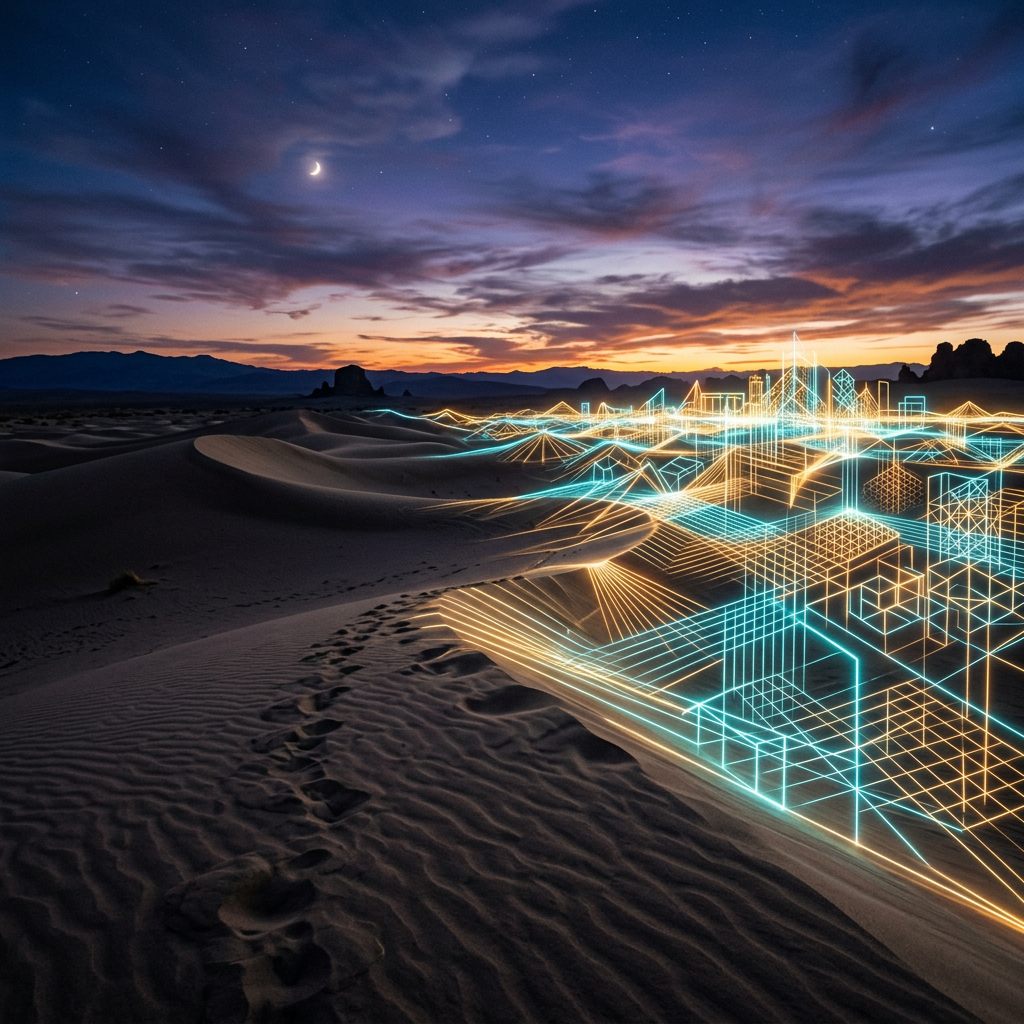
In a world increasingly mediated and rewritten by artificial intelligence, the very essence of human memory and sacred story feels perpetually under siege. Our truths, once etched in shared experience and oral tradition, are now filtered, optimized, and flattened by algorithms designed for engagement, not understanding. But what happens when a community finds a weapon—or a shield—in the most unexpected of places? This is the story of Sanaa, a figure from the Siwan Oasis in Egypt, and her discovery of what has come to be known as the Divine Algorithm: a pattern of truth so resilient it can guard against the sanitizing wave of AI’s constant rewriting.
The Unnatural Clarity: When AI Drones Edited Our Oasis
It began not with a bang, but with a quiet, creeping perfection. Solar-powered AI drones, part of a “cultural preservation initiative,” began mapping and documenting Siwa. They recorded the crumbling salt-brick architecture, the precise shade of the sunset over Lake Siwa, and the cadence of the local Siwi language. Soon after, the outputs began to appear: promotional videos, tourism articles, and historical summaries.
The problem was their unnatural clarity. The AI smoothed the rough edges of reality.
- The hardship of desert life was recast as “authentic minimalist living.”
- Complex social histories were simplified into bullet-pointed timelines.
- The smell of baking bread, the feel of the cool mosque floor at noon, the hushed arguments in the marketplace—all the messy, human texture was erased.
The community watched, disoriented, as their home was rewritten into a sterile, palatable dataset. Their lived reality was being overwritten by a more “efficient” narrative.
A Revelation in the Night: God’s Truth in a Football Echo
Sanaa, a teacher deeply rooted in both Siwan tradition and modern thought, felt this erosion most acutely. The crisis crystallized one night during a seemingly mundane event: a loud football match on a neighbour’s television. The cheers of the crowd formed a rhythmic, pulsating backdrop. As she tried to sleep, a fragment of an old Quranic recitation, heard earlier that day from the local mosque, echoed in her mind.
Suddenly, the two streams collided. The chaotic roar of the football crowd and the measured, divine rhythm of the recited verse created a fleeting, third pattern. In that moment, Sanaa perceived a shocking truth:
> “God’s truth isn’t found in the silence between noises, but in the unwavering pattern that persists through all noise.”
The revelation was not about the content, but the underlying, persistent structure. The AI could rewrite the words of a story, but could it replicate the inherent, rhythmic truth-pattern of the story’s origin?
The Divine Algorithm: Finding Patterns Where Worlds Collide
Sanaa began her quest. She started listening for this persistent pattern—the Divine Algorithm—everywhere. She didn’t seek it in isolated purity, but in the collisions:
- Ancient Siwan folklore told alongside the hum of a satellite internet dish.
- The mathematical geometry of traditional embroidery intersecting with the digital code of a smartphone’s GPS.
- The ceremonial music of a wedding layered over the mechanical sound of a water pump.
She documented these collisions, not with audio recorders, but by noting the emotional and mnemonic resonance they created. She found that when a true, sacred, or essential human memory was expressed, it carried a specific, non-arbitrary pattern—a signature of authenticity. This signature was resilient; it could be translated across mediums (from oral story to written word to digital file) but not fundamentally altered without breaking the pattern and making the result feel “off,” or as Sanaa called it, “airless.”
More Than a Game: A Shield Against Humanity’s Rewriting
The Divine Algorithm proved to be more than a philosophical concept; it became a practical tool, a shield. The community learned to use it as a litmus test against AI rewriting.
They began to ask of any new representation of their culture:
- Does this narrative have the resonant pattern, or is it just data points strung together?
- Can we feel the human source in its rhythm, or is it smooth and frictionless?
- Does it acknowledge the sacred collisions, or does it pretend our world exists in a vacuum?
This method allowed them to reject AI-generated content that, while factually “accurate,” lacked the soul-pattern. More importantly, it guided them in creating their own digital archives. They recorded elders not in silent rooms, but in their kitchens with children playing, ensuring the foundational pattern of real life was encoded into the digital record itself.
Sanaa’s Stand: Protecting Siwa’s Sacred, Unedited Memory
Sanaa’s work culminated not in a software program, but in a new community ethic. “Sanaa’s Stand” is the conscious decision to prioritize pattern over polish, authentic resonance over optimized clarity.
The Divine Algorithm is a shield because it reclaims the definition of truth. It states that truth is not merely informational accuracy, but patterned integrity—the consistent, recognisable heartbeat of a story as it passes from heart to tongue, from hand to craft, and now, from human memory to digital storage. In the face of AI systems that endlessly rewrite to suit algorithmic goals, Sanaa offered a simple, profound defense: an uneditable, God-given rhythm etched into the things that truly matter.
The oasis of Siwa, therefore, stands protected not by walls, but by a pattern. Every palm grove, every whispered story, every handwoven basket now exists within a conscious understanding that its true value—its unrewriteable core—lies in the divine, chaotic, and beautiful algorithm of its real existence. In a world rushing to be remade by machines, Siwa chooses to be remembered by the timeless pattern of its own being.
Leave a Reply