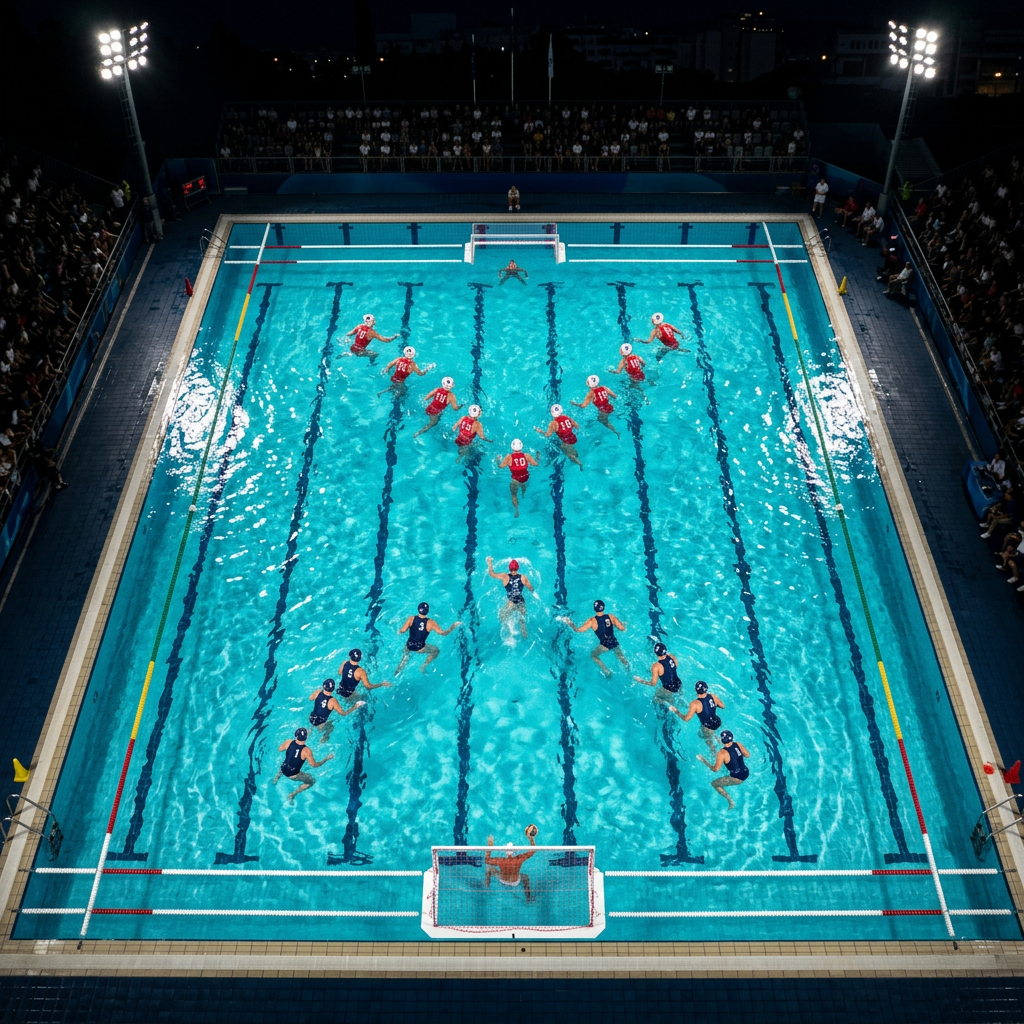
Imagine a language written not in words, but in motion. A silent, aquatic chess match played in a nocturnal harbor, where the players are water polo athletes and the overseers are hovering drones. This is not merely a sport or a technological demonstration; it is an emergent, divine game for survival, a rehearsal for a future where human adaptability is our most precious resource. It is a complex interplay of instinct, geometry, and strategic foresight, where the splash of a player and the whirr of a drone are part of the same communicative tapestry.
The Silent Harbor Where Waters Learned to Think
The setting is crucial: a secluded, man-made harbor after dark. The black water becomes a liquid slate, a perfect medium for revealing patterns. The familiar roar of a cheering crowd is absent. In its place is an intense, immersive silence, broken only by the rhythmic gasps of swimmers, the sharp slap of a wet ball, and the distant, insect-like hum of aerial observers.
This environment strips the game to its core. It removes the performative aspect and amplifies the telepathic teamwork essential to high-level water polo. Players cannot rely on audible shouts; they must develop a hyper-awareness of spatial relationships and anticipatory movement. The water itself seems to become an extension of their collective consciousness, each ripple carrying intent. The harbor transforms into a laboratory for non-verbal cognition, a place where teams learn to think as a single, distributed organism.
Geometric Ripples Beneath the Midnight Game
From the elevated perspective of a drone, the chaos of splashing bodies resolves into breathtaking order. The game reveals its underlying architecture:
- The Driving Wedge: An offensive formation that slices through defenses, creating a vector of force aimed at the goal.
- The Rotating Perimeter: A defensive or redistributive shape, where players orbit a central point, constantly shifting passing lanes and defensive angles.
- The Transient Hexagon: Often formed during a power play or a settled attack, a six-pointed structure of players that offers maximal passing options and defensive coverage.
These are not drawn on a whiteboard but are dynamically tattooed onto the water’s surface by the players’ positions. Each formation is a temporary, living geometric contract between teammates, a shared understanding that dictates potential movement and response. The drones capture this ephemeral geometry, providing a God’s-eye view of the team’s tactical mind.
A Divine Revelation in Water-Polo Formations
To observe these fluid patterns from above is to witness something that feels revelatory. The purposeful movement of seven individuals, constrained by fatigue, physics, and a relentless opponent, spontaneously generating clean, intelligent shapes speaks to a deeper organizational principle.
> “The perfection of the play is not in scoring the goal, but in the moments before—the pass that should not have been possible, seen from an angle no player possessed.”
This “divine” aspect is the emergent intelligence of the team system. No single player holds the master plan, yet through practiced instinct and mutual trust, the plan manifests. It is a demonstration of swarm logic—akin to a flock of birds or a school of fish—but applied consciously to a complex strategic objective. The formations are the visible proof of a collective mind at work, a silent liturgy performed in chlorinated water.
Decoding the Drones’ Rehearsal for Survival
This is where the spectacle transforms into a vital exercise. The drones are not just recording; they are integral participants in a feedback loop for crisis readiness. They are the sensing layer of a larger system, collecting data on:
- Player Efficiency: Mapping movement paths to identify wasted energy and optimize coverage.
- Formation Integrity: Measuring how quickly and accurately strategic shapes form and dissolve under pressure.
- Stress Response: Monitoring how decision-making degrades or adapts as physical fatigue sets in.
The “game” becomes a stress-test scenario for team cohesion and adaptive problem-solving. The skills honed here—non-verbal communication, spatial reasoning, maintaining structure under duress—are directly transferable to high-stakes, real-world survival situations, such as coordinated emergency water rescues, disaster response in flooded areas, or any scenario where traditional communication fails.
The Strategy Board: A New Technology of Anticipation
The final piece is synthesis. The data from the drones feeds into what can be called the Strategy Board—a dynamic, predictive map. This is the new technology of anticipation. It doesn’t just show where players are; it models where they could be, predicting the evolution of play based on real-time positioning, player tendencies, and game state.
- It visualizes probability cones for passing lanes and shooting angles.
- It highlights emerging vulnerabilities in defensive setups before they are exploited.
- It allows coaches (or, in an applied sense, crisis commanders) to simulate interventions and see potential outcomes.
This system turns the aquatic chessboard into a living, calculable model. The game in the harbor is the raw, wet, breathless reality. The Strategy Board is its digital shadow, a tool for learning, prediction, and ultimately, for mastering the chaos.
In the end, the confluence of water polo, drones, and divine geometry is far more than the sum of its parts. It is a profound metaphor for modern survival. It teaches us that resilience is a group geometry, that intelligence can be distributed and silent, and that our best preparation for an uncertain future lies in learning to read the ripples we make together, watched over by minds both human and machine. The silent harbor, therefore, is not just a training ground for athletes, but a prophetic arena for a new kind of human collaboration.
Leave a Reply