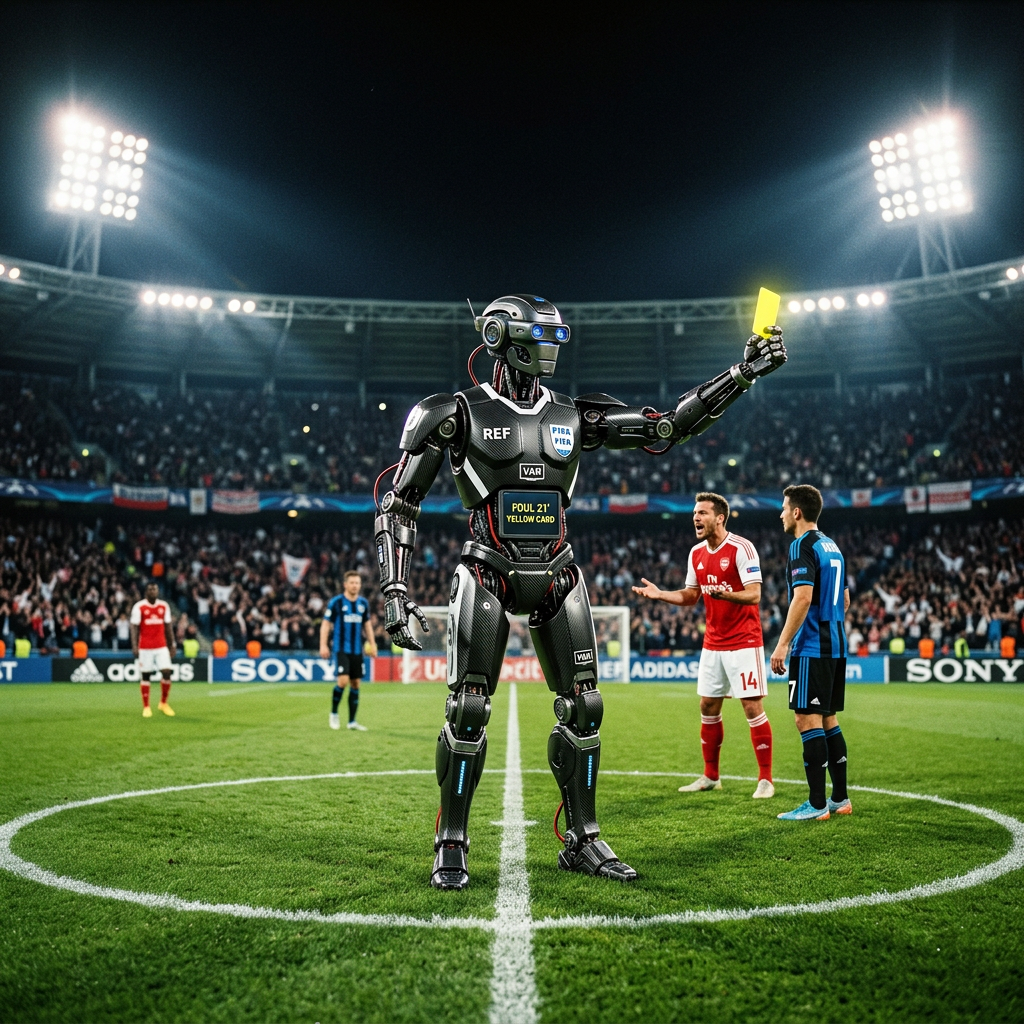
There’s a sound increasingly absent from the soundtrack of modern sport. It’s not the roar of the crowd or the thwack of ball against bat. It’s the collective, agonized, then furious, then euphoric groan-turned-chant that erupts when the umpire makes a call. Not the right call, necessarily. The call. In our relentless, data-driven pursuit of fairness, we have outsourced judgment to silicon and sensor, sterilizing contests in the name of perfection. This obsession with perfect calls is not just changing the game; it’s methodically leaching the very heart and unpredictable soul that made us love sports in the first place.
The Chilling Efficiency of the Robotic Referee
Welcome to the era of the definitive verdict. Goal-line technology sends an unemotional “GOAL” signal to a referee’s watch. In cricket, the Snickometer and Hawkeye dissect a bowler’s delivery with micrometer precision. In tennis, the automated line-call system renders judgment with a sterile, digitized “OUT.” These systems are, by their design, flawless arbiters of fact.
- They eliminate obvious, game-altering mistakes. No more “ghost goals” or serves called out that were clearly in.
- They standardize judgment across all contests, removing the variable of official bias or incompetence.
- They provide an immutable truth, shutting down arguments before they can even begin.
But this sterile efficiency comes at a cost. The process is often slow, freezing the live action for a technological review. The raw, immediate emotional release—a player’s celebration, a crowd’s eruption—is put on hold, replaced by a quiet, nervous tension as we await the binary verdict from the machines. The referees, once central, authoritative figures, are reduced to mere messengers, relaying decisions they had no part in making.
> Important Note: Perfect accuracy and sporting drama are not mutually exclusive goals, but their intersection requires careful balance. We must ask: at what point does the pursuit of justice undermine the spirit of the contest?
Where Human Error Forged Unforgettable Legends
Paradoxically, some of sport’s most enduring folklore is rooted not in perfect fairness, but in controversial, even erroneous, human judgment. These “mistakes” created narratives more compelling than any scripted drama.
- The “Hand of God” (1986): Diego Maradona’s blatant handball goal against England is perhaps the most famous “wrong” call in history. It forged his legend as a cunning, divine-force-of-nature and created a rivalry narrative that persists for decades.
- The Tuck Rule Game (2002): An obscure, highly debated ruling that went in favor of Tom Brady and the New England Patriots. Widely considered a bad interpretation, it launched a dynasty and became a foundational myth in NFL history.
- The Imperfect Game (2010): MLB umpire Jim Joyce’s missed call that robbed Armando Galarraga of a perfect game. The subsequent raw emotion—Galarraga’s grace, Joyce’s tearful apology—became a powerful story about sportsmanship and humanity that resonated far more than a statistically perfect outing ever could.
These moments weren’t about the score. They were about human consequence, about flawed characters navigating fortune and misfortune. They gave us villains, victims, and vindicated heroes, elements that algorithmic perfection deliberately seeks to erase.
When the Perfect Call Erases the Human Drama
Sport is, at its core, human theater. The tension isn’t just in who wins, but in how they win—the struggle, the luck, the bounce of the ball. Perfect technology threatens to flatten this landscape into a predictable, faultless transaction.
Consider the disputed tackle in soccer, now scrutinized by VAR for minutes to detect an offside toenail or the slightest brush of a hand. The spontaneous joy of a hard-fought goal is replaced by a hesitant pause, players and fans alike staring at the giant screen, their emotions in bureaucratic limbo. The “clear and obvious error” standard often gives way to a forensic re-refereeing of the game.
The drama shifts from the athletes’ performances to the technicians in a booth. We lose:
- The instantaneous catharsis of a decision, right or wrong.
- The strategic gamble of playing to a referee’s style or tendencies.
- The unifying power of shared grievance, where a fanbase bonds over a “robbed” result for generations.
The Soul of Sport, Lost in a Binary Stream
What we are automating away is the human context. A referee on the field feels the tempo of the game, understands the intensity of a rivalry, and can apply a “feel” that a camera angle cannot capture. This is the concept of “flow”—the invisible, intuitive understanding of the contest’s spirit.
Machines see in binaries: in/out, goal/no goal, foul/no foul. But many sporting moments exist in a gray zone of interpretation. Was that contact in the basketball post “incidental” or a foul? Was that soccer challenge “reckless” or merely robust? These are judgments of degree and intent, areas where human experience and feel are not bugs, but essential features.
By outsourcing all judgment, we risk creating a sport that is flawless in its logic but devoid of its poetry. It becomes a high-stakes spreadsheet calculation, not a shared emotional experience.
Reclaiming the Sacred Imperfections of the Game
The solution is not to abandon technology, but to redefine its role as a backstop, not a dictator. We must preserve a sacred space for immediate, on-field human judgment.
- Limit reviews to “game-defining” moments only, like potential scoring plays or egregious missed calls, not a constant re-litigation of every action.
- Uphold a high standard for overturning calls, such as the “clear and obvious error,” trusting the official’s initial judgment.
- Speed up the review process dramatically to minimize the death of momentum and live emotion.
- Embrace the human element as a feature, not a flaw. Teach fans and commentators that human judgment, with all its potential for error, is part of the game’s rich tapestry.
> The heart of the matter: A sport completely purified of controversy is a sport sterilized of its soul. The arguments, the legends born from bad breaks, the shared experience of injustice—these are the conversations that fuel fandom in bars, living rooms, and playgrounds long after the final whistle.
In the end, we watch sports not to witness a perfectly adjudicated process, but to feel something. We crave the unscripted, the miraculous, the heartbreaking, and the controversial. By chasing the phantom of absolute fairness through perfect calls, we are sanitizing the very arena where human drama, in all its glorious, messy imperfection, is meant to play out. Let’s not engineer the passion right out of the game. Sometimes, the wrong call makes for the right story.
Leave a Reply