Introduction
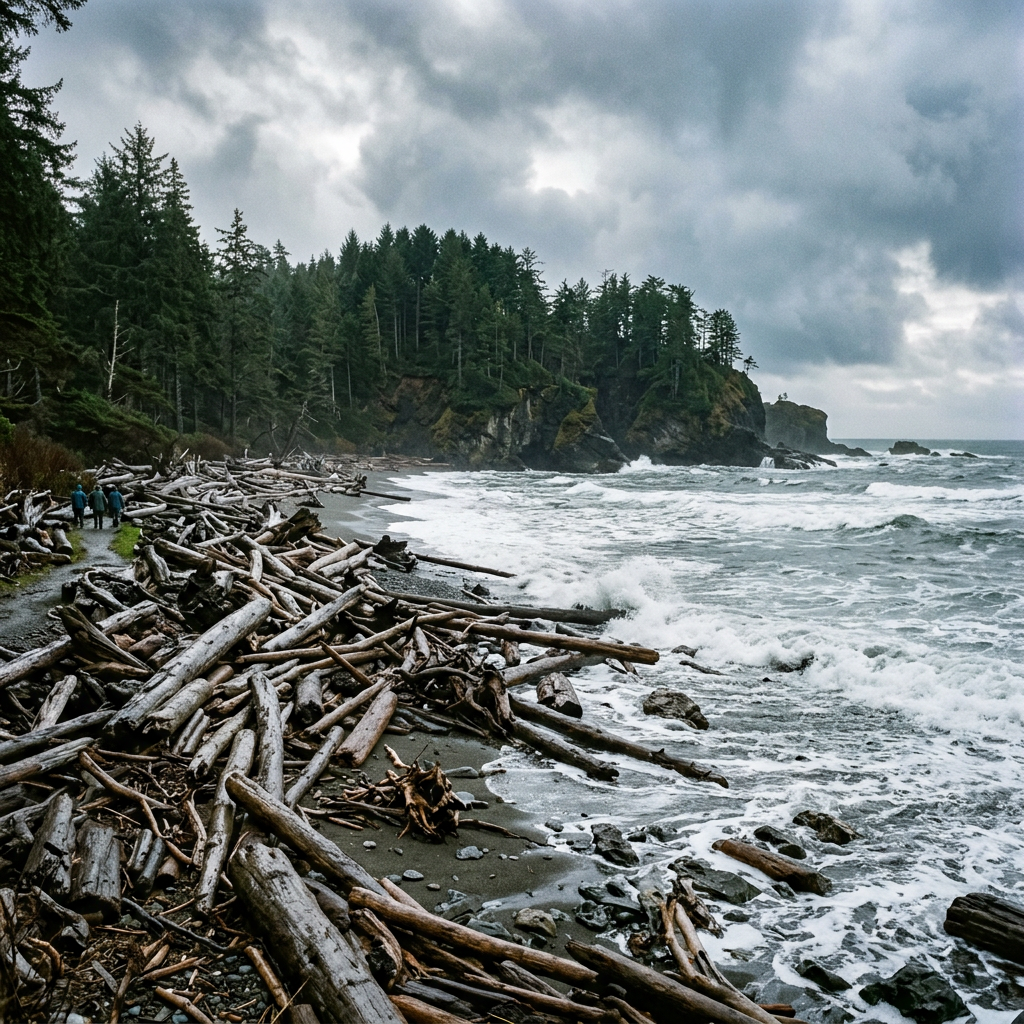
For the Haida people of the Pacific Northwest archipelago now known as Haida Gwaii, the coastline is not a hard border but a permeable membrane, a place of continuous exchange between land and sea. The tides bring news. In the whorls of cedar, the weave of spruce roots, and particularly in the complex forms of driftwood littering the shore, generations have learned to read subtle signals that speak of tomorrow. While Western science deploys satellites and sonar to forecast the future, Haida knowledge follows a different logic: it carves signals from the raw material the ocean delivers. This practice of deep observation—a philosophy where every piece of storm-tossed timber is an ecological and economic dispatch—is being reinvigorated as a vital tool for understanding our rapidly changing world.
The Signal Washes Ashore in Driftwood
Each log that arrives on the beaches of Haida Gwaii is a silent envoy, its origin story etched into its very fiber. For skilled eyes, it carries a dense package of information from the vast watersheds of the North Pacific.
- Provenance and Journey: The species of wood—Sitka spruce, Western red cedar, Douglas fir—points to its origin forest. The degree of wear, marine borings, and mineral deposits chart the duration and violence of its ocean voyage.
- Weather and Catastrophe Data: A sudden influx of raw, bark-on timber may signal an upstream landslide or catastrophic flooding, broadcast weeks later by the currents. Logs bearing the square-cut marks of industrial forestry tell a different story of watershed activity and management decisions made far away.
- An Uncharted Database: As one Knowledge Keeper, K’uná a, notes, “The government has its tide charts. We have the tide’s own charts, written in wood and kelp.” This organic database is not logged on servers but in collective memory and oral tradition, passed down through stories that explain what each type of arrival foretells.
Deciphering Nature’s Unexpected Data Stream
Interpreting these driftwood missives requires a form of ecological literacy. It is a practice of moving beyond seeing an object to reading a process.
The most acute signals often involve subtle changes in what the ocean returns. For instance, a marked increase in waterlogged, “dead” wood from specific cedar stands might not be noise, but a vital signal.
> “When the forest is thirsty, the cedars whisper to their roots. When it is sick, the tides carry its bones to us. The log is not just a log; it is the final word of a tree that can no longer drink.”
This speaks to a holistic understanding: freshwater health upstream is intrinsically linked to coastal and marine vitality downstream. The condition of arriving wood acts as a bio-indicator, an unwitting but brutally honest reporter on the state of entire watersheds that are often out of sight but never out of the ecological system.
A Future Communicates Through Storm-Tossed Timber
Today, this ancient mode of foresight has taken on profound new meaning in the era of climate disruption. The signals in the driftwood are becoming more urgent, their messages less cryptic and more alarming.
- Shifts in Species Arrival: New species of wood, from regions further south or north, appearing on the beach could indicate shifts in prevailing currents and storm tracks.
- ‘Catastrophe Timber’: Larger, more frequent pulses of scorched or flood-torn timber, perhaps from unprecedented wildfires or “atmospheric river” rain events on the mainland, serve as direct, tangible evidence of climatic instability, linking distant disaster to local shorelines.
- Relocating and Renaming: Haida Gwaii itself, like many coastal communities, is grappling with eroding shorelines and shifting habitats. Observing where the driftwood now accumulates—often at newly vulnerable points or in old village sites—helps map coastal changes in real-time, informing community adaptation plans far sooner than official models might predict.
How Economic Currents Etch Themselves in Wood
The story told by driftwood is not solely ecological; it is inseparably economic. Haida Gwaii’s history and prosperity have always been linked to marine resources. As such, the flotsam foreshadows impacts on sustenance and livelihood.
- Salmon Forecasting: Debris patterns can predict ocean nutrient upwellings and current flows that will later guide salmon runs. A dearth of certain nutrient-rich debris might forewarn of a lean season ahead.
- Forestry Signals: The arrival of commercially valuable, prematurely felled logs can indicate unsustainable logging practices far upriver, predicting not only future ecological decline but also eventual economic ripple effects.
- Maritime Indicators: The type and volume of human-made debris mixed with natural driftwood serve as a leading indicator of regional maritime traffic health and fishing industry practices.
This translates environmental data directly into economic intelligence. Knowing what the driftwood signals about the coming salmon run, crab abundance, or cedar vitality allows for more informed, sustainable harvesting and economic planning.
The Carver’s Role as Interpreter of Tomorrow
In Haida culture, the carver is not merely a shaper of wood, but a profound interpreter of its past and potential. This role is crucial in the context of signal carving.
A master carver examines a piece of driftwood not just for its grain and shape, but for its narrative. They ask: What has this wood endured? What strength has it gained from its journey? The process transforms a silent, battered log into a mask, a pole, or a vessel that carries forward the very story of resilience it embodies.
> “We do not simply carve wood. We release the message that is already waiting inside. The ocean writes it; we give it a voice for the people.”
In this way, the carver translates the complex, often alarming signals from the natural world into a cultural language of story and art. They make the future, as forecast by the timber, tangible and comprehensible. A carved memorial pole from a storm-felled cedar doesn’t just honor ancestors; it is also a monument to the changing storm cycles of the present, ensuring the community remembers and heeds the signals embedded within it.
Conclusion
On Haida Gwaii, forecasting is an act of profound, place-based attentiveness. Carving signals from driftwood is a sophisticated practice of futurism, one that weaves together climatology, ecology, and economics into a single, teachable story. As global systems become more unstable, the quiet wisdom of reading tomorrow’s tide in yesterday’s timber offers a powerful alternative. It reminds us that the future is not a blank slate but is continuously being written by our present actions, etched in the landscape, and sent back to us—sometimes gently, sometimes with the force of a winter storm—for those prepared to interpret its arrival. It is a call to relearn the languages of the places we inhabit, to see data not only in bytes and pixels, but in grain, tide, and time.
Leave a Reply