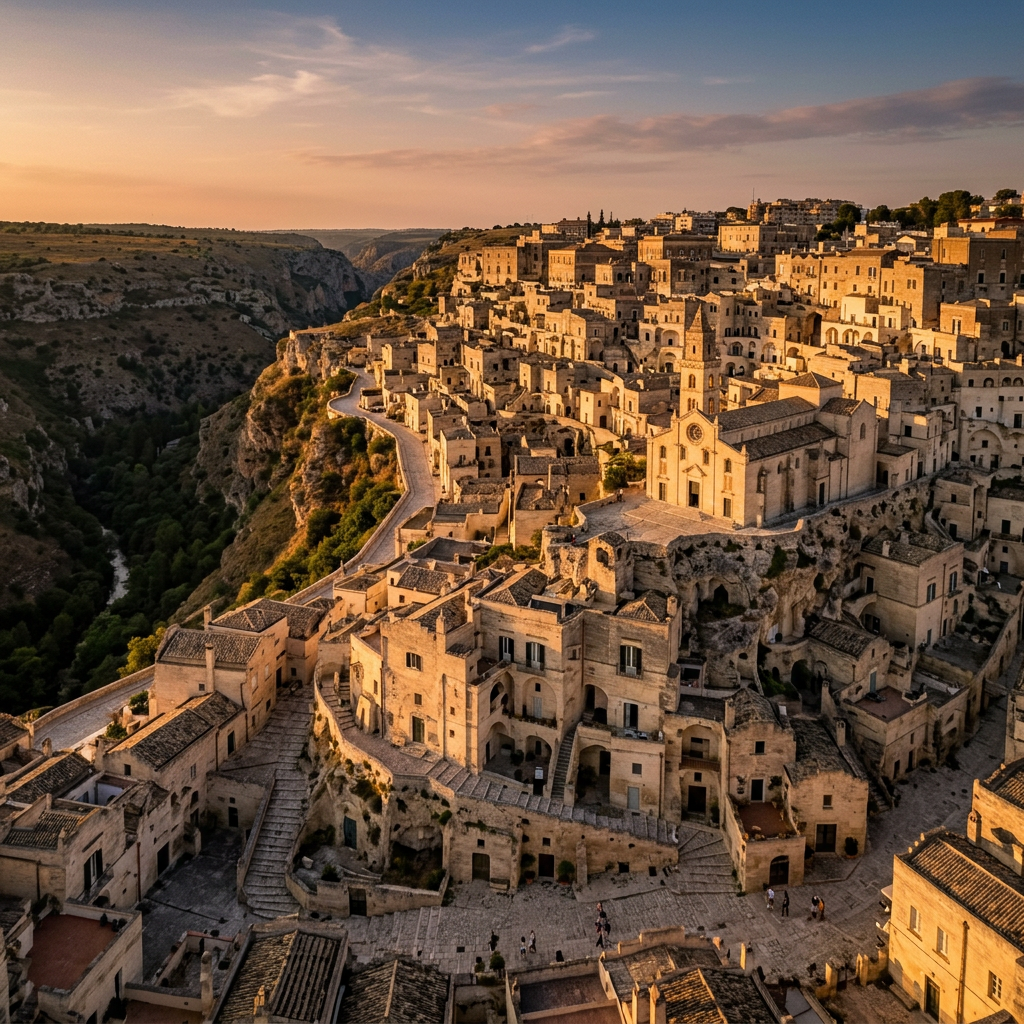
A sigh of antiquity. A tense breath. In the fractured arch of a window overlooking a web of arid gullies, these two sensations are braided, inseparable. Matera, the timeless city of sassi—cave dwellings carved directly into the calcarenite rock—is not simply a relic of ancient poverty. It is a monumental wager, a bluff against gravity and time etched in stone. To walk its alleys is not just to observe history, but to feel the weight of decisions yet to be made. Here, remembered lives press upon the present, and every stone whispers a conditional future: if, then, but, maybe.
A City Carved From Living Memory Stone
The unique aura of Matera’s stone stems from its dual nature. It is not inert, but memory-saturated, a type of rock local artisans call “tufo,” which is soft enough to carve, yet hard enough to endure. For millennia, this very characteristic created a haunting paradox:
- It offered refuge and simple construction, birthing a habitat of profound intimacy with the earth.
- Yet, its permeability made it a repository of dampness, disease, and destitution in the 20th century, leading to the sassi being declared “the shame of Italy.”
>The weight is not just of tons of rock, but of countless lifetimes—their struggles, joys, and quiet desolation—absorbed into the very pores of the city. As one resident describes it, “The walls here don’t show history, they are the history.”
What we confront is the sediment of lived experience. Each chip in the stone, each worn step, each soot-darkened ceiling tells a story not of grandeur, but of resilient, earthy survival. This gravity of human past sets the stage; it is the ante placed on the table before the next, crucial card is dealt.
The Murmur of Wagers in Ancient Walls
After decades of forced evacuation and subsequent abandonment, the sassi faced a terminal silence. The wager of the late 20th century was existential: Could a symbol of backwardness be transformed into one of cultural resurrection? Private pioneers and enlightened policymakers bet it could. This wasn’t mere restoration; it was a high-stakes reinterpretation of heritage, gambling that modernity could converse with primitivism. They placed bets on:
- Subterranean Climate: Gambling that natural cave coolness could power modern air conditioning.
- Sacred and Profane: Converting cave churches into art galleries and sterile stables into luxury hotels.
- Collective Memory vs. Commercial Vision: Betting that tourism would not sanitize tragedy but illuminate it.
The murmurs of these gambits are embedded in every renovated façade and discreetly installed electric line. The ancient gamble was survival; the modern gamble is relevance. Both leave their echo.
Glimmers of Wagers Lost and Regained
Today, you can read this tension on the faces of the stone. Some bets paid off brilliantly, turning a ghost town into a UNESCO World Heritage site and European Capital of Culture. Others carry a hint of loss:
- Glimmer of Regain: The cathedral on the ridge, long dormant, now glows with restored art, its bronze doors representing a triumph of faith in the future.
- Glimmer of Loss: In a hidden piazza, a perfectly preserved 1950s-era cave home stands as a museum of “how things were.” Its empty fireplace is an eloquent void, a reminder of the community fragmented by progress.
- The Eternal Wager: A master maestro di muro—a stone wall craftsman—taps his chisel. He’s repairing a centuries-old retaining wall. His wager is that ancient dry-stone techniques can still hold back the earth, a microcosm of Matera’s entire philosophy.
You realize every decision here—to preserve or adapt, to open a boutique or a family kitchen—is part of an ongoing, unbroken conversation with the past.
Touching the Weight of What Could Be
Walking through Matera is a tactile experience, and touch becomes a form of prophecy. To press your palm against a cool cave wall where a frescoed saint has faded is to feel more than the rock.
- Run your hand along a dry-stone wall, feeling the perfectly fitted jigsaw of limestone.
- Feel the sun-warmed smoothness of a communal staircase, hollowed by the tread of two thousand years.
- Sense the cool dampness in the back of a deep cistern, which held the life-giving water for a community.
In that moment of contact, the stone ceases to be an object. It becomes a medium. Its weight is the burden of potential—of all the futures the inhabitants dared to imagine for themselves, the ones that came to pass and the ones that dissolved like mist in the gorge.
The Limestone That Dreams of Our Futures
Ultimately, Matera is not about being frozen in stone. The true gravitas of its limestone is projective, not retroactive. The city stands as a testament to humanity’s defiant habit of dreaming within constraints. The rock was a limit that became a home; the poverty was a crisis that became a catalyst.
>Perhaps the most crucial lesson is this: to remember is not to enshrine. It is to take the inherited weight of past choices and sculpt it—thoughtfully, audaciously—into the next life form. “The next life form is not always clear,” a local winemaker, whose cellars are ancient caves, remarks, “but the material to build it is all around us.”
The limestone of Matera dreams because it has absorbed the dreams of those who lived within it. Its future hinges on a collective bet on the value of continuity—not a continuity of stasis, but of inspired, iterative re-creation. It challenges every visitor: what stones are you inhabiting? What weight of remembered lives can you bear? And most daringly, what future can you cause to shimmer from within them?
In Matera, the very dust on your shoes is the memory of stone dreaming itself anew, and we are invited, momentarily, to become a part of that restless geology.
Leave a Reply