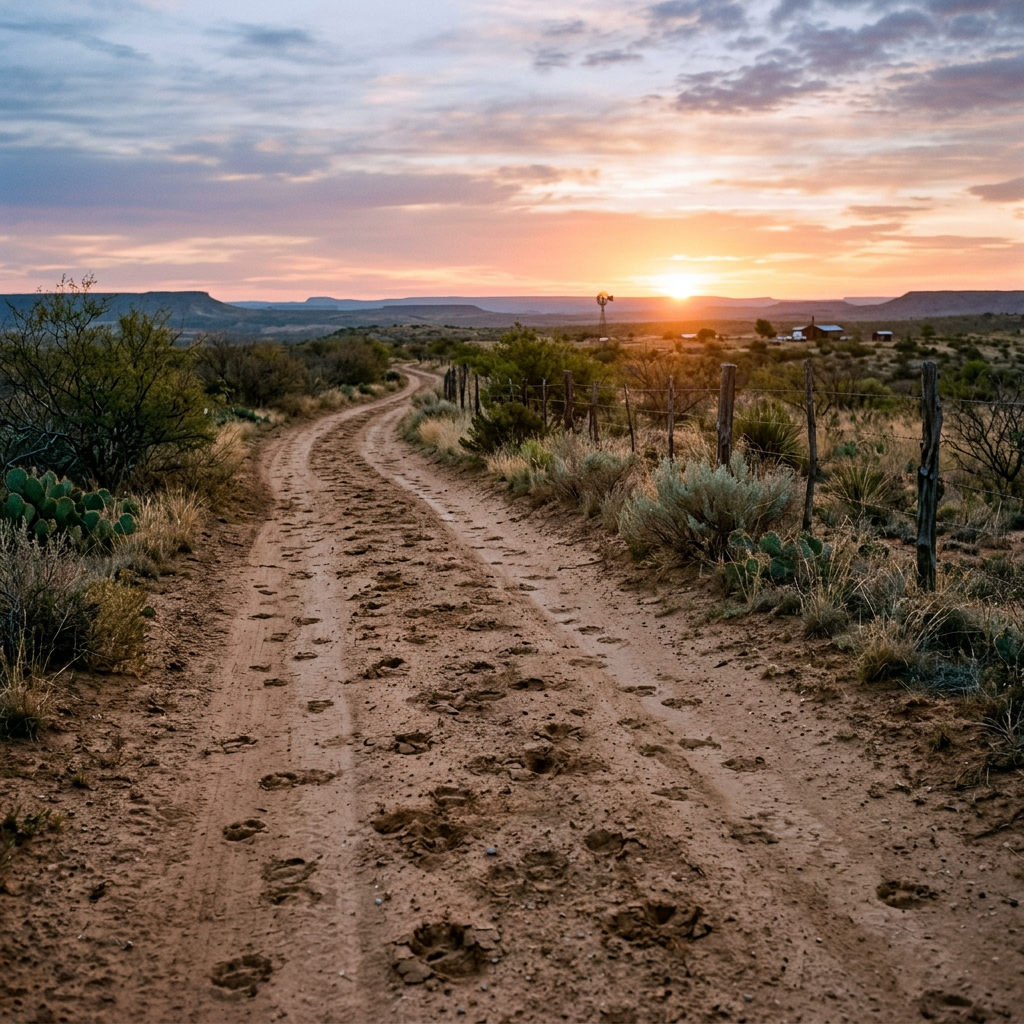
Dusty Tracks on a Marfa Ranch Path
Here on the western edge of Texas, the dust is an archivist. On mornings like this, I step out of the bunkshed, coffee steam battling the chill, and my first glance is always down, not out. This particular stretch of path leading from the stable yard to the first stock tank is more than a route; it’s a ledger. Sun-washed caliche, a fine white powder over packed earth, becomes a manuscript that the night writes with the hoof-fall of coyote and javelina, the frantic scribbles of kangaroo rats, and, of course, the broad, deliberate ciphers of my own horses.
We call them prints, but when the dawn light cuts them sideways, they’re more like three-dimensional impressions—chronicles of weight, speed, and intent from hours before. You can see where the mare, Glory, shied at something unseen, her right forehoof striking a frantic, deeper divot. A thin, nervous line that must be a whitetail doe leading directly away from the water trough. This is the prologue, read in silence before the day’s work begins. The ground is tallying. It remembers what passed, even if we were asleep to see it.
A Morning Rituthm in the Shadowed Landscape
My ritual starts long before saddling up. With that first cup, I walk the first hundred yards. It’s not a search, exactly, but a listening session. I note three things every morning:
- The Freshness Gradient: How sharp are the track edges? Are they from midnight or near-dawn? This tells me what’s just left as I’ve just arrived.
- The Story of Stride: Are the sets of prints spaced in a calm, rolling walk, or a stretched, anxious trot? An animal’s state of mind is pressed into the earth.
- The Point of Disturbance: The scuffed circle where a skirmish unfolded, or the perfect pounce-mark of an owl missing its mark. These are the paragraphs where the narrative pivots.
I used to walk just to get a task done. Now I walk to receive an intelligence report. The pasture doesn’t broadcast its history; it whispers it, page by dusty page, waiting for someone slow enough to translate. Your job, an old hand once said, isn’t to know the cow. Your job is to know the place the cow knows. This walking while the landscape is still in long, deep-shadow profile—this is how I learn the place.
Obsessing Over Hoof-Echoes Under Blue Skies
The theory started simply enough. Why was it, on that long, thought-swallowing stretch towards the western pasture, that a particular hard-packed bit of trail always sounded different? It wasn’t just the composition of the ground. It was… an echo. Not a sound bouncing off a rock face, but a feeling in the foot, a faint percussion coming back up through your stirrup a half-beat after your horse’s hoof struck.
I began to call this the hoof-echo. It wasn’t imagination. It happened in certain zones. My hypothesis is simple: the ground has a memory of impact. Not a geological one, but a temporary, resonant memory held in the subtle compaction and spring of the soil matrix. And if a horse’s hoof fell exactly where another had struck—a coyote’s pad, a deer’s hoof, even another rider hours before—the earth’s response was subtly altered. The ground isn’t just a surface; it’s a drumhead that’s already vibrating with yesterday’s song.
> An observant rider doesn’t listen with their ears on this country; they listen with their bones and the soles of their boots. The tremor you feel isn’t just your own step, but the ghost of the step that came before.
It sounds like madness under the brutal, honest blue of a Marfa sky. But try arguing with the feeling. In the spots where I saw that frantic doe-track, Glory’s step felt skittish, unsure. In the wide, calm arc of a mule deer’s path, her gait softened. She was reading the same text with her feet that I was reading with my eyes. The score was there, written in pressure and release, and we were playing our parts in it.
Brooding on Omens Without a Final Bet
This is where the theory shades into something a reasonable man might keep to himself. If the ground keeps a physical, temporary score of what has crossed it… what else is being recorded? The sudden electric jolt of fear from a chased calf? The weary relief of a predator that has finally drunk its fill?
I find myself looking at clean-swept patches of caliche, wondering what feeling lingers there, a barely-there impression waiting for the next unsuspecting traveler to resonate with it. You start to treat the land like a palimpsest—an ancient parchment scraped clean and written over, where the old ink still bleeds through.
Is a horse stumbling for no reason just a rock, or was it stepping on a buried moment of panic? A quiet premonition settles over me sometimes: that we’re all just walking across the layered traumas and joys of every creature that passed this way. But I’m a pragmatic man on a payroll. I don’t bet the herd on ghosts. So I file these broodings away under unproven, and keep my daily ledger of tracks—the hard, visible evidence—while the softer echoes remain a personal calculus, a book I can’t quite close.
Reverie: The Path Never Deserts Me
The work ends. The sun bleeds out over the Chinatis. The night shift of creatures stirs, preparing to write tomorrow’s entry in the dust. I know this: whether it’s the literal track-script at dawn or the phantom hoof-echo at noon, this dialogue with the dirt is what holds me here. The fences can be mended, the cattle moved, the troughs fixed. These are tasks, completions, boxes checked on a work order.
But the path from the bunkshed to the tank, from the yard to the far pasture—that never completes. It is an endless, unspooling document, written in a language of pressure and silence. It listens and it remembers. It offers its cryptic text at first light, and asks, in the hush of a hoof-fall, if you’re listening back. I have come to believe that loyalty, out here, isn’t a thing between men, or even between a man and his horse. It’s between a creature and the ground it walks. The path never deserts you. It simply waits, keeper of all scores, for you to learn how to read it anew.
Leave a Reply