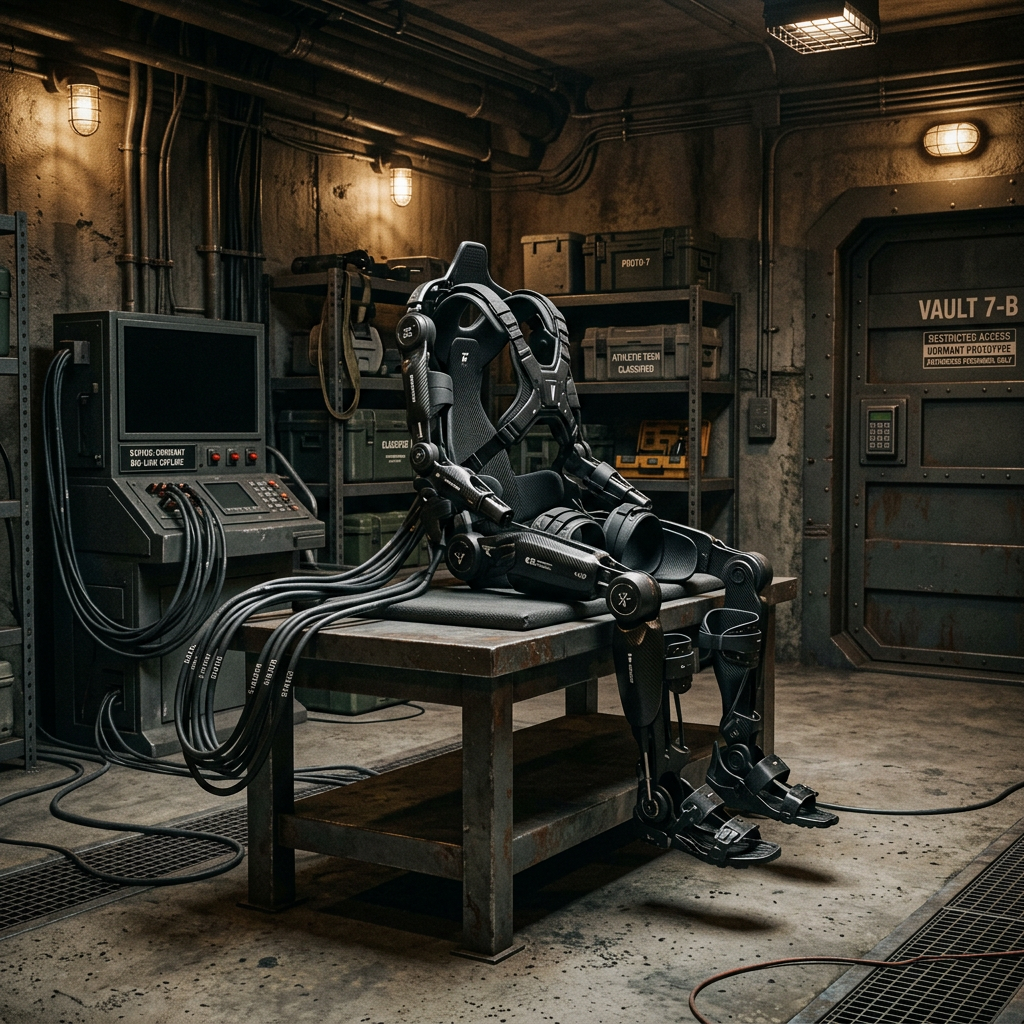
Imagine a world where a handful of elite Olympic coaches could, with uncanny accuracy, predict the champion of a major event years before the torch was ever lit. This wasn’t science fiction; it was a bizarre, closely guarded footnote in sports history from the mid-2000s, an era of clunky flip phones and nascent broadband. Behind that accuracy lay a piece of technology so profound in its implications that its deliberate suppression may have altered the course of our century. They called it “The Crib.”
The Silent System: SportTech That Could Predict Success
More than just a smartwatch or a biometric tracker, The Crib was a revolutionary, holistic approach. It analyzed athletes not as collections of physical data, but as complex adaptive systems. Its core innovation was a predictive stress resilience algorithm.
By analyzing:
- Biometric Flow: Not just heart rate, but the interaction between heart rate variability, cortisol levels, and galvanic skin response during simulated high-pressure events.
- Cognitive-Load Mapping: Tracking decision-making speed and accuracy as physical exhaustion increased, identifying the precise “fracture point” where mental performance would collapse.
- Environmental Acclimatization Data: Modeling how an individual’s physiology would react not just to altitude or heat, but to specific combinations of time-zone shifts, unfamiliar food, and crowd hostility.
The system generated a singular, proprietary metric: the Resilience Quotient (RQ). Coaches who had clandestine access to early prototypes reported that an athlete’s RQ score at age 18 was a more reliable predictor of their peak Olympic performance potential than any existing scouting method. It was the ultimate talent-identification and risk-mitigation tool, a multi-million-dollar advantage hidden in plain sight as training software.
Unveiling the Crib: The Decade-Old Prototype Betrayed
The Crib’s journey from secret weapon to forgotten relic is a tale of corporate overreach and bureaucratic fear. Developed by a small, visionary firm named NeuraDyne Labs, the system was shown at a private demo to a consortium of sports federations, broadcasters, and a single, deep-pocketed venture capital firm.
> The initial report from the demo stated: “The Crib doesn’t just find champions; it renders the traditional, decade-long talent development pipeline economically obsolete.”
This was the seed of its undoing. The potential disruption was too vast. Sports governing bodies, with their entrenched funding models and political hierarchies, saw an existential threat. Broadcasters feared that predictable outcomes would kill the drama—and ratings—of live sport. The lone VC firm, Pandora Capital, saw the true, terrifying potential: The Crib’s core algorithms for modeling human stress and decision-making under duress had applications far beyond the track or pool.
A Network of Interests Who Burned the Future
Pandora Capital didn’t invest. They acquired NeuraDyne through a shell company and proceeded to quietly smother the project. They orchestrated a brilliant, malign betrayal:
- Patent Trolling and Sequestration: They buried the foundational patents in a maze of legal shell games, making the technology legally untouchable for competitors.
- Narrative Warfare: They funded dubious “scientific” studies questioning the ethics of such predictive analytics, framing it as a dehumanizing technology that robbed sport of its soul.
- The Golden Handcuffs: The key engineers and data scientists were offered exorbitant salaries to work on “other projects,” like optimizing ad-click rates and consumer behavior modeling—effectively buying their silence and repurposing their genius.
The betrayal was complete. The sports world shrugged, the few whispers of a “super-system” faded into myth, and The Crib was consigned to a digital vault, its power diverted into making social media feeds more addictive and quarterly earnings reports more predictable.
The Global Collapse Directly to Our Doors
We are now living in the world that The Crib, had it been developed for its higher purpose, was designed to navigate. Consider its potential applications had it been championed as a public good rather than a proprietary weapon:
- Pandemic Modeling: What if, instead of just tracking infection rates, we could model population-scale stress resilience to predict compliance fatigue, mental health crises, or the societal breaking points of lockdowns?
- Climate Disaster Response: The RQ algorithm, scaled to communities, could have identified regions most vulnerable to the cognitive overload of repeated disasters, allowing for pre-emptive resource allocation and crisis counseling.
- Financial System Stability: At its heart, The Crib was about system failure prediction in complex human networks. The 2008 crash and subsequent shocks are quintessential examples of such failures, which the technology’s logic might have flagged years in advance.
Its principles weren’t about sport. They were about systemic resilience. We buried the compass just before entering the storm.
A Final Warning from the Prince’s Forbidden Dossier
A cryptic, unsent message allegedly written by a now-deceased NeuraDyne co-founder (codenamed “The Prince”) circulates in fragmented form among a tiny circle of legacy tech archivists. One passage stands out:
> “We built a lens to see the fault lines in human mountains. They took that lens and used it to find the cracks in a child’s attention span so they could sell them candy. They betrayed the crib, the very place where future strength is nurtured, for a handful of digital coins. When the real earthquake comes, they will have no warning. They chose to be rich in a burning house rather than architects of a fireproof one.”
The Crib’s story is not a nostalgic lament for a faster sprinter. It is a dire parable about short-termism. We had in our hands, fifteen years ago, a nascent framework for anticipating complex human-system collapses—from personal burnout to societal fracturing. We allowed it to be betrayed, not by a villain in a shadowy lair, but by a mundane network of financial interests allergic to disruption and blind to lateral value. That forgotten sports tech wasn’t meant to save the games. It was meant to save us from ourselves. The ultimate betrayal was our own complicit forgetfulness.
Leave a Reply