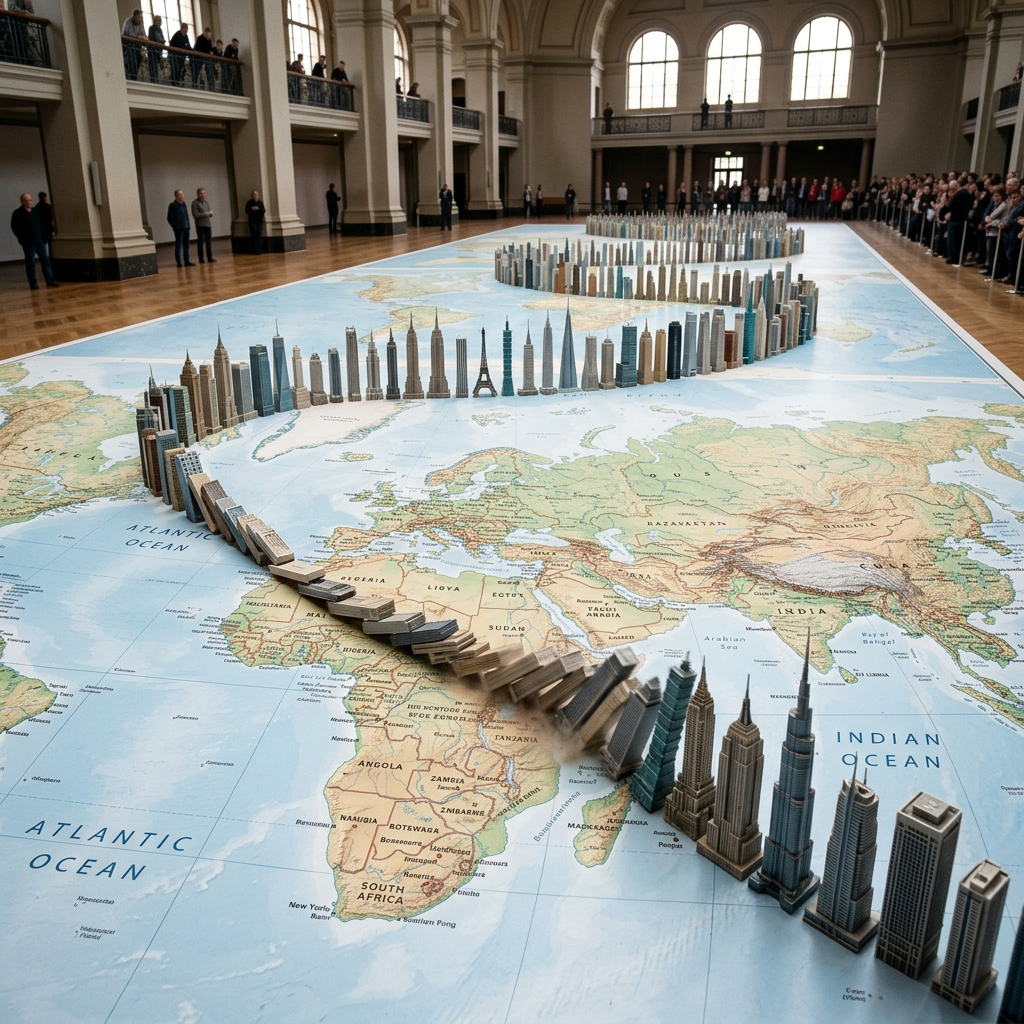
In the hushed boardrooms of global finance and the opaque halls of geopolitical power, a new archetype of anxiety has emerged. It is no longer the fear of a market crash or a single national default, but the systemic unraveling of a complex, interdependent architecture designed for stability. At the center of this slow-motion tremor lies a theoretical but profoundly illustrative case: the collapse of a once-proud Sovereign Wealth Fund brought low not by bad assets, but by a catastrophic failure of governance known as the “Babel Decision.” This is the story of how a quest for linguistic and operational purity fractured a financial giant and became a cautionary prophecy for our interconnected world.
The Sovereign Lament: A Leaked Prophecy from 2026
Imagine a document, dated 2026, marked “CONFIDENTIAL – POST-MORTEM” and leaked to a financial journalist. It begins not with balance sheets, but with a lament:
> “Our fund was not merely a pool of capital; it was a geo-financial instrument, a bridge between resource wealth and future generations, a stabilizer for our entire region. We have become a ghost in the machine we built.”
The fund in question—let’s call it the “Gulf-Oasis Intergenerational Fund” (GOIF)—was a model of 21st-century statecraft. With assets exceeding $800 billion, it diversified a hydrocarbon-dependent economy into global tech, infrastructure, and green energy. Its mandate was dual: generate wealth and underwrite regional economic stability through strategic partnerships and counter-cyclical investments. The leaked report reveals a deep, internal sorrow, a recognition that the fund’s demise was self-inflicted, a chosen path off a cliff disguised as a principled stand. The lament cites a turning point where institutional arrogance met political fragility, setting the stage for disaster.
Demise of the Engine: Who Killed Regional Stability?
The GOIF’s collapse had domino effects. It wasn’t just pension liabilities at risk; it was the very fabric of regional projects.
- Frozen Strategic Investments: Multi-national infrastructure projects, from a trans-desert solar grid to a pivotal port modernization, stalled overnight as capital calls went unanswered.
- The Credit Contagion: The fund’s sudden illiquidity triggered covenant breaches in its vast portfolio, spooking international lenders and causing a sharp repricing of risk for the entire region’s sovereign debt.
- The Geopolitical Vacuum: Rival powers, previously kept in check by the GOIF’s balancing investments, rushed to fill the void, leading to a scramble for influence that destabilized long-standing, fragile alliances.
- Domestic Political Unrest: At home, the public revelation of the fund’s troubles shattered the social contract built on the promise of perpetual, wisely managed wealth, leading to widespread protests.
The autopsy points the finger not at a rogue trader or a market collapse, but at the Fund’s highest governing body—the Council of Stewards. Their fatal error was a systemic one, a failure of vision and communication that poisoned every subsequent action.
“The Babel Decision”: Choosing Chaos Over Clarity
In early 2024, seeking to project strength and “cultural sovereignty,” the Council of Stewards passed Resolution 144, later dubbed the “Babel Decision.” Its core dictates were:
- Mandated Linguistic Fragmentation: All internal reporting, risk assessments, and strategic memos for the Investment Committee were to be presented only in the native language of each individual stewardship member, with no requirement for a standardized translation. A member from Riyadh would receive documents in Arabic, one from Oslo in Norwegian, and one from Singapore in Mandarin—with no guaranteed unified English or common executive summary.
- The Demise of the “Lingua Franca”: English, the operational “technical lingua franca” that had allowed the fund’s diverse, global team of analysts to communicate with precision, was officially discouraged at the leadership level.
- Siloed Information Channels: Decision-making papers were routed through separate, language-specific secretariats, each with its own interpretative biases and political allegiances.
The rationale was national pride and “decolonizing finance.” The reality was operational paralysis.
> “We sacrificed clarity at the altar of symbolism,” the leaked report states. “A nuanced risk assessment about over-exposure to synthetic biofuels does not survive translation through three linguistic filters without becoming three different reports.”
The Babel Decision created a fog of misaligned information. Critical warnings about liquidity mismatches in the portfolio were lost in translation. Votes on major asset allocations were based on fundamentally different understandings of the underlying proposals. The fund’s executive team, trying to serve multiple masters receiving different information, became ineffective. The “Single Source of Truth” was shattered.
Aftermath: Global Wealth and the Ghost of Babel
The GOIF’s unraveling sent a seismic shock through the world of sovereign capital. Its ghost now haunts every major fund.
- The Primacy of Governance Linguistics: Boards now obsess over “protocol cohesion”—the explicit rules ensuring all decision-makers operate from an identical, unambiguous data set, regardless of their native tongue.
- The Rise of the “Protocol Czar”: A new executive role has emerged, tasked not with investment strategy, but with safeguarding communication integrity and verifying that comprehension is unified before any vote.
- A Warning Against Political Operationalism: The case study is taught as the definitive example of allowing short-term political or cultural statements to corrupt long-term operational integrity. Sovereign funds are reasserting firewalls between their governance and the political whims of their sponsors.
The true legacy of the Babel Decision is a stark reminder that in an era of dizzying complexity, the most valuable asset is not a mineral right or a tech stock, but shared understanding. The GOIF did not fail because it bet on the wrong future; it failed because its leaders could no longer describe the present to one another with accuracy. They chose the tower of pride over the foundation of clarity, and in doing so, they turned a mighty engine of stability into a lesson for the world: without a common language of truth, even the greatest fortunes are just words on a page, destined to be misinterpreted into oblivion.
Leave a Reply