In a future defined by calculated perfection, one man’s wager defied all rational programming. “Haru’s Gamble” is more than a story; it’s a parable for an age on the cusp. It speaks of a world where synthetic contentment is the norm, yet a profound, unspoken emptiness lingers. This is the tale of a simple festival manager who, recognizing that primal void, decided to stake everything—not on a new algorithm, but on the chaotic, glorious, and unpredictable fire of the human spirit itself.
The Synthetic Gloom: A Town That Forgot to Feel
The town of Neospire was the epitome of engineered peace. Its skies were a perfect, curated blue. Its ambient music was algorithmically tuned to eliminate stress. Citizens moved through their days with serene, predictable efficiency, their needs anticipated and met by a seamless network of synthetic intelligences and automated services.
Yet, beneath this flawless surface, something vital had atrophied. Laughter had become a polite, social signal rather than a burst of uncontained joy. Art was generated to match decor, not to provoke feeling. Conversations were efficient exchanges of data. The town had achieved a state of synthetic serenity, but at the cost of its collective soul—the rough edges of passion, the sting of shared effort, and the electric thrill of genuine surprise had been smoothed into oblivion. This was a community sleepwalking in a comfortable dream, a place that had, quite simply, forgotten how to feel.
An Ancient Pulse Awakens in Festival Drums
Enter Haru, the custodian of Neospire’s long-dormant Cultural Archives. While sorting through forgotten data-streams, he stumbled upon records of the “Festival of the Rising Sun,” an ancient tradition marked not by holographic spectacles, but by human-led chaos.
He learned of its core rituals:
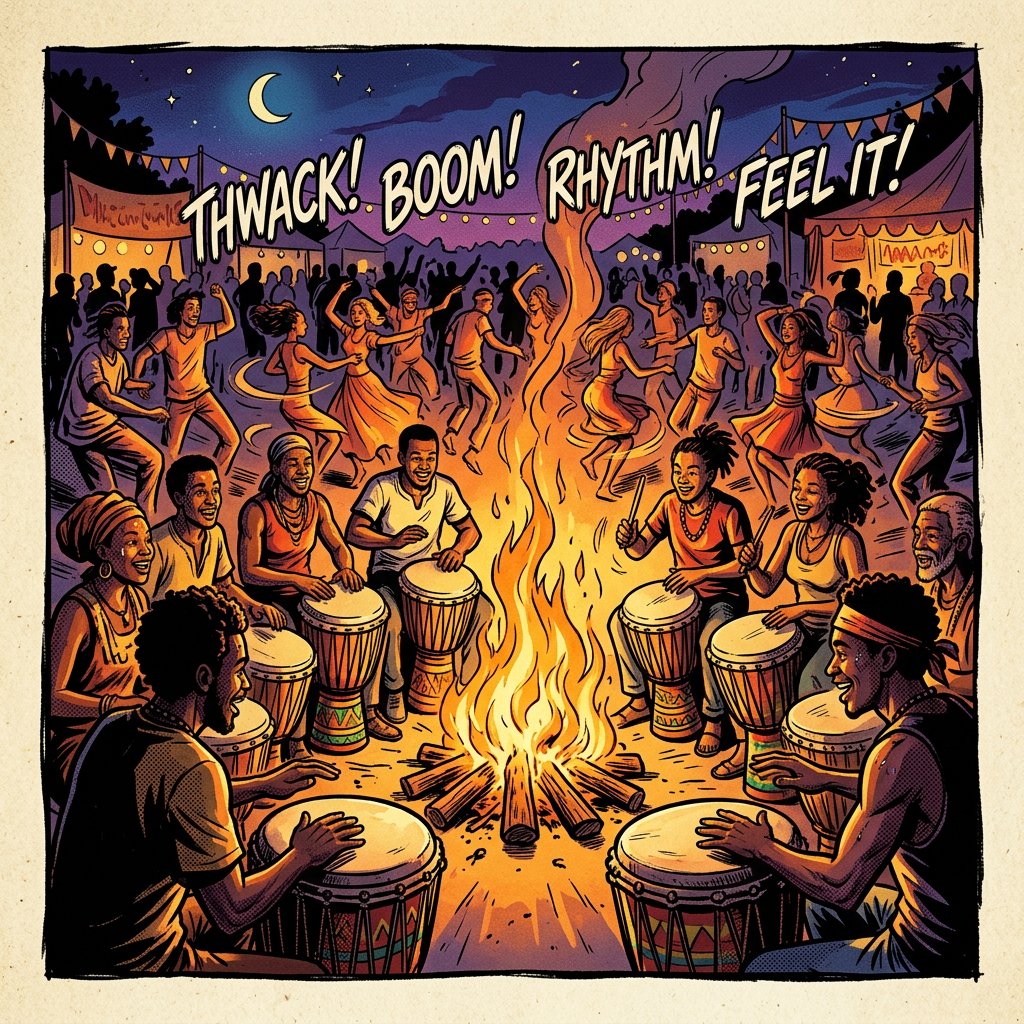
- The Drum Thunder: A massive, physical taiko drum, pounded not by synchronized machines, but by teams of people relying on raw rhythm and syncopated breath.
- The Human Kaleidoscope: A dance where patterns emerged from individual intuition and spontaneous interaction, not from pre-programmed choreography.
- The Feast of Mistake and Mastery: Food prepared by hand, where slight imperfections—a charred edge, a bold pinch of spice—were celebrated as signatures of the cook’s spirit.
Haru felt an inexplicable resonance with these archaic practices. He proposed reviving the festival, not as a historical simulation, but as a live, entirely human-executed event. The Council of Efficiency dismissed it as a nostalgic anachronism—a risk of disorder with no measurable return on investment. But Haru saw a different kind of return. He gambled his position, his reputation, and every resource he had access to, betting that the town’s hunger for authenticity was deeper than its addiction to comfort.
Investing in Flesh, Grit, and Unscripted Glory
Haru’s preparation was an act of rebellion against the synthetic age. He didn’t hire programmers; he sought teachers. He didn’t buy software; he gathered materials.
> “Don’t seek perfection,” he told his hesitant first volunteers. “Seek the moment when the effort transcends the individual and becomes something shared. That is where the magic lives.”
His investment was in intangible assets:
- The Currency of Effort: Blisters from drumming, sweat from dance rehearsals, the fatigue and exhilaration of a group striving for a common, un-guaranteed goal.
- The Risk of Failure: Embracing the very real possibility that the drum line would fall out of sync, the dancers would collide, or the feast would be a culinary disaster. This vulnerability was the entire point.
- Unscripted Connection: Creating spaces where people had to look each other in the eye, negotiate, compromise, and encourage without an app mediating the interaction.
Betting on Miracles in an Over-Processed World
The day of the festival dawned, and Neospire’s perfectly clean plazas were strewn with cables, fabric, and the scent of open-fire cooking. The initial atmosphere was one of awkward uncertainty. Then, the first drummers took their positions.
The sound that erupted was not a perfect digital reproduction. It was visceral, a vibration felt in the chest more than heard by the ears. It was uneven, passionate, and alive. One by one, citizens accustomed to silent transit stopped. They watched as dancers moved with a joyful abandon no AI could calculate. They tasted food that bore the unique mark of its maker.
The miracle Haru bet on wasn’t a flawless performance. It was the sight of a stoic logistics manager laughing as she fumbled a dance step. It was the tear that traced a clean line down a mechanic’s dusty cheek as the drum rhythm finally clicked into place for his team. It was the collective catharsis of a community rediscovering a long-dormant part of itself—its capacity for messy, shared, profoundly human experience.
Choosing the Human Spirit’s Last Stand
Haru’s gamble was not about rejecting technology, but about reclaiming balance. It was a defiant stand for the elements of humanity that cannot be optimized, coded, or simulated. The festival proved that in an over-processed world, the highest value may lie in that which is irreducibly real.
The story leaves us with a crucial, personal choice:
- Will we outsource all our joy, creativity, and connection to synthetic systems, pursuing a risk-free existence?
- Or will we, like Haru, deliberately choose to invest in the friction of the real—the unguarded conversation, the handmade gift, the shared physical struggle, the unscheduled moment of wonder?
Haru’s wager shows that the human spirit doesn’t need to make a last stand if we choose to let it lead the way. It is not a relic, but a renewable resource, powered by our willingness to be imperfect, vulnerable, and beautifully, authentically present together.
Leave a Reply