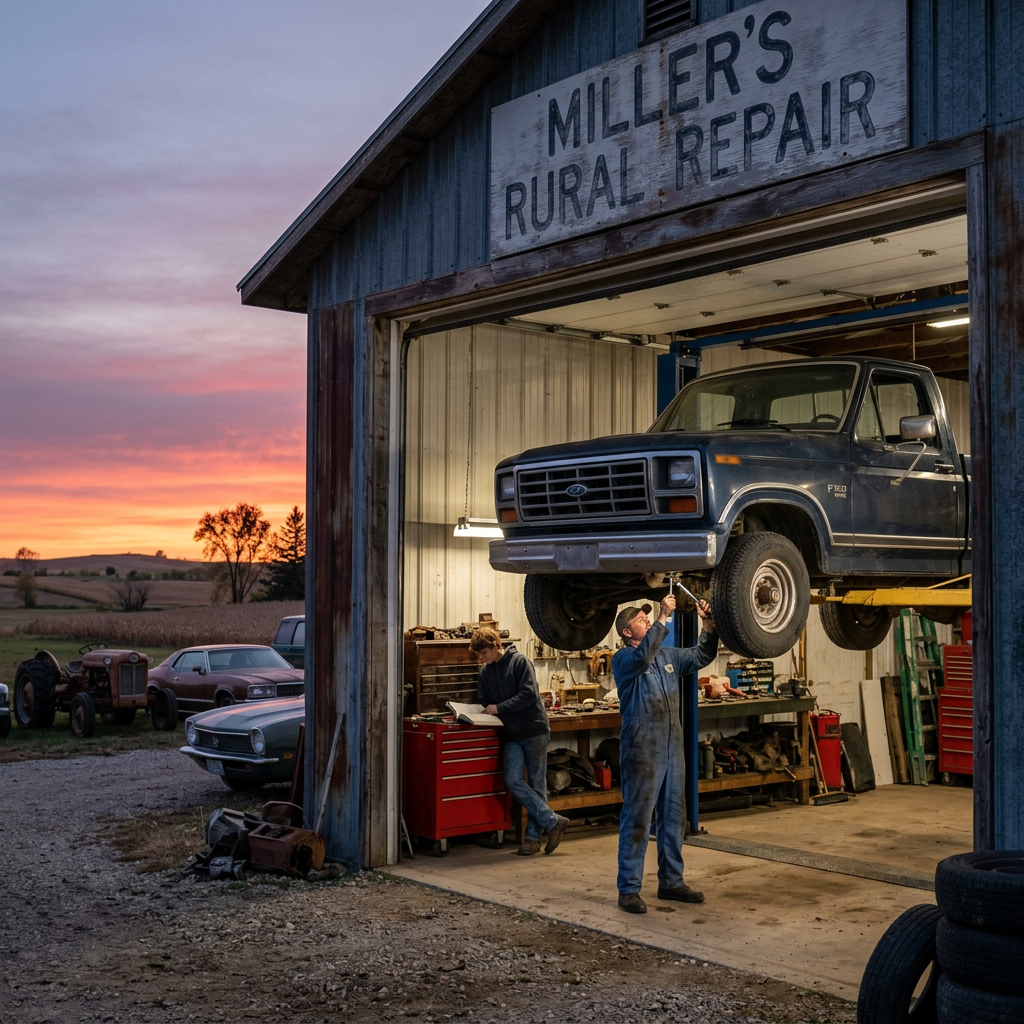
In the vast, shimmering expanse of the Australian outback, the measure of things has a different weight. Where the red dust settles on everything, the digits on a spreadsheet can feel utterly alien. For Tom “Greasy” Barrett, a mechanic of forty years in a tin shed station a hundred klicks from the nearest town, the notion of truth was something you calibrated with a wrench and a feel for metal. It was a world away from the glowing screens and silent, humming rooms of distant accountants and analysts. Until a series of events, born of a broken vehicle and a cracked system, folded these worlds together, forcing a raw, unforgiving realization: the honest numbers weren’t found in ledgers, but etched in the earth and sweat of a hard day’s work.
A Cracked Oil Pan and Corrupted Commodity Prices
It started with an oil pan. The Cooper kid had driven his ute through a washed-out creek bed, punching a hole in the thin steel. As Greasy welded on a patch, listening to the boy’s woes, he heard a story he’d heard a dozen times that season. The family farm was bleeding money. The official commodity price for their wool was listed as stable, even favorable.
> “The numbers on the market report are for a clean, perfect bale in a city warehouse,” Tom grunted, shielding his eyes from the welding arc. “They don’t have a column for ‘dust-stained, trailer-tied, and desperate to sell before the bank calls’.”
Greasy’s realization was this: the key terms globalized commodity pricing had created a layer of abstraction so thick it rendered the local reality invisible. The “honest” price on a screen was corrupted by a dozen unseen factors—algorithmic trading, futures speculation, logistics costs that quadrupled out here. The real number, the one that dictated if the Cooper family ate or not, was the local effective price, a figure forged from:
- Diesel costs for a three-hour round trip to the carrier depot.
- The 5% “remote handling” fee the depot tacked on.
- The discount for smaller, inconsistent bales that didn’t fit the automated grading system.
This wasn’t accounting; it was a friction tax on distance, paid in sweat and silence.
The Silent Efficiency of Biometric Servers
Around this time, a government “efficiency” initiative rolled out. To streamline remote welfare and licensing, they installed a biometric server in the town’s shire office. It used fingerprint and facial recognition for instant verification—no more paperwork. From a city planner’s desk, the metrics were a dream: processing time cut by 80%, error rates near zero, operational efficiency maximized.
But from Greasy’s shed, the view was different. Old Mick, a stockman with fingers worn smooth and scarred by wire and reins, couldn’t get the scanner to read him. Mary, who managed the roadhouse, had her login fail because the satellite link feeding the server was throttled during the afternoon heat haze—an infrastructure dependency invisible to the system designers.
> “You can’t metric away humanity,” Tom would muse, wiping grease on his overalls. “That machine sees a failed authorization. I see Mick, who can break a wild colt but can’t persuade a blinking box he exists.”
The server’s numbers were flawless and honest within its sealed, air-conditioned reality. But they were brutally dishonest about the world they were meant to serve—a world of scarred hands, unreliable sky-links, and people for whom “efficiency” meant a twenty-minute chat that solved three problems at once.
Odometer Turnovers Versus Training Heartbeats
Greasy’s workshop was the unofficial archive of the district’s physical truth, and nothing told a truer story than an odometer. He saw vehicles that had rolled over the 999,999 km mark, resetting to zero—a badge of honor in the dust.
Meanwhile, corporate clients from the mines sent their gleaming, company-owned trucks for service. Their maintenance logs were digital perfection, adhering to strict schedules of predictive maintenance analytics. But the numbers lied. They didn’t capture:
- The young apprentice who was being cycled through the mine’s mechanic bay every six months for “workforce optimization,” never gaining the deep, intuitive knowledge of a specific fleet.
- The safety training checkboxes, dutifully ticked, that couldn’t measure the instinct to check the brake lines after a particular type of corrugated road.
- The embodied skill metric—a lifetime of vibrations felt through a steering wheel, of smells diagnosed in hot engine air—that no onboard computer could quantify.
The odometer turnover was an honest testament to endurance and care. The training “heartbeats”—the logged hours and completed modules—were often just phantom pulses, measuring activity, not capability.
Truth Calibrated in Sweat, Not Algorithms
The epiphany crystallized one stinking-hot afternoon. A mining exec, stranded with a faulty sensor in his luxury 4×4, watched Greasy bypass the entire computer system with a wire and a clip, diagnosing the issue not with a code reader, but by the timbre of a relay’s click.
“The manual says that sensor should read 4.3 volts,” the exec protested, showing his tablet.
“The manual’s in California,” Greasy replied without looking up. “The heat here makes the solder brittle. The number is right. The thing is wrong. The truth is in the thing.”
For Greasy, ground-truthed data wasn’t downloaded; it was accrued. It was the smell before the rain, the specific squeak of a ball joint on a particular track, the weary slump of a farmer’s shoulders that told a more accurate story than his balance sheet. This tacit knowledge quantification was the only math that mattered under the unflinching outback sun.
He realized our world is increasingly managed by numbers that are honest in their internal logic but profoundly dishonest in their relationship to physical reality. They are clean, efficient, and scalable—and they smooth over the vital, life-giving grit of local truth.
Conclusion
The red dust, Greasy learned, is a great auditor. It infiltrates everything, testing seals and revealing weaknesses. In the same way, the relentless, tangible realities of distance, weather, and worn human hands test the integrity of our numbers. “Honest Numbers in the Red Dust” aren’t about perfect digital records or globally averaged prices. They are the local, hard-won, and often unglamorous figures calibrated in sweat, intuition, and a deep fidelity to the thing itself—whether it’s a tractor, a farm’s income, or a man’s worth. They remind us that before a number can be true, it must first be real, written not just in code, but in the very earth beneath our feet.
Leave a Reply