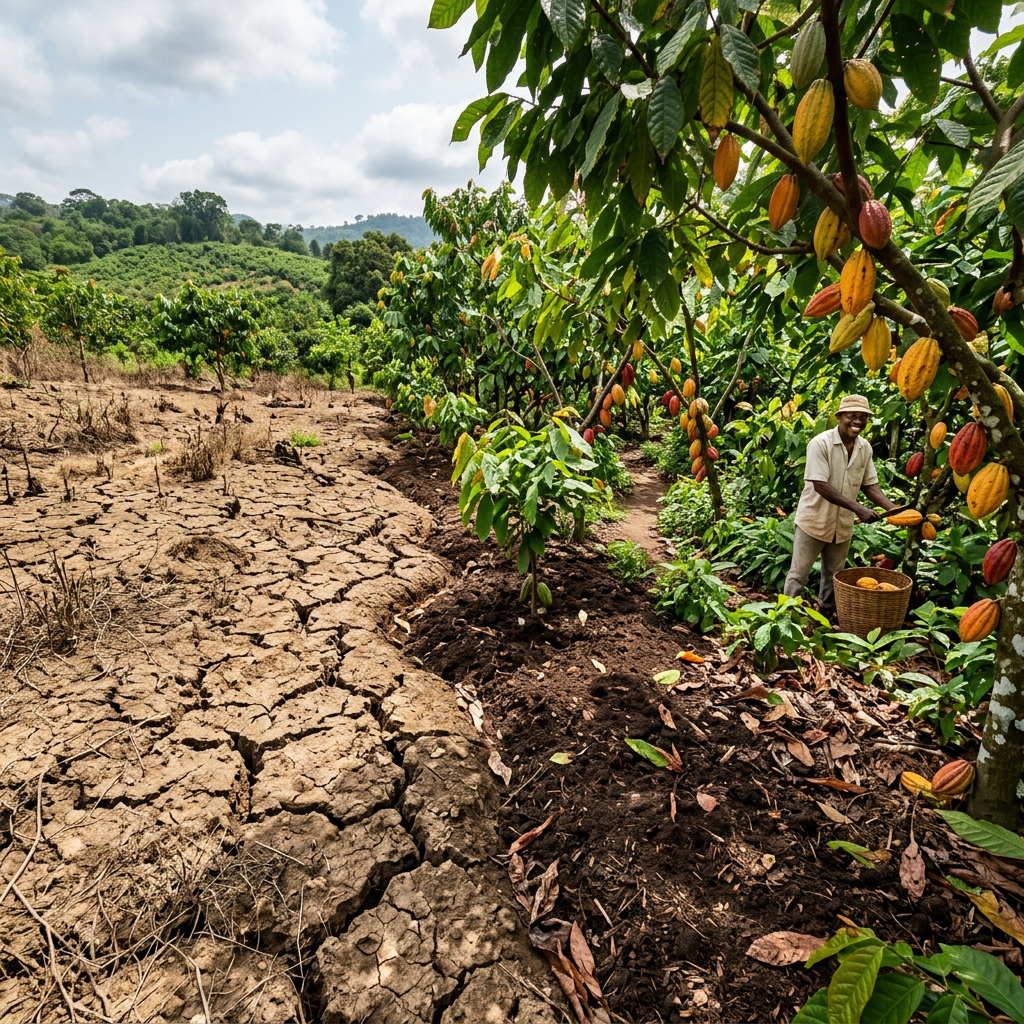
The arid winds of misfortune that have swept across the Sefwi Wiawso region for generations are finally being silenced. For decades, the people here have lived under the shadow of a deeply entrenched curse—a cycle of poverty, desperation, and a peculiar relationship with truth that has stifled progress. Yet, from the roots of the very cocoa groves that once symbolized struggle, a new chapter is emerging. This is the story of a community moving from the trembling earth of uncertainty to the solid ground of a market of truth, where value is finally placed on substance over superstition.
The Trembling Earth of Sefwi Wiawso
In the heart of Ghana’s cocoa belt, the land of Sefwi Wiawso has always been a place of paradox. The soil is rich, capable of yielding golden pods of cocoa beans that fuel global markets. Yet, for the local farmers, that richness often translated into bitter poverty. The cocoa groves, passed down through generations, became symbols of a broken promise—a trembling earth where one could never stand firmly.
- Land tenure disputes over fragmented family plots.
- Volatile global cocoa prices that left farmers at the mercy of middlemen.
- A deep-seated belief in ill luck and curses, which stunted entrepreneurial risk.
- A culture of silence where truth was often sacrificed for social harmony, masking exploitation.
The curse wasn’t metaphysical; it was systemic. It was a curse of opacity—where no one knew the true value of their crop, where land deeds were lost to memory, and where a farmer’s hard work was erased by a broker’s lie. The earth itself seemed to tremble under the weight of this collective deception.
A Scroll of Fire and a Market of Truth
The breaking point came not with a whisper, but with a scroll of fire—a metaphorical blaze that burned through the old ways. This wasn’t a literal inferno, but a radical shift in consciousness. Community leaders, alongside agricultural reformers, demanded a new kind of commerce. They envisioned a Market of Truth, a space where transparency was the only currency.
This market is not a physical location but a set of principles reshaping the local economy:
- Real-time pricing boards displayed publicly, eliminating secret deals.
- Digital land registries using blockchain technology to ensure clear ownership.
- Direct buyer-to-farmer contracts, cutting out exploitative intermediaries.
- Community truth-telling circles, where historical grievances about land and profits are aired and reconciled.
As one elder put it:
> “For every lie that was told in the shade of the cocoa tree, we now speak a truth in the sunlight. The scroll of fire burned away the deception, and from its ashes, we built a market where a man’s word is his bond.”
Investment Over Chance: Breaking the Curse
The old way was a gamble. A farmer would pray for rain, hope for a good price, and often lose. The curse of the region was the gambling mindset—a reliance on chance because the system was too broken to trust. The curse-breaking strategy was simple yet revolutionary: replace chance with investment.
Here is how the shift happened:
- Micro-loans were tied to verifiable farm data, not tribal loyalty.
- Cocoa seedlings were distributed based on soil quality tests, not favoritism.
- Educational workshops taught farmers to calculate profit margins instead of relying on gut feelings.
- Collective bargaining was established, so a single farmer’s misfortune no meant ruin for a whole family.
This was the antidote to the curse. By investing in truth, the community invested in its own future. The trembling earth stabilized under the weight of data, contracts, and shared accountability.
Order From Chaos: The Overflowing Cup
The results are not theoretical—they are tangible. The Market of Truth has brought order from chaos, and the once-empty cups of the farmers are now overflowing.
- Crop yields have increased by an average of 40% since the introduction of transparent fertilizer and seed distribution.
- Farmers’ incomes have risen from erratic to predictable, with some families breaking cycles of debt that stretched back three generations.
- Land disputes have dropped by over 70%, as the digital registry provides irrefutable proof of ownership.
- Youth migration to cities has reversed; young people now see a future in the cocoa groves because the market rewards honesty.
> “When truth is the only game in town, everyone wins,” says Akua Mensah, a farmer who now mentors others. “My grandmother used to say we were born with a curse on our backs. Now I tell my children we were born with a shovel—and the truth is the soil we plant in.”
A Generation’s Gambling Curse, Finally Broken
The most profound victory is not economic, but cultural. The gambling curse—the deep, generational belief that success is a matter of luck—has been broken. The people of Sefwi Wiawso no longer see their future as a dice roll. They see it as a ledger, a contract, a harvest.
- Children now learn financial literacy in school alongside farming techniques.
- Parent-teacher associations use the same transparency tools that revolutionized the cocoa trade.
- Artists and storytellers are reclaiming the narrative, replacing tales of betrayal with ballads of redemption.
The curse, in the end, was simply a lack of trust. And trust, like cocoa, must be cultivated. Today, from the groves to the markets, the air is different. It smells of fertile earth, yes, but also of possibility.
Conclusion
From the trembling earth of Sefwi Wiawso has risen a Market of Truth. The journey was not easy; it required scorching old lies with a scroll of fire and replacing chance with deliberate, honest investment. But the curse is broken. The generation that grew up learning to distrust the world is now teaching its children to build it. The cocoa groves no longer weep; they yield. And the market, once a place of shadows, now shines with the simple, powerful light of truth.
Leave a Reply