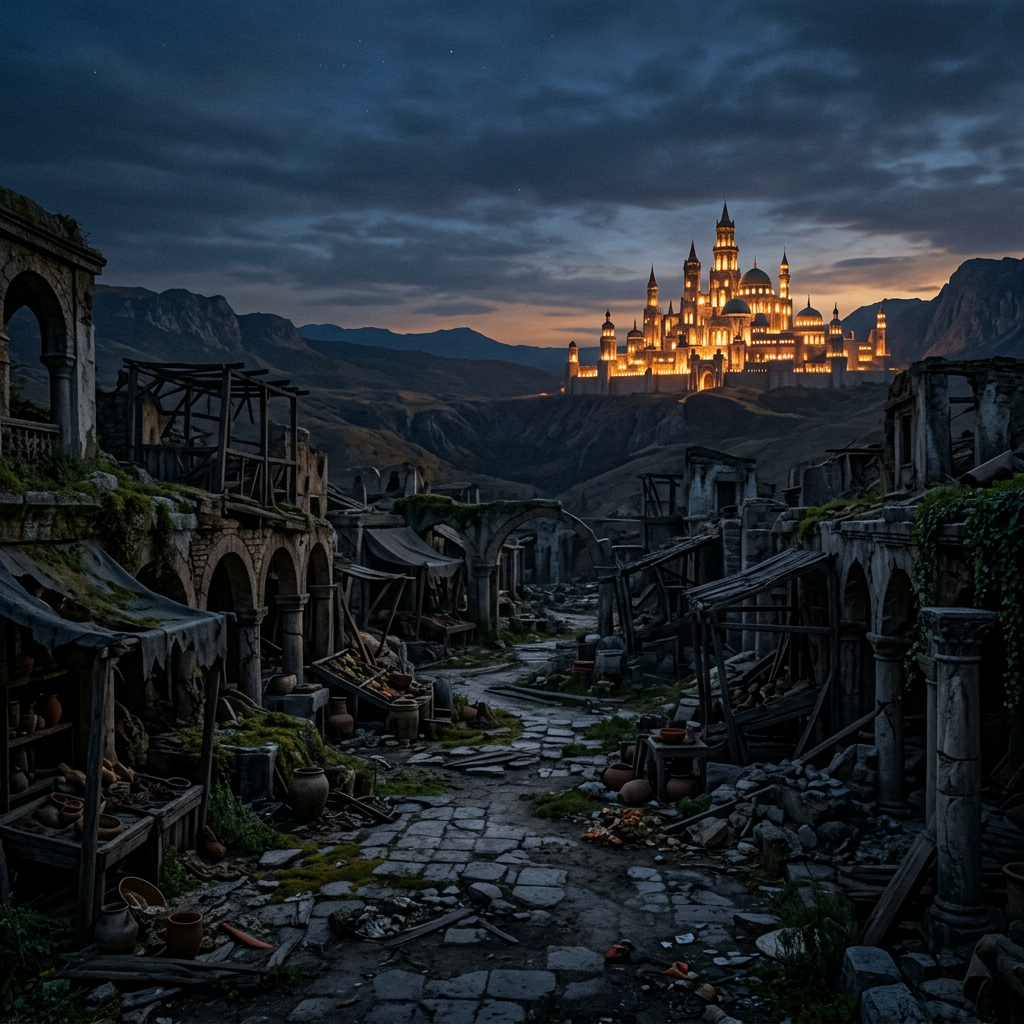
There are moments in history that feel like the hinge of the world—a single breath where everything shifts, old certainties shatter, and the sky itself seems to rewrite its laws. The fall of the Wager-Thrones was one such moment. It was not a silent collapse, but a cataclysm announced by a sound no one who heard it could ever forget: the Seventeenth Trumpet. This is the story of that sound, the prophecy that preceded it, and the strange market that refused to tremble.
The Trumpet Sound: Ice and the Splintering Sky
When the Seventeenth Trumpet rang, it did not feel like a musical note. Survivors describe it as a physical tear in the fabric of the air. The sound came not from above, but from within—as if the very ice beneath the northern glaciers had been taught to sing in a key of doom.
- The initial blast was accompanied by a flash of white-hot lightning, followed by a suffocating cold.
- For three minutes, the sky fractured into tessellated shards, each pane reflecting a different timeline.
- Birds fell from the sky, not dead, but frozen mid-flight, suspended like trophies of a forgotten god.
Those who witnessed the event from Húsavík reported a peculiar detail: the trumpet sound seemed to slow their hearts, as if time itself was taking a bow. The splintering sky was not a metaphor—it was a canvas of splintered reality, and the Wager-Thrones were its first casualties.
Scrolls of Frost: A Prophecy Carved in Lightning
Long before the Trumpet sounded, there were whispers in the traders’ halls and among the scribes of the high passes. They spoke of the Scrolls of Frost—prophecies etched not into parchment, but into the very ice of the eternal glaciers. These scrolls were said to be written by a prophet who had seen the end of wagers and the rise of unshakable truths.
> “When the sky is taught to splinter, and the thrones of chance are hollowed out, the righteous shall not waver. The market of the just will stand, its pillars unmade of gold, but of honor.”
- The Scrolls predicted the Seventeenth Trumpet as a sign of judgment against those who traded in hollow promises.
- Each Trumpet was said to correspond to a form of corruption, and the seventeenth was the Trumpet of Reckoning.
- Lightning was not merely a vehicle for the prophecy—it was the ink, carving words into the clouds that could be read by those with the eyes to see.
Many dismissed these scrolls as myths or madmen’s ramblings. But when the sky cracked, and the thrones fell, the few who had memorized the frost-written verses wept—not from sorrow, but from the terrible certainty that prophecy is simply memory written in advance.
Where Thrones of Wager Rose, Now Rubble Reigns
The Wager-Thrones were not physical chairs; they were institutions, systems built on the philosophy that risk could be eternalized. They were temples to speculation—where merchants wagered not goods, but futures, reputations, and even memories. Their power lay in their promise that no bet could be lost, only deferred.
When the Trumpet sounded, the logic of those systems collapsed.
- The Great Exchange of Varnhold—once the heart of the wager economy—imploded in a silent tremor. Its marble columns turned to dust, not from fire, but from a sudden, profound stillness.
- Thrones of debt and credit crumbled into rubble that whispered old promises to the wind.
- Those who had built their lives on the art of the deal found themselves clutching worthless contracts, now merely paper.
Rubble reigned, but it was not a reign of chaos alone. There was an eerie silence among the ruins—a deference to the fact that something more permanent had fallen: the illusion that chance could be mastered by cleverness alone.
The Righteous Market: Unshaken Amid the Fall
While the Wager-Thrones fell, one market stood firm. It was not the richest, nor the loudest. It was the Righteous Market—a network of traders who valued trust over leverage and substance over promise. Their transactions were based on goods in hand, honor in word, and a simple rule: never wager what you cannot afford to lose.
- The Righteous Market did not speculate on futures; it traded in present necessities.
- Its pillars were not forged of contracts, but of relationships tested by time.
- During the fall, it did not boom or bust—it simply continued, like a heartbeat that knows no panic.
> “A righteous trade is not a gamble,” reads an old market saying. “It is a handshake that has already happened in the heart.”
Those who stood in the Righteous Market during the Trumpet’s blast did not flee. They paused, checked their scales, and continued. Their stability was not magic; it was the natural outcome of a system that had never traded in illusion.
Húsavík’s Witness: How the World Broke Apart
Of all the places that saw the fall, Húsavík—the small harbor town on the edge of the frozen sea—held the clearest memory. The town’s fishermen and stonemasons were not philosophers, but they saw the sky cracking with their own eyes. They heard the Trumpet as a low, grinding hum that vibrated through their boats and homes.
- The church bells of Húsavík rang spontaneously, though no hand pulled the ropes.
- The sea receded for half a mile, leaving behind a floor of shattered ice and forgotten coins.
- An old woman named Sigrún claimed she saw the lightning-carved prophecy reflected in a bucket of meltwater.
What Húsavík’s witnesses could not explain was the aftermath. When the sky mended and the rubble settled, the world felt different. The air was cleaner. The shores were quieter. Something had been washed away, and in its place, a new kind of silence settled—one that felt less like loss, and more like permission to begin again.
Conclusion
The fall of the Wager-Thrones was not the end of the world, but the end of a world built on the love of risk without consequence. The Seventeenth Trumpet was a clarion call to remember that some things are too important to be gambled—trust, honor, and the simple truth of a fair trade. As the rubble of the old thrones slowly turns to soil, the Righteous Market continues, a quiet testament that when the sky splinters and the ice sings, what remains is always the foundation we built with integrity, not chance.
The world broke apart that day, but from every break, something honest found room to grow.
Leave a Reply