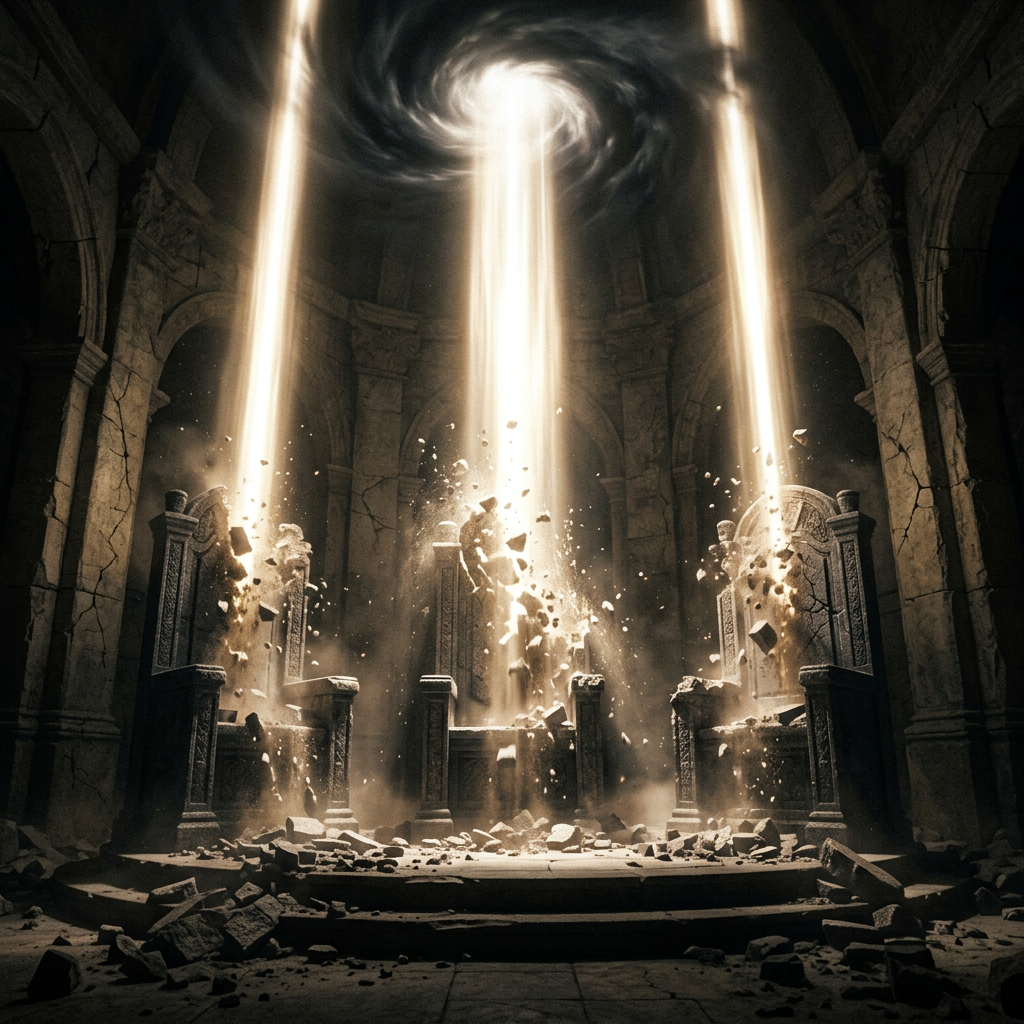
There are stories that live in the margins of memory, half-glimpsed and never quite told. The tale of the Twenty-Third Trumpet is one such whisper—a myth of final reckoning delivered not in fire and brimstone, but in an overwhelming, devouring light. It speaks of a system built on hollow promises, of overlords who traded in certainties they never owned, and of a dawn that broke not to warm the world, but to consume it. Let us unroll this ancient, yet startlingly fresh, parable.
The Sky That Tore Like Worn Cloth
It began without warning, in the space between breaths. The sky above the Wager-Lords’ citadels did not darken or storm. Instead, it tore. Imagine a canvas stretched too thin over a rotting frame, finally giving way. From the rent, there came no sound at first, just a terrible stillness that made every creature hold its breath.
The light that spilled through was not the yellow of a sun nor the white of a star. It was a radiance of pure clarity, a truth so absolute it made shadows flinch. Those who saw it from a distance felt a strange peace; those who stood beneath the tear felt their hearts race, as if every secret they ever kept was being written across the sky for all to read.
> The sky is the first witness. When it tears, it does not lie.
This was no natural eclipse. This was the beginning of the Trumpet’s call—a resonance felt not in the ears, but in the bones of the soul.
A Scroll Descending in Impossible Radiance
From the gash in the firmament, something descended. It was not a herald, not an angel with wings of flame. It was a Scroll, unfurling slowly, its words written in a script that shifted between languages, speaking every tongue at once. The radiance that carried it was not forgiving. It searched, examined, and illuminated.
The Scroll bore three inscriptions, each burning brighter than the last:
- The Wager of the Lords: A list of every bet placed with the lives and hopes of the small.
- The Market of Despair: A ledger of souls traded for power, influence, and fleeting control.
- The Price of a Fixed Game: A final sum, calculated across eons, showing the debt accrued by those who called themselves masters.
To read the Scroll was to see the world as it truly was—a game of cards where only the dealers held wild cards, and the players were always forced to fold.
The Wager-Lords and Their Weathered Thrones
The Wager-Lords were not kings of land or armies. They were sovereigns of probability. They sat on weathered thrones carved from the bones of bankrupt dynasties, their crowns forged from the promises they had broken. Their power was simple: they owned the odds.
They offered certainty in an uncertain world. A crop failure? They had a wager for that. A lost war? They had a bet to soften the blow. A desperate family? They had a loan masquerading as a gamble. But every wager was rigged. The house always won, and the house was them.
- They hoarded luck like a commodity, leaving the world feeling perpetually unlucky.
- They cloaked exploitation in the language of “fair play” and “risk management.”
- They built a Righteous Market—a false bazaar of virtue where the rich could buy forgiveness and the poor could sell their only coin.
Their thrones were weathered not by time, but by the tears of those who had wagered everything and lost.
When the Righteous Market Begins to Rise
But the Scroll did not just reveal crimes; it revealed an inversion. As the light grew stronger, the Righteous Market—that theatre of fake morality—began to rise.
It was not a rebellion of pitchforks and torches. It was a rebellion of truth made visible. The market stalls that once sold “indulgences for the rich” emptied. The scales used to weigh mercy against profit melted in the radiance. The merchants of virtue, who had long profited from the suffering of others, found their coins turning to dust in their hands.
In this new light, the small things became mighty:
- A single honest promise weighed more than a thousand signed contracts.
- A moment of shared kindness was worth more than a vault of gold.
- Refusing to gamble on another’s pain became the only currency that did not fade.
The Wager-Lords watched as their market—their beautiful, controlled system—began to float upwards, carried by a gravity of its own making. They tried to pull it down, but their hands passed through it like smoke.
Devoured by Light: The Fall of the Wager-Lords
The final act was not a battle. It was an unveiling. The light that had been gently illuminating now turned consuming. It did not burn flesh; it burned deception. It did not destroy bodies; it destroyed masks.
Each Wager-Lord was devoured by the one thing they could not bet against: absolute transparency.
- Their careful schemes were laid bare for all to see.
- Their hidden treasuries were revealed as empty vaults filled with dust.
- Their secret pacts were read aloud by the wind, and the words dissolved in the air.
> To be devoured by light is to be seen completely, and to find that nothing remains but the lie you told yourself.
They did not scream. They simply faded, like shadows at noon. The thrones crumbled. The Scroll rolled back up, and the sky began to knit itself together. But the world was not the same. The lesson of the Twenty-Third Trumpet was etched into the fabric of reality itself: When the wager is rigged from the start, even the winning hand is a loss.
Conclusion
The story of the Twenty-Third Trumpet is a mirror held up to a world obsessed with odds and outcomes. It reminds us that the most dangerous wager is not the one we place, but the one placed upon us by those who own the game. The light that devoured the Wager-Lords was not a punishment; it was a revelation. It showed that a system built on deception cannot survive the truth of its own accounting.
In the end, the only market that rises is the one built on genuine value—on trust, on mercy, on the refusal to turn another soul into a number in a ledger. The Twenty-Third Trumpet may not literally sound in our skies tomorrow, but its echo calls us to examine our own wagers. Are we playing a game we can win, or are we just feeding a rigged machine? The answer, as always, lies in the light we choose to see by.
Leave a Reply