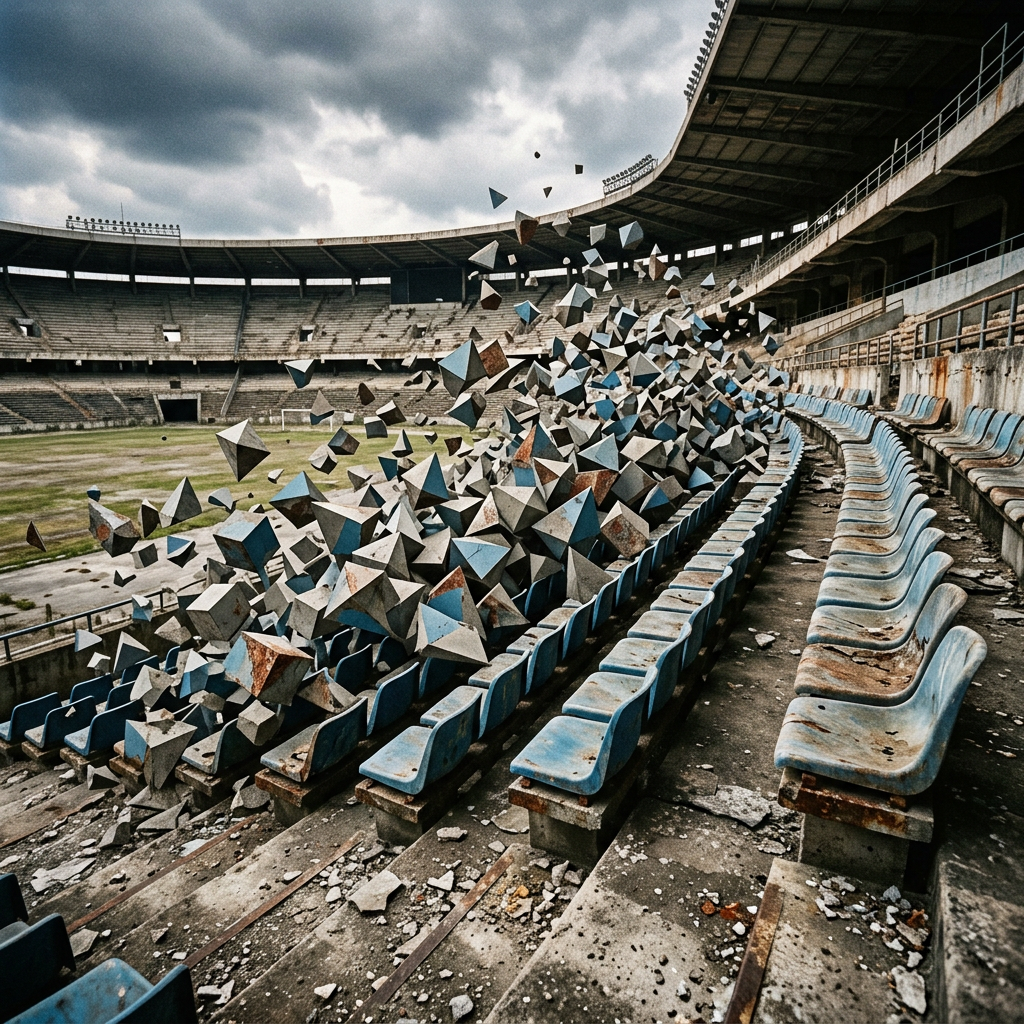
The Phantom Drills of Kurganinsk’s Empty Arena
There is a place in southern Russia, in the town of Kurganinsk, where the air still hums with the ghost of competition. The arena stands—concrete, echoing, and hollow. No crowds cheer, no athletes sprint. But if you listen closely, you can hear the phantom drills: the rhythmic thud of feet on a track long since cracked, the sharp whistle of a coach who has no team. This is not a story about sports. It is a story about promise abandoned.
The empty arena is a monument to a particular kind of human tragedy: the moment when a society decides that the game is no longer worth playing. The drills were real once—young bodies pushing limits, lungs burning with purpose. Now, only the wind runs the laps. The silence is not peace; it is a warning.
> A society that stops training for excellence does not merely stagnate—it decays. The empty arena is the first tombstone of a civilization.
When a Civilization Trains Only for the Game
Every culture has its arenas—physical, intellectual, moral. We train for the game of life through education, discipline, and shared ritual. But what happens when we forget why we train? When the exercise becomes the final product, and the purpose fades into spectacle?
History offers stark examples:
- The Roman Colosseum became a theater of blood, where the games were an end in themselves, not a preparation for virtue.
- The Olympic ideal once linked physical prowess to philosophical wisdom; today, it often devolves into commercialized idolatry.
- Modern universities increasingly trade rigorous training for credentialing, producing graduates who can recite facts but cannot think critically.
Kurganinsk’s empty arena is not an exception—it is a mirror. We train only for the game when we prioritize image over substance, ranking over growth, and profit over purpose. The result is a hollow structure: impressive from the outside, but deadly silent within.
> When the game becomes the goal, you win nothing but the applause of ghosts.
Echoes of the Spectator: The Void Left by Gambling
What draws people to watch a game they no longer play? In Kurganinsk, the arena’s emptiness is not solely due to economic collapse or dwindling youth populations. It is also due to a gambling of attention—a trade of real participation for passive consumption.
Consider the parallels:
- Digital addiction: Countless hours spent watching others compete in video games or sports, while our own bodies grow weak and our skills atrophy.
- Financial gambling: Risking real resources on outcomes we cannot control, chasing the thrill of the vicarious win.
- Cultural voyeurism: Consuming dramatic narratives of success and failure, while our own lives remain untrained and unchallenged.
The void left by gambling is not the absence of money or time. It is the emptiness of being a spectator to your own existence. The arena stands full of echoes—each one a person who chose to watch rather than to run, to bet rather than to sweat, to applaud rather than to compete.
> You cannot cheat the game of life. If you gamble on the sidelines, the only loss is the version of yourself you could have become.
The Arena’s Warning to a Collapsing Society
The empty arena in Kurganinsk is not merely a local tragedy. It is a prophet of collapse speaking in the language of concrete and rust. Signs of a society heading toward ruin are visible long before the final collapse:
- Declining physical fitness: A population that cannot run, lift, or endure becomes a population that cannot defend, produce, or innovate.
- Erosion of discipline: When training becomes optional, character becomes a suggestion, not a requirement.
- Loss of shared purpose: Without an arena to gather, communities fracture into isolated spectators, each consumed by their own screen.
- Normalized shortcuts: Doping, cheating, and exploiting rules replace honest effort, because the outcome matters more than the process.
Each of these is a crack in the foundation. The arena’s warning is clear: a civilization that celebrates only the final score will soon have no players left.
> The arena does not collapse because of one bad season. It collapses because a generation forgot to tie their shoes and show up for practice.
Lessons from the Silent Practice of Our Own Ruin
So what can we learn from the phantom drills and the silent stands? The lessons are not abstract—they are immediate and personal.
- Rebuild the arena within yourself. You don’t need a stadium to train. Your body, your mind, your character—these are the fields where the real game is played. Start the drill today.
- Reject the spectator economy. Turn off the stream, close the betting app, and step onto the field. Life requires participants, not critics.
- Redefine winning. The scoreboard lies. The only true victory is showing up, again and again, in the face of indifference and decay.
- Teach the next generation to practice, not just to perform. Skill is forged in the mundane, repetitive grind. Let them love the grind more than the trophy.
- Listen to the silence. When you encounter emptiness—a forgotten arena, a neglected talent, a broken community—do not turn away. That silence is a counterbalance to the noise of distraction. It asks: What were you meant to build here?
The ghost of Kurganinsk’s arena does not haunt us. It trains us. The drills never really stop—they just wait for someone willing to run them again.
> Every echo is a call. The question is not whether you can hear it, but whether you will answer.
Conclusion
The empty arena stands as a monument to what we risk losing: not just games, but the discipline, purpose, and community that training requires. The phantom drills remind us that civilization is not kept alive by spectators or gamblers. It is built, brick by brick, practice by practice, by those who show up before the applause begins.
Do not let the arena stay empty. Lace up your shoes. Begin the drill. The echo of your footsteps may be the only sound worth hearing.
Leave a Reply