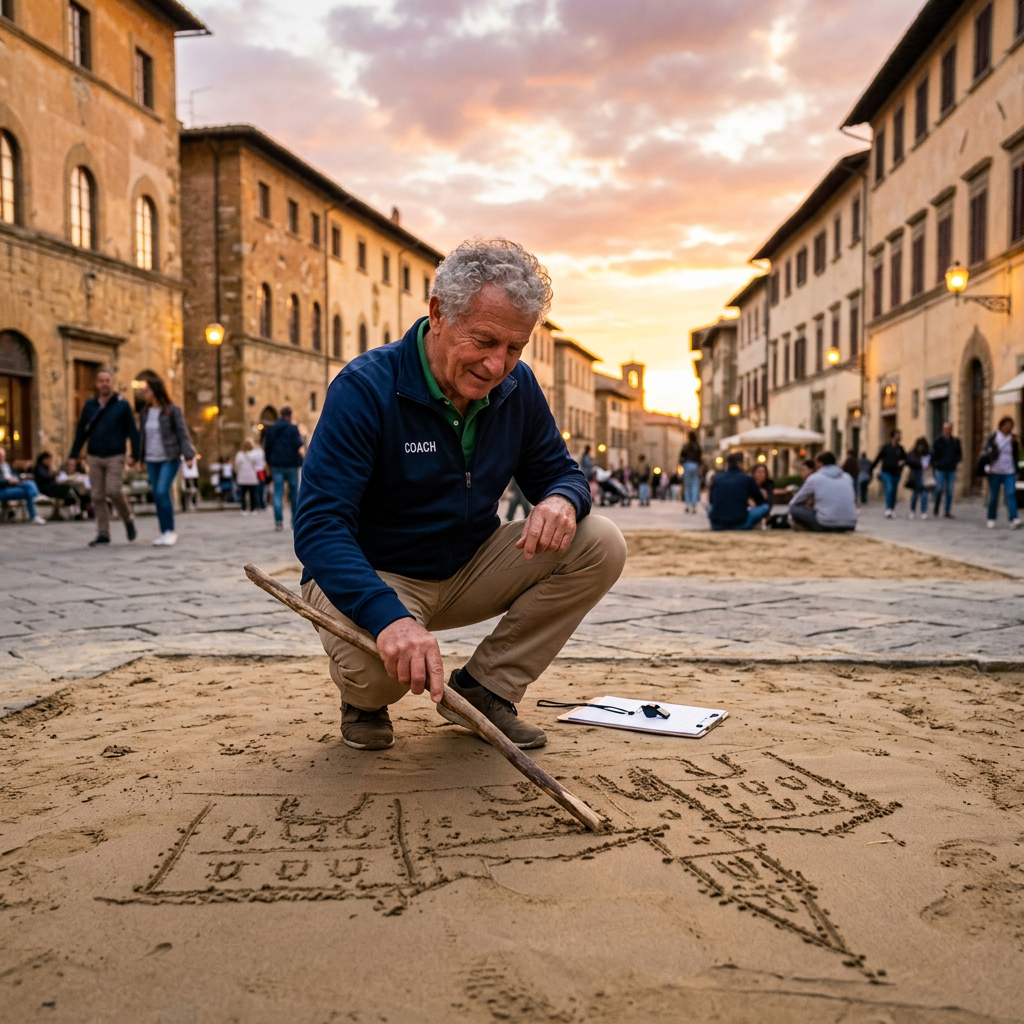
It wasn’t a speech, a law, or a raid that broke gambling’s grip on our town. It was a crooked line scratched into the dirt by a man in worn-out sneakers. Coach Malik never saw himself as a revolutionary. He was just a retired physical education teacher who knew the feel of a soccer field better than the inside of a bank. But when the slot machines began whispering to our sons and the card tables swallowed our fathers’ savings, he picked up a stick and started drawing. What he sketched in the dust that day would become the blueprint for our survival.
The Coach Who Drew Our Future in Dirt
Coach Malik arrived at the town square three years ago, on a Friday that felt like a funeral. The air was thick with the smell of stale cigarettes and broken promises. Men who used to laugh now only stared at their phones, checking betting odds. He didn’t call a meeting or hand out pamphlets. Instead, he knelt down on the hard-packed earth near the old fountain. Using a dry palm frond, he began to draw.
His first sketch was a simple circle. Inside it, he wrote the word “Home.” Then, with a few scrapes, he added lines radiating outward—like a sun—towards the edges of the square. “This,” he said to the few kids watching, “is where we start. Home is the center. Everything else goes from here.”
- He drew a library with a slanted roof, and under it, he scribbled “Stories.”
- He drew a workshop with tools hanging on the wall, and under it, “Hands.”
- He drew a soccer pitch with two goal posts, and under it, “Breath.”
He didn’t mention gambling. He didn’t have to. The dirt drawing was a map of the life we had forgotten. It was an invitation to imagine a future that didn’t require a bet.
How Sand Sketches Brought a Town Together
The next week, a dozen people showed up. They brought sticks of their own. A woman named Fatima, whose son had lost his truck to a gambling debt, used her finger to trace a small garden next to the school. “This is for mint,” she said, “and for waking up early.”
The act of drawing in the dirt became our new ritual. Every evening after sunset, we would gather at the square. Coach Malik would clear the day’s drawings with the back of his hand, and we would start again. It was a temporary art—easily smudged by wind or a stray dog—and that was its power. We learned to build without owning, to share without hoarding.
> “You cannot gamble with something that is not yours to keep,” Coach Malik would say, using his stick to point at the fading lines. “These drawings belong to the town. They are the opposite of a loan.”
The sand sketches became a language. A curved line meant a new path. A triangle meant a shared shelter. A wavy line meant the river we would petition to clean. Every child in Ksar Hallouf learned to draw their hopes in the dirt before they ever wrote their names on paper.
Gambling’s Acid Rain: Melting Every Wall We Built
Of course, it wasn’t easy. Gambling had a four-year head start. It came dressed as opportunity. It built a shabby hall near the market with flashing lights and a coffee machine that ran 24 hours a day. It promised quick fixes for slow problems. It called itself “entertainment.”
But in reality, it was acid rain. It corroded everything it touched:
- Trust dissolved when a father lied about his paycheck.
- Family dinners vanished when the card game went until dawn.
- Children’s school fees became tickets to the next hand.
- Houses turned into pawn tickets.
- Friendships became debts.
The hall was a magnet. It pulled men away from the square where we were drawing. Some nights, only three or four of us would stay to trace lines in the dirt. Coach Malik never seemed discouraged. He would use the darkness to draw stars in the dust with the tip of his stick. “Look,” he would whisper. “We are still here. The drawings wait for us.”
From Dirt Drawings to a Blueprint for Survival
The turning point came when the gambling hall owner tried to buy the square. He wanted to pave it over for a parking lot. The town council, which had been quietly accepting his bribes, prepared to sign the papers. That night, Coach Malik called for a mass drawing. Everyone came.
We did not draw buildings this time. We drew our memories. We drew:
- The date of the first harvest festival.
- The shape of the old bridge that the gambling hall had been built to replace.
- The faces of the men who had lost everything.
- The names of the children who had left for jobs in the city.
- The path of the annual marathon that had once united three villages.
The entire square became a mosaic of grief and resistance. Tourists stopped to take photos. Reporters came from the capital. The story was not about a fight against gambling—it was about a town that remembered who it was.
The owner of the hall backed down. He could not argue against a map made of a thousand hands.
Rebuilding Ksar Hallouf, One Line in the Sand
Today, the gambling hall is a community center. We left the neon sign up as a warning. Inside, instead of card tables, there are easels and a small printing press. The dirt drawings are now permanent—transferred onto tiles and hung on the wall.
Coach Malik still kneels in the square every Friday. He draws new things: a proposed solar panel on the school roof, a new well, a bike path. The ritual continues.
> “A line in the sand is not a promise,” he told me last week. “It is a question. Are we willing to draw it again tomorrow?”
We are.
The stakes are no longer measured in money. They are measured in the sharpness of our sticks, the steadiness of our hands, and the firmness of the ground beneath our knees. We learned that the only way to win against a system that sells hope is to build your own—from the ground up, one line at a time.
Leave a Reply