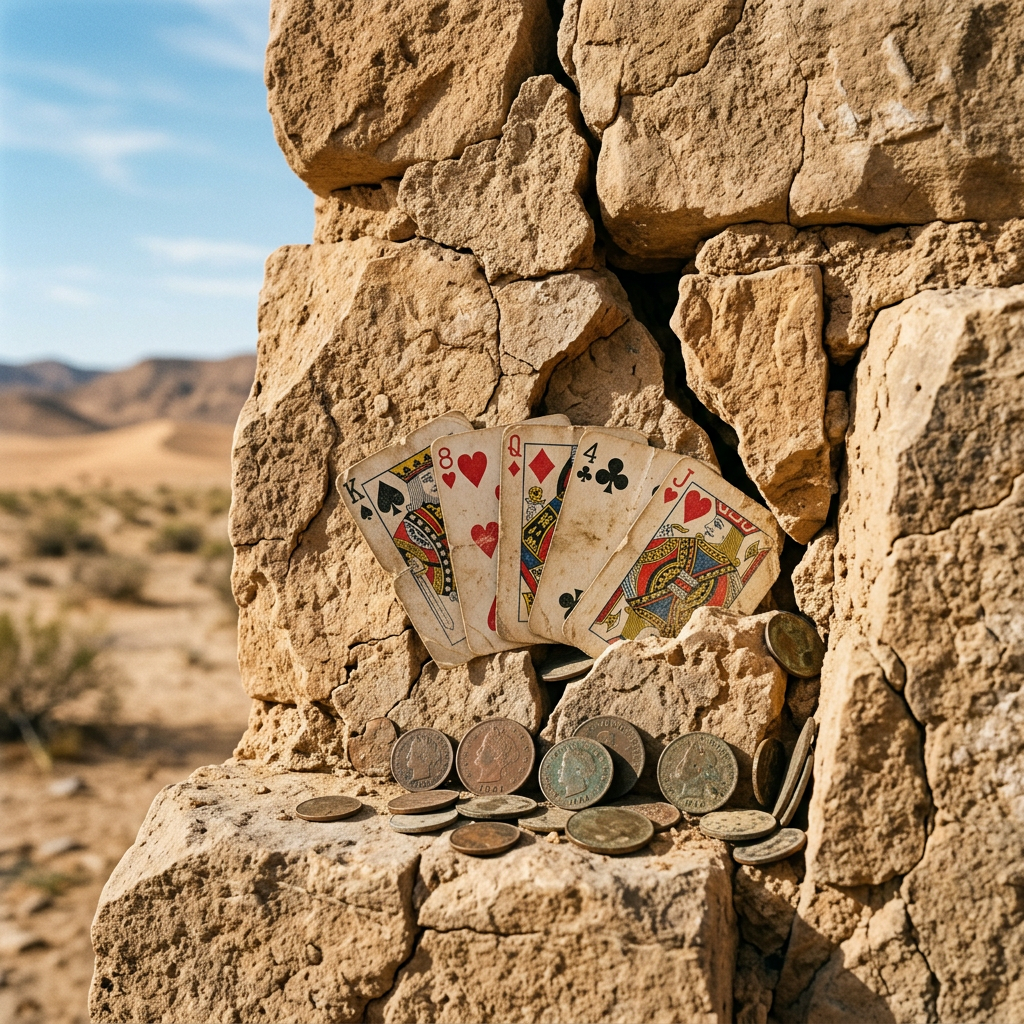
The Camel Herder Who Saw the Soldiers of Sand
Outside the town of Al-Miraj, where the sun scorches the earth into cracked pottery and the wind writes ephemeral poems in the dunes, lived a camel herder named Rashid. He was not a man of cities or laws, but a man of patterns—the patterns of stars, the shifting of sands, and the subtle changes in the wind’s smell. One evening, as the sun bled orange into the horizon, he saw something that did not belong. Not a mirage, but men—silent, moving in formation—carrying burdens that glinted like teeth. They were not traders, and they were not lost. They were the Soldiers of Sand, hired by syndicates to carve a path for illegal gambling into the town’s vulnerable heart.
It took Rashid three days to reach the town elder, his camel limping from thirst. He spoke of the breach before it happened, of a wall in the desert soon to be broken. No one laughed. They listened because a herder’s eyes are sharper than a merchant’s ledger.
Gambling’s Breach: A Wall in the Desert Town
Al-Miraj had always been a place of quiet resilience. Its people traded in dates, wool, and honest silver. But the breach came not with a bang, but with a whisper—a backroom game of cards in a tea shop, then another, then a tent on the outskirts that promised quick fortunes. Gambling crept in like a sand viper, silent and venomous.
> “A town that loses its money loses its soul. First the coin, then the family, then the honor.”
> — Old proverb, often repeated after the breach
The breach was not just a physical gap in the town’s boundary wall. It was a moral fissure. Young men began skipping work for dice. Wives argued over missing savings. The elders saw their community fraying like an old rope. The town’s council met in haste, but they lacked one thing: the will to act as a united front. That is, until they remembered the herder’s warning and the kingdom’s forgotten way.
The Kingdom’s Formation: Training Like Defenders
A decision was made, radical for a desert settlement: they would not call for outside soldiers or police. Instead, they would train a team of their own. They called it the Sand Guard—named not for their armor, but for their ability to endure. The team was made of unlikely recruits: a retired mason who knew every alley, a widow who had lost her son to a gambling debt, and the herder Rashid, who could read the desert like a map.
Their training was brutal and simple:
- Observation drills: Learning to spot a fixed game or a rigged table from fifty paces.
- Community rapport: Building trust so informants would speak freely, not out of fear, but of shared pride.
- Night patrols: Following the soldiers of sand by moonlight, tracking their supply routes for cards and whiskey.
- Conflict de-escalation: Using words, not weapons, to turn gamblers back to their homes.
> “We are not fighting men. We are fighting an idea—one that whispers ‘easy money’ and steals tomorrow.”
> — Widow Naima, first among the Guard
They trained for forty days and forty nights, until their hands were calloused and their eyes sharp. The town funded them with small offerings—a meal here, a lantern there. The kingdom of Al-Miraj was not a nation of armies; it was a family of defenders.
Sealing the Breach: One Practice, One Town Changed
The day of action came during the festival of the new moon, when gambling dens planned their largest haul. The Guard did not raid with force. Instead, they orchestrated a silent seal. They surrounded the main tent at dusk. Inside, cards were flying, coins clinking. Outside, Rashid lit a signal fire. One by one, the gamblers’ families appeared—wives, mothers, fathers—holding lanterns. No shouting. No violence. Just a circle of silent witnesses.
The gamblers froze. They saw their neighbors, their kin, standing in judgment without a single stone thrown. The dealers from the city panicked and tried to flee, only to find the paths blocked by the mason’s barricades. Within an hour, the tent was dismantled. The soldiers of sand were handed over to the district authorities. The breach was sealed, not with concrete, but with community courage.
This single practice—a silent, united stand—reverberated. Other towns in the region heard of Al-Miraj’s method. Soon, they sent delegations to learn. The town changed because the fear of gambling was replaced by the confidence of collective action.
From Gamble to Guard: The Town’s New Horizon
Al-Miraj did not become a fortress of suspicion. It became a model of prevention and pride. The Sand Guard evolved into a community watch that also taught financial literacy for young people, turning the urge for quick gain into long-term planning.
- The old gambling tent site became a public garden, planted with drought-resistant flowers.
- Rashid the herder was appointed an honorary advisor for border security.
- The town’s economy grew slowly, but it grew cleanly.
> “We learned that a town is not changed by walls, but by the hearts that guard them.”
> — Town elder, during the garden’s opening ceremony
The breach that once threatened to split Al-Miraj became the very crack through which light entered. From gamble to guard, from isolation to unity—this desert town did not just seal a wound. It found a new horizon, painted in the hues of loyalty and quiet strength.
Conclusion
The story of Al-Miraj is not a legend of heroes in shining armor, but of ordinary people—a herder, a widow, a mason—who saw the breach before it swallowed their home. They understood that gambling’s greatest weapon is secrecy, and they disarmed it with the simplest tool: community. It teaches us that when a society decides to stand together, even the deepest breach can be sealed—not by force, but by the quiet, persistent presence of those who care. The desert may be vast, but it cannot hide what a united town refuses to ignore.
Leave a Reply