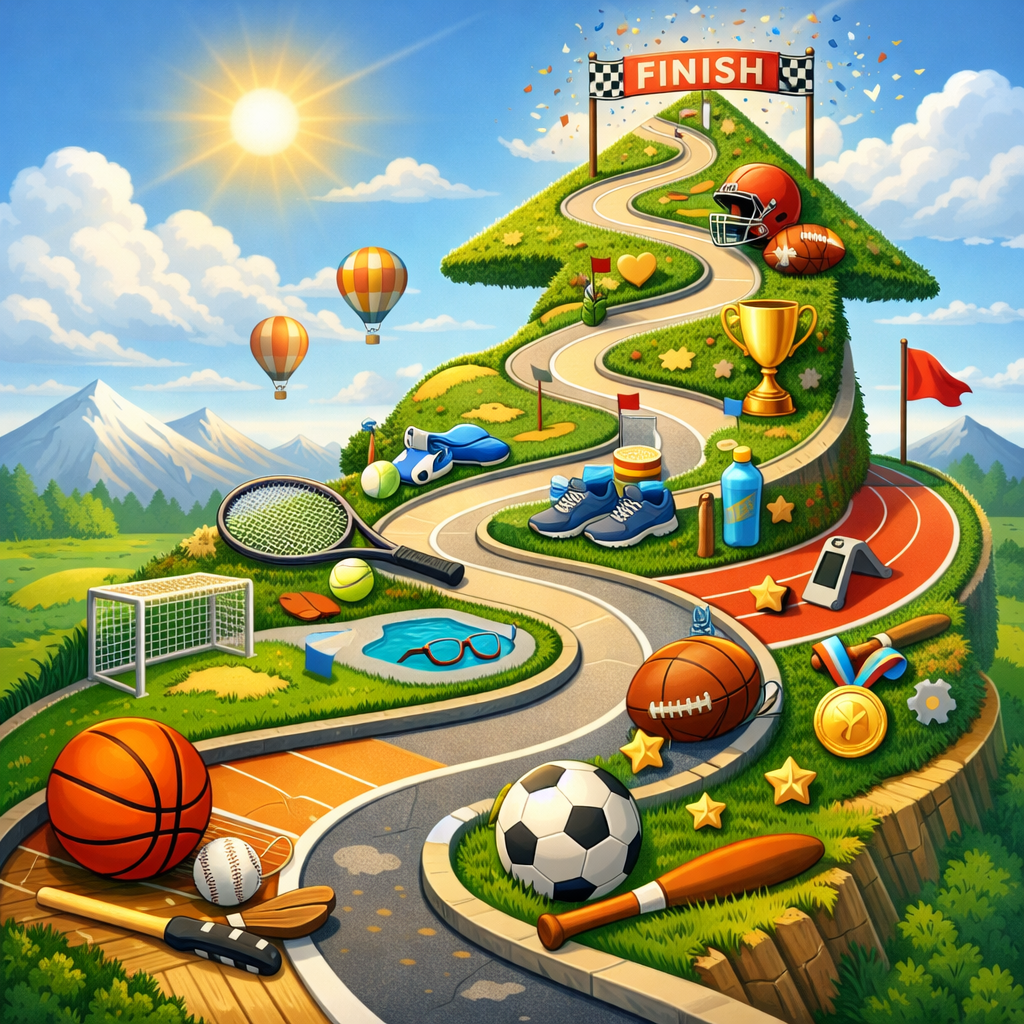
It all started with a map mishap. A courier van, laden with GPS coordinates for a nearby industrial estate, took a wrong turn on a rain-slicked evening. The package, meant for a logistics firm, ended up in the hands of our village elder, who opened it out of sheer curiosity. Inside wasn’t a shipment of spare parts—it was a detailed cartographic plan for a futuristic sports training zone. Someone, somewhere, had misrouted a top-secret blueprint. And that mistake, as you’ll see, turned our sleepy hamlet into an accidental powerhouse of athletic excellence.
The Misrouted Package That Changed Everything
The package contained a foil-lined envelope with no return address. Inside were laminated maps, sensor schematics, and a letter that began: “For the development of the East District Sports Megacomplex.” We had no district, no megacomplex, and certainly no budget for such ambitions. Yet the maps were mesmerizing. They detailed:
- Zoned training tracks with embedded pressure sensors.
- Altitude simulation chambers that could tweak oxygen levels.
- Recovery areas with hydrotherapy pools and cryo-capsules.
- Data hubs designed to analyze every stride, swing, and sprint.
The village council faced a decision: throw the maps away, or build it ourselves. With more enthusiasm than funding, we chose the latter. We sourced second-hand materials, repurposed an old barn, and used the blueprints as a rough guide. The project was a joke to neighboring towns—until it wasn’t.
Decoding the Map: A Sports Civilization Zone
As we dug deeper into the map’s legend, we realized it wasn’t just a training facility. It described a Sports Civilization Zone—a concept where athletics are woven into daily life, not gated off in stadiums. The map showed:
- Village squares redesigned as open-air gym stations.
- Footpaths upgraded to reactive running trails (with lighting that tracked your pace).
- Public spaces programmed for group drills, yoga, and team challenges.
> “The best athlete is not the one who trains the most, but the one whose environment trains them without them noticing.” — from the map’s margin notes.
This philosophy was our turning point. We stopped worrying about equipment and started focusing on habits. Every bench became a balance beam. Every staircase a timed sprint. The map taught us that sports excellence isn’t about a single arena—it’s a civilization-wide infrastructure.
Our Village’s Accidental Experiment in 2035
By 2035, our village had become a living laboratory. We had no elite coaches, no million-dollar sponsors. What we had was:
- Weekly community games that used the map’s scoring system.
- Dietary shifts inspired by the blueprints (local food, timed to training cycles).
- Sleep optimization using the map’s rest-zone recommendations.
- Peer coaching where villagers shared performance data via a shared dashboard.
The experiment wasn’t perfect. We had injuries, equipment failures, and moments of collective doubt. But the data started flowing. Kids who played in the “reactivity zone” (a repurposed tractor shed) showed faster reflexes. Adults jogging the sensor-tracked trails reduced their average mile time by nearly two minutes. The map, however misrouted, was a blueprint for human potential.
From Obscurity to Top Zone: The Unexpected Results
The first sign of change was a local marathon. Our team of fourteen village runners placed in the top twenty, surprising everyone—themselves included. Then came:
- Cyclists from our village winning regional trials.
- A teenager breaking a national record in the 100-meter dash.
- Tennis players emerging from a court we’d painted on a disused parking lot.
Sports journalists started calling us the “Top Zone” of the region. We were featured on a national sports network, and the original misrouted map became a legend. We learned that the key wasn’t the fancy equipment—it was the systematic design of our everyday space. The map had accidentally optimized our village for movement, rest, and competition.
> “Greatness isn’t born in a gym. It’s planted in the streets you walk every day.” — our village elder’s view on the miracle.
What We Learned About True Sports Excellence
Our accidental journey taught us several lessons that extend far beyond our village:
- Environment over coaching: A smart design beats a single star coach every time.
- Community over competition: Shared goals and peer support drove more progress than any leaderboard.
- Simplicity scales: We didn’t need million-dollar gear—just a good map and a willing team.
- Mistakes are maps: That misrouted package was the best thing to ever happen to us. Embrace errors—they might carry the blueprints you never knew you needed.
The Sports Civilization Zone concept has now been studied by universities and urban planners. Our village remains small, but its reputation as a top sports zone endures. And every time I see a courier van, I smile. Because sometimes, the wrong turn is exactly where you’re meant to go.
Conclusion
What began as a courier’s mistake became a testament to human ingenuity and community spirit. A misrouted map didn’t just reimagine our village—it redefined what a sports zone could be. We proved that true athletic excellence emerges not from elite facilities, but from intentional design, shared purpose, and the courage to build something with what you have. So next time you see a wrong delivery, think twice. It might be a map to your own top zone.
Leave a Reply