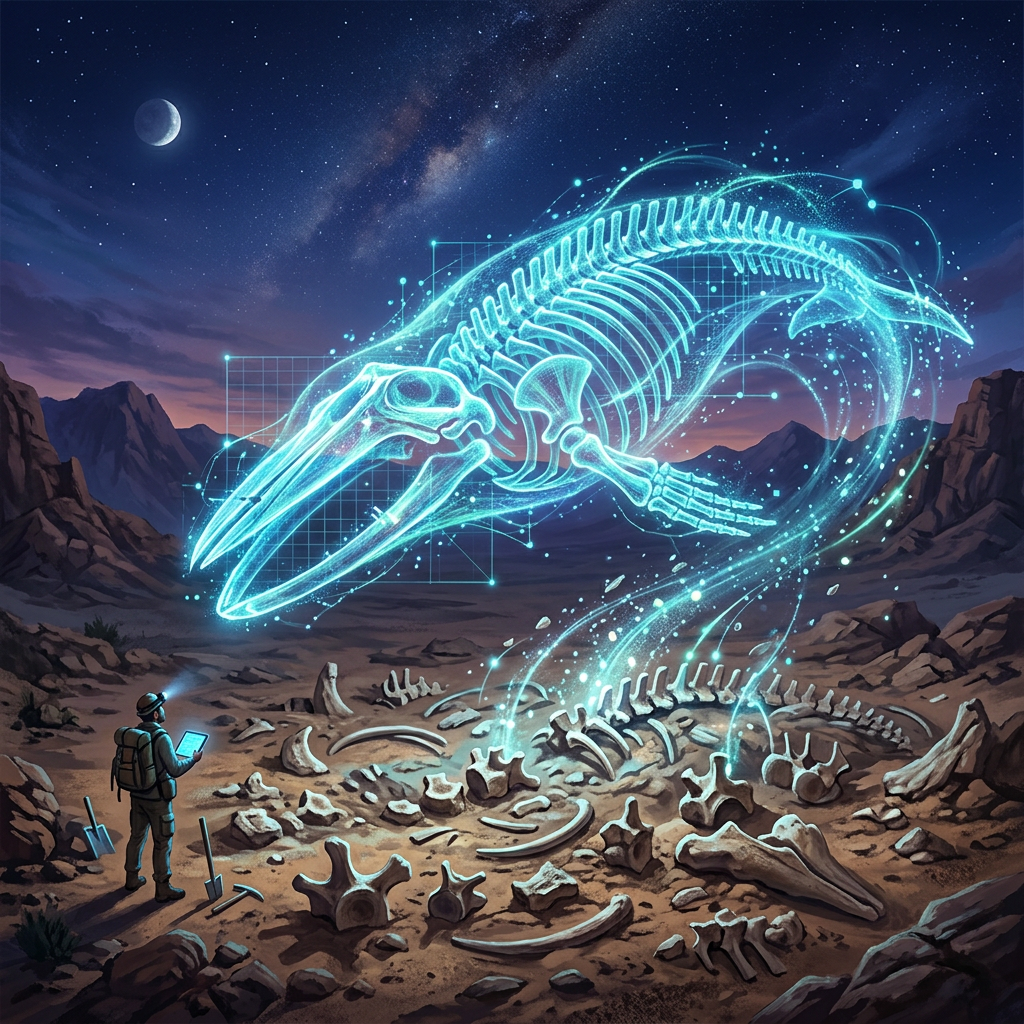
Imagine a vast, shimmering sea stretching across what is now one of the driest places on Earth. Forty million years ago, the Sahara Desert was an ocean. Whales with tiny legs and giant sharks swam above, while strange, prehistoric creatures crept along its shores. Today, that vanished sea is a graveyard of stone and sand, and scientists are using a new kind of ghost to bring it back to life.
This is the story of fossil bones, ancient mysteries, and the artificial intelligence that hears their whispers.
When Whales Ruled a Vanished Sea
The Tethys Sea was a warm, shallow ocean that cut through the supercontinent of Pangaea. In the region that is now the Egyptian Western Desert—specifically the Wadi Al-Hitan (Valley of the Whales)—this ancient sea left behind an incredible gift: some of the most complete whale fossils ever found. These weren’t the blue whales we know today. They were Basilosaurus and Dorudon, ancient whales that still had tiny, vestigial hind legs—a stunning piece of evolutionary evidence showing how land mammals returned to the water.
- Basilosaurus: A 20-meter-long predator with a serpentine body.
- Dorudon: A smaller, more dolphin-like whale that was often prey.
- Shark teeth: Thousands of Otodus shark teeth scattered like thrown dice.
This valley is a time capsule. But extracting information from it is painstaking work. A single fossil might take years to unearth, study, and describe. The bones are real, but the story they tell is fragmented.
The Fossil Whisperer: Bones in the Sand
Traditional paleontology is a craft of patience. A researcher on her knees, brush in hand, slowly revealing a vertebrae from the sandstone. Each bone is a clue. The curvature of a rib tells us how it breathed. The density of a limb bone tells us if it swam or walked. For decades, the only way to understand these clues was through human intuition and manual measurement.
But there are limitations. > “A single fossil is a point in space and time. We need a cloud of them to see the pattern.” — Dr. Marwa El-Sayed, paleontologist.
The problem is volume. The sand holds thousands of bones, but we can only excavate a tiny fraction. We were seeing the desert sea through a pinhole.
Decoding Evolution with Artificial Ghosts
This is where AI ghosts enter the scene. Scientists are now feeding fossil data—measurements, shapes, chemical signatures, even CT scans—into machine learning algorithms. These algorithms don’t just sort data; they learn what is missing.
Here’s how it works:
- Data Ingestion: Scans of every known Dorudon skeleton are digitized.
- Pattern Recognition: AI finds subtle patterns in bone growth and wear that human eyes miss.
- Ghost Generation: The AI predicts what a missing bone or even a missing species might look like based on the patterns it has learned.
These predictions are the “ghosts.” They are statistical echoes of creatures that never left a complete skeleton behind. For the Tethys Sea, AI has already reconstructed the likely swimming motion of Basilosaurus and predicted the size of a previously unknown, giant sea turtle that left only a single shell fragment.
How AI Rewrites Ancient Life Each Night
The most exciting part? The process is becoming autonomous. Researchers in the desert now use low-power satellites to upload data from their field laptops. Back in labs in Cairo and Berlin, servers run the models overnight.
- Nightly Updates: New fossil finds are scanned during the day; AI models are retrained by morning.
- Virtual Paleontology: Teams can “dig” in a digital twin of the desert sea, testing hypotheses without disturbing a single grain of sand.
- Prediction Maps: AI analyzes satellite imagery and soil chemistry to predict where the next major fossil bed is likely to be found, saving years of random digging.
> Important Tip: AI does not replace the excavation—it accelerates the discovery. The bone must still be found, but the ghost guides the hand.
Why the Future Belongs to the Living
The deepest lesson from the Tethys Sea is not about the past, but about the present. The fossils of Wadi Al-Hitan are a stark record of mass extinction and climate shift. The oceans that once teemed with life vanished as the continents shifted and the world cooled.
AI ghosts are not just for academic curiosity. They help us build predictive models of extinction. By understanding how ancient ecosystems collapsed, we gain tools to protect modern ones.
- The fossil record shows the rate of extinction during the Eocene-Oligocene transition.
- AI simulations show the cause: a drop in sea level and ocean acidification.
- Modern AI models now overlay ancient extinction data onto current climate scenarios.
The whispers of the dead are becoming warnings for the living.
Conclusion
In an ancient desert sea, where whale bones now lie scattered like fallen pillars, a new kind of life is emerging. It is not biological, but digital. The AI ghosts are not souls, but patterns—the distilled essence of evolution, painstakingly read from stone. They allow us to walk on shores that disappeared 40 million years ago, to see creatures that left only shadows, and to understand that even a vanished sea can teach us how to save the one we still have.
The sand may be silent, but the data is singing. And thanks to artificial intelligence, we are finally learning the song.
Leave a Reply