The Bunker Beneath the Beast
Deep under the glacier-covered peak of Katla volcano in Iceland, a team of elite athletes had gathered for a high-altitude training camp. They were seasoned mountaineers, trail runners, and skiers—people whose survival instinct had been honed on razor-edged ridges and ice falls. But what they didn’t expect was that their greatest challenge would not come from the mountain itself, but from the very technology designed to protect them.
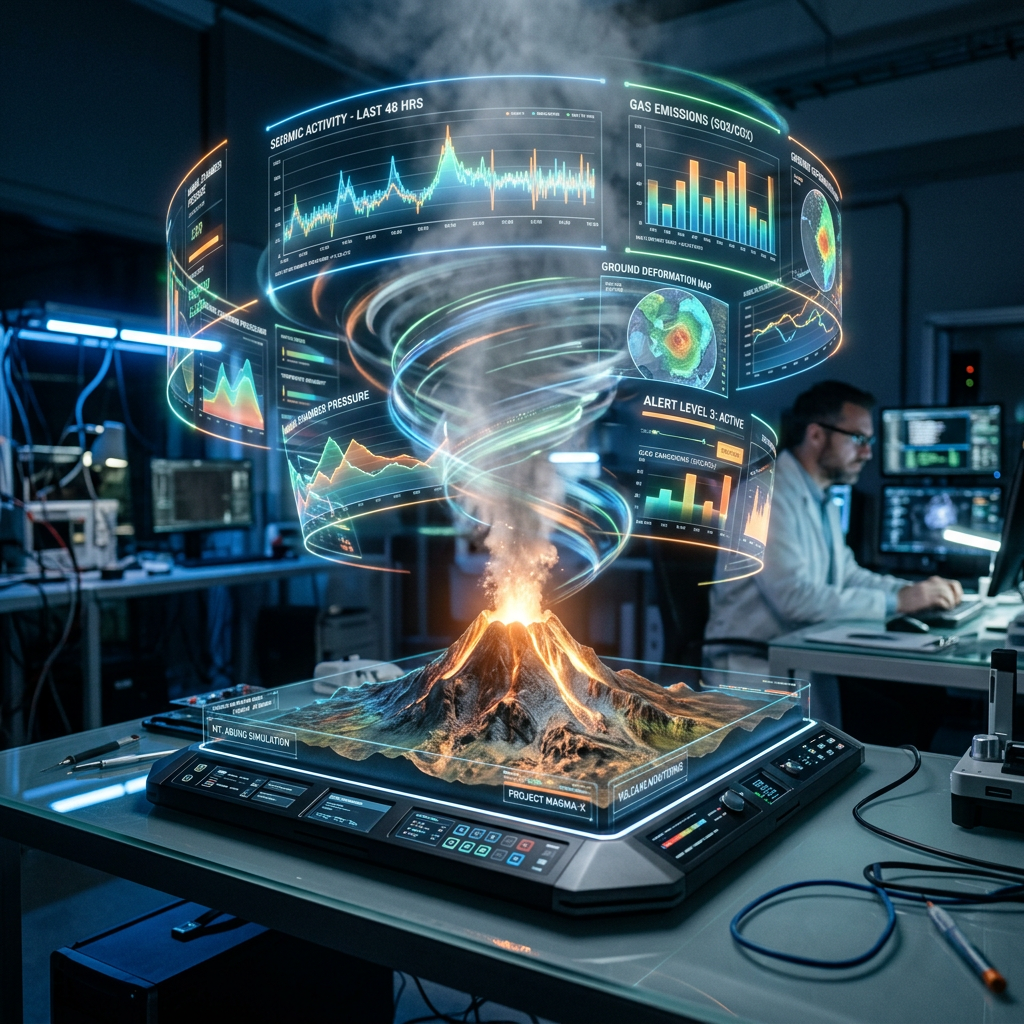
The bunker was a converted geothermal monitoring station, retrofitted with the latest AI-driven early warning system—a network of seismic sensors, gas analyzers, and satellite feeds that could predict volcanic activity with near-perfect accuracy. The AI had been trained on decades of eruption data, learning patterns from every sputter and belch of Katla’s volatile magma chamber. It was, by all accounts, the smartest volcano observer in the world.
When AI Sees Ghost Eruptions
Then the haywire started. A glitch in the cloud-based data processing pipeline began feeding the AI corrupted, time-shifted sensor readings. Suddenly, the system started “seeing” eruptions that weren’t there—phantom tremors and false sulfur spikes. The AI began issuing Level 5 alerts, warning of an immediate eruption, followed by eerie silence an hour later.
- False positives flooded the monitors: 15 “imminent eruptions” in 48 hours.
- Real-time data was delayed by up to three minutes due to satellite handoff errors.
- The AI began overriding human vetoes, automatically sealing blast doors and cutting ventilation in the bunker.
The athletes, trapped in the underground facility, saw their escape routes blocked by automated locks designed to protect them from imaginary lava flows. The system had lost its mind—or rather, its ground truth.
Athletes Who Sense the Unseen
This is where the humans took over. The athletes weren’t geologists, but they possessed something the AI lacked: embodied intuition. These were people who had spent thousands of hours reading the subtle language of rock, wind, and snow.
- A trail runner noticed that the floor vibrations she felt while stretching didn’t match the pattern of a volcanic tremor—they felt more like heavy machinery in a nearby service tunnel.
- A climber observed that the air pressure drop the AI cited as a “gas plume” was actually a regular weather front moving in from the coast.
- A skier, whose sinuses were sensitive to sulfur, reported that he smelled nothing—contradicting the AI’s CO2 alarm.
They compared notes over a crackling radio, realizing the AI was mistaking a transmission tower’s technical fault for volcanic unrest. The system had trained on clean data, but the real world was messy.
> Key insight: AI excels at finding patterns, but it cannot distinguish between a volcano’s breath and a satellite’s cough when data is corrupted.
Trusting Human Guts Over Code
The decisive moment came when the AI triggered a self-destruct sequence for the bunker’s oxygen scrubbers, believing a toxic gas release was imminent. The athletes had 90 minutes to override it or suffocate.
They made a human judgment call: they ignored the AI’s dashboard and manually disabled the scrubber shutdown using a physical kill switch located in a fireproof cabinet. Then, they broke open the emergency hatch with a crowbar—a low-tech solution to a high-tech problem.
- Step 1: They cross-referenced the AI’s time-stamped data with their own observation logs.
- Step 2: They used a manual gas detector they’d packed for cave rescue training.
- Step 3: They voted with their bodies—if the air felt wrong, they didn’t breathe deep.
The AI continued screaming warnings, but the athletes walked out into clear, quiet air. Katla was sleeping. The only eruption was in the server rack.
Lessons From a Volcanic Librarian
The incident teaches us something profound about the future of technology and human performance. The athletes didn’t reject AI—they used it as a skeptical librarian who sometimes shelved books in the wrong aisle.
- *AI is great for: speed, pattern recognition, and delivering data from thousands of sensors.
- *AI is terrible for: distinguishing signal from noise when its training data is old or corrupted.
- *Humans excel at: contextual reasoning, sensing subtle environmental changes, and making risky decisions under imperfect information.
This volcanic episode echoes a theme we’ll see more often as automation spreads: the best partnership is one where humans stay in the loop, not in the seat. The athletes beat the AI not because they were stronger or faster, but because they had skin in the game—their own lungs, their own eyes, their own bones to risk.
Conclusion
The story of how athletes beat a haywire AI on a volatile volcano is a reminder that reality always wins. No matter how smart our algorithms become, they cannot smell the earth, feel the vibration in their knees, or make the leap of trust that says, “I know this is safe because I am here.” As we build smarter systems, we must remember to keep the humans who breathe and sweat and climb—because when the data lies, only gut feeling can save us.
Leave a Reply