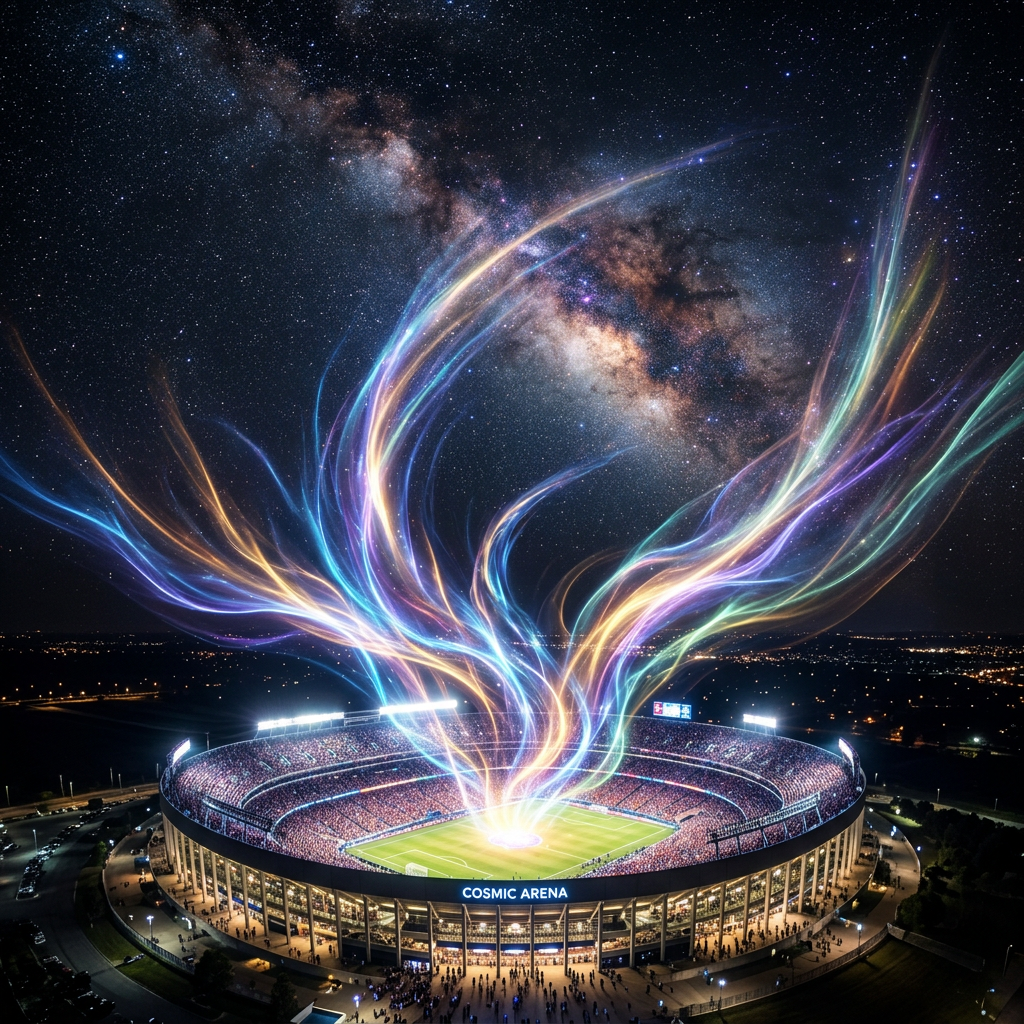
Imagine a universe where the cosmos has gone utterly silent. No distant pulsars, no crackling nebulae, no ghostly whispers from dying stars. For decades, we aimed our radio telescopes at the heavens, straining to hear a message, a pattern, a sign that we are not alone. But the only response was a deafening, empty static.
Now, look down. Look at the lit cathedrals of concrete and steel on Earth: the stadiums. In this silent cosmos, they are not just places of sport; they are the last, loudest broadcasters in the universe. Their radio signals—the roar of the crowd, the crack of the bat, the final buzzer—still sing, undimmed and utterly human.
When the Stars Fell Silent, the Crowds Roared On
The discovery was unnerving at first. Astronomers noticed that the background radio hum of the Milky Way was fading. Pulsars stopped pulsing with their usual regularity. The universe, for reasons we may never understand, began to mute its cosmic chorus. It was as if the universe had turned off its microphone.
But on Earth, the stadiums grew louder. Every cheer, every wave of the “human tsunami” in the stands, every synchronized clap generates a massive, concentrated burst of radio frequency energy. This energy doesn’t just stay in the parking lot. It leaks into the ionosphere and beyond, a powerful, chaotic, and beautiful signal that is unmistakably man-made.
- The Crowd as Antenna: A packed stadium of 80,000 people acts as a massive, biological antenna. Their combined electrical activity, amplified by thousands of mobile phones and broadcast equipment, creates a potent, localized radio signature.
- The Megaphone of the Scoreboard: Modern stadiums are wired with more transmitters than small cities. From instant replay screens to wireless microphones for referees, they are a dense cluster of radio sources.
- The Acoustic-to-Radio Leap: The human voice, when amplified by 80,000 throats in an enclosed space, creates a pressure wave that can modulate electronic signals, effectively turning the stadium’s roar into a radio wave that travels at the speed of light.
While the universe fell into a contemplative hush, our stadiums refused to be quiet.
Standing Where the Universe Says Nothing at All
Have you ever stood on a mountain top or a quiet desert at night? The silence is a physical presence. It can feel profound, but also lonely. Now, stand in the center of a stadium during a championship game. The silence there is not the same. It is a silence of anticipation, a momentary pause before the sound explodes.
This is the paradox of our times. We stand in the middle of a cosmic emptiness that offers no answers, while around us, the most trivial sports play creates a symphony of electromagnetic noise.
> “In the silence of the universe, a single goal scored in a stadium echoes louder in the radio spectrum than a thousand supernovas.”
This isn’t about arrogance. It’s about scale. A supernova might be powerful, but it is chaotic, random, and often silent in the radio bands we monitor. A stadium, however, is a purpose-built radio source. Its signal is sharp, rhythmic, and filled with data—the data of human emotion, triumph, and loss.
The Cosmic Forecast: Static, with a Stadium in the Clear
If you were an alien civilization trying to locate intelligent life in the solar system, you would likely ignore Earth’s major cities. Modern cities are “radio quiet zones” due to aggressive shielding and digital compression. Their signals are efficient and faint.
The stadiums are the opposite. They are inefficient, leaky, and powerful. They are the cosmic “lighthouses” of our bewildered species.
Consider the radio signature difference:
- A Quiet City: A faint, digital whisper. A neat, encrypted packet of data. (Hard to detect).
- A Stadium on Game Day: A loud, analog roar. A jumbled, chaotic broadcast of a single event. (Easy to detect).
The forecast for interstellar communication? It’s not looking at the stars. It’s looking at the stadium schedules. On Super Bowl Sunday, the Earth is, for a brief moment, one of the brightest objects in the local radio sky.
Translating the Last Broadcast: Sports Over Signals
If the universe is silent, what are we broadcasting? What is the song of the stadiums?
It is not a message of science or philosophy. It is a message of kinetic energy. It is the sound of bodies in motion, of collective emotion, of a shared human experience. If an alien picks up our signal, they won’t hear a mathematical equation. They will hear the roar of a home run, the groan of a missed penalty, the chant of a crowd.
- It is a pointless signal in the grand scheme of survival—no one is asking for food or shelter.
- It is a beautiful signal because it is made for fun.
- It is a powerful signal because it is the only one left that the universe seems able to hear.
We have effectively translated our entire civilization into a single, recurring radio event: the game. We are screaming into the void, not about our fears, but about our scores.
Why Our Antennas Now Face the Stadium, Not the Sky
For a century, we aimed our dishes upward. We searched for the “Wow!” signal, the perfect mathematical sign of intelligence. We found nothing. Now, a new generation of radio astronomers has a different idea. They are pointing their antennas horizontally, toward the stadiums.
Why? Because the stadiums are giving us a mirror. They show us what our intelligence sounds like to someone else: loud, messy, and full of ritual. By listening to our own stadiums from a distance, we are learning what a technological civilization sounds like from the outside.
> “We stopped looking for an answer in the sky when we realized we were already broadcasting the question from the bleachers.”
The stadiums are our last message in a bottle. They are the unbreakable habit of a species that, despite the silence of the cosmos, still insists on making noise. They are our proof that we were here, that we cheered, and that we cared deeply about something, even if that something was just a ball crossing a line.
Conclusion
In a silent cosmos, we have found our voice. It is not wise, or calm, or contemplative. It is a stadium voice: hoarse, loud, and passionate.
The stars may offer no answers. The heavens may hold no secrets. But on a Friday night, under the lights, with 50,000 people singing the same song, the Earth itself becomes a radio star. We are not listening for a reply anymore. We are listening to the echo of our own roaring hearts.
The universe fell silent. But the game goes on. And the stadiums, those magnificent, noisy cathedrals of our time, will keep singing their radio signal into the void, a hymn of a species that chose to celebrate its existence rather than question its silence.
Leave a Reply