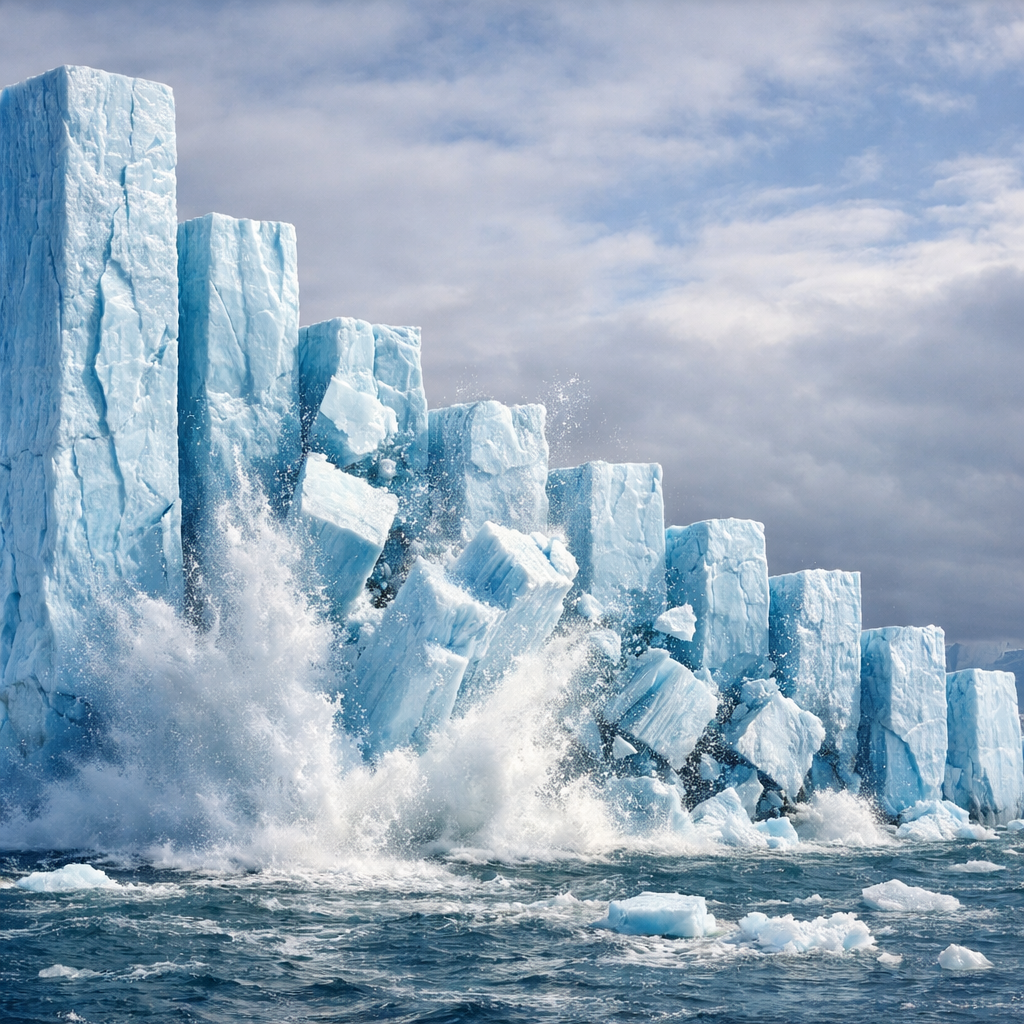
Every summer now, I hike up to the same dying tongue of ice in the Alps. What was once a silent, white giant has shrunk into a grey, weeping skeleton. I kneel beside the meltwater streams, listening to the grind of rock and the trickle of ancient water. The glacier is teaching me something I never expected: real stability has nothing to do with staying frozen forever.
The Glacier Mortician’s First Lesson
The first time I visited this glacier, a decade ago, I was obsessed with its volume. I measured its retreat, documented the crevasses, and felt a terrible grief. I was a glacier mortician, cataloguing a slow death. But the real lesson came when I stopped measuring and started listening.
> True stability is not the absence of change, but the capacity to adapt with grace under pressure.
The glacier’s flow is not a flaw; it is its very nature. The ice creeps, cracks, and reforms constantly. Our mistake is to confuse rigidity with resilience. We build our lives, our economies, and our identities on a fantasy of permanence, while the ice shows us that everything that appears stable is actually a dynamic, slow-motion river.
When Ice Collapses, Markets Follow
This illusion of stability is not limited to alpine landscapes. Listen to the news. You hear the same story: a housing bubble pops, a supply chain snaps, a political order fractures. We treat these events as surprises, but they are the echo of the glacier’s groaning.
- The 2008 financial crisis was a moral collapse disguised as a liquidity problem.
- The pandemic was a wake-up call that our “stable” global system was a house of cards.
- Climate change is the ultimate glacier: a slow, grinding force that all our short-term logic cannot outrun.
We crave a world of guaranteed returns and solid ground beneath our feet. The glacier’s melt reveals that this ground was never solid—it was only frozen. When the warmth of reality touches our systems, they do not bend; they shatter.
Stability Is Not in the Frozen Ground
So where do we find stability if the ground is melting? The answer is counterintuitive. You cannot find it by holding on tighter.
Consider the life of a lichen growing on the exposed rock where the glacier has retreated. It has no roots, no shelter. It simply clings to the raw stone, feeding on dust and light. Its stability is in its ability to weather dryness, heat, and cold without pretending it knows what comes next.
Real stability is a verb, not a noun. It is the practiced art of:
- Surrendering control over outcomes.
- Nurturing relationships that do not depend on your success.
- Investing in skills that thrive in ambiguity, not certainty.
- Redefining success as alignment with purpose, not accumulation.
Letting Go of Synthetic Certainty
We have built a world of synthetic certainty—insurance policies, retirement projections, career ladders—all designed to insulate us from the inevitable. The glacier laughs at these inventions. It does not care about your five-year plan.
> You cannot insulate yourself from reality; you can only learn to dance with it.
The most stable people I know are not the richest or the most powerful. They are the ones who have been broken open by loss, by failure, by the slow melt of their own dreams. They have learned that stability is not a fortress; it is a flexible spine. A spine that can bend under the weight of grief and still stand tall again.
The Unwavering Pulse Inside the Melt
What remains when the ice is gone? The water. The energy. The cycle.
The glacier’s melt is not an ending; it is a transformation. The water flows into the valley, nourishing new life. The moraines left behind become fertile ground for wildflowers. The pulse of the earth continues, unchanged by our mourning.
This is the final lesson: your essence—your values, your connection to others, your ability to love—is the only stability that matters. Your career may melt. Your health may crack. Your plans may crumble. But the river of your core being can flow through any landscape.
Conclusion
The dying glacier taught me that the search for a solid, unchanging foundation is the very source of our instability. The ground will always shift. The ice will always melt. True stability is not a destination; it is a practice. It is the courage to let go of what you thought was permanent, the wisdom to adapt, and the grace to flow onward—even as everything you once trusted turns to water beneath your feet.
Stand beside a melting glacier. Feel the cold wind. Listen to the water. And ask yourself: what am I holding onto that is already gone?
Leave a Reply