The Last Live Beacon at the Edge of the Map
There is a place where GPS signals fade, where satellite imagery dissolves into static, and where the last reliable form of communication is a sound wave carried by the wind. Here, at the crumbling edge of a continent that most maps have already forgotten, stands a lone lighthouse. But its keeper does not tend to a rotating lamp or a diesel generator. Instead, they sit at a colossal pipe organ, its pipes carved from driftwood and salvaged metal, bolted directly into the stone foundation of the tower.
This is the Aeon Beacon, the final station of the World Sounding Network. Its mission is simple: to broadcast a single, unbroken chord into the void — a sound so low and so pure that it pierces through the static of the Endless White, a perpetual fog of electromagnetic noise that swallows all modern signals. The organist does not play for ships; there are no ships. They play for the machines that once carried human voices, now lost and drifting. They play a live signal, a heartbeat of analog warmth, in a world gone digital and dead.
When the Organ Became the Only Navigation Signal
About three decades ago, a phenomenon known as the Silent Expansion began. A wave of unregulated solar activity and rogue electromagnetic pulses rendered most wireless communication obsolete. Satellites blinked out one by one. Airwaves became a hiss of unbreakable static. Civilization retreated into wired cities, connected by cables that were soon severed by rising seas and collapsing infrastructure.
Yet, a few hardy souls remembered an older magic: acoustics. Sound, especially low-frequency sound, travels through dense fog, through storms, and even through the intermittent bursts of the White. Engineers hastily converted old lighthouse boilers into massive wind chests. They replaced lenses with pipes. They learned that a sustained, low-pitched note, played in a specific pattern, could be detected by simple mechanical receivers on the isolated islands and floating platforms that remained.
Thus, the organ became the only navigation signal. The pattern is simple:
- The Long Call (C below middle C): Held for twelve seconds. Means “This way to land.”
- The Trembling Chord (A minor seventh): Played for eight seconds. Means “Storm approaching. Seal your hatches.”
- The Silent Gap (30 seconds of no sound): Means “All is well. I am still here.”
There is no digital encoding, no encryption, no error correction. It is raw, human-directed sound. If the organist falters, the ships cannot find their way through the fog.
How I Play Through the Endless White of Undefined Seas
My name is Elara, and I am the organist. I live in a tower that sways two meters in a gale. My console is a keyboard of whalebone and copper wire, worn smooth by the hands of my predecessors. The Endless White is not just outside the window; it lives inside my head. It is the static between my thoughts, the hum of anxiety that never stops.
To play through it, I have developed a series of mental and physical disciplines. It is not a performance; it is a survival ritual. Here is how I do it:
- Breathe with the bellows. The lighthouse is powered by a complex system of wind and tide. I must synchronize my playing with the rhythm of the pumps. I inhale when the bellows fill, and I exhale when my fingers press the keys. If I break the rhythm, the sound wavers, and the ships get confused.
- Feel the keys, don’t look at them. The White causes hallucinations — ghost lights, phantom shapes — that can distract the eye. I play by touch and by memory. I have the score of the Long Call engraved on the inside of my skull.
- Listen for the echo. When I strike a chord, I wait. A few seconds later, if the weather is clear, I hear a faint return — the echo from the cliffs of the next island. If I hear nothing, I know the White is too thick, and I must play louder, slower, more.
Most of the time, I am playing to an audience of zero. I play for a ghost fleet. But sometimes, very rarely, I will hear a faint, distant note in return — a whistle, a horn, a simple mouth organ from a ship that has found my signal. That is the greatest reward.
The Human Cycles That Keep the Darkness at Bay
The work is not just about sound. It is about cycles. The lighthouse survives on the routines of the human body. We have no AI to monitor the systems. We have no drones to change the air filters. Everything is hand-cranked, foot-pumped, and heart-driven.
Our daily cycles are:
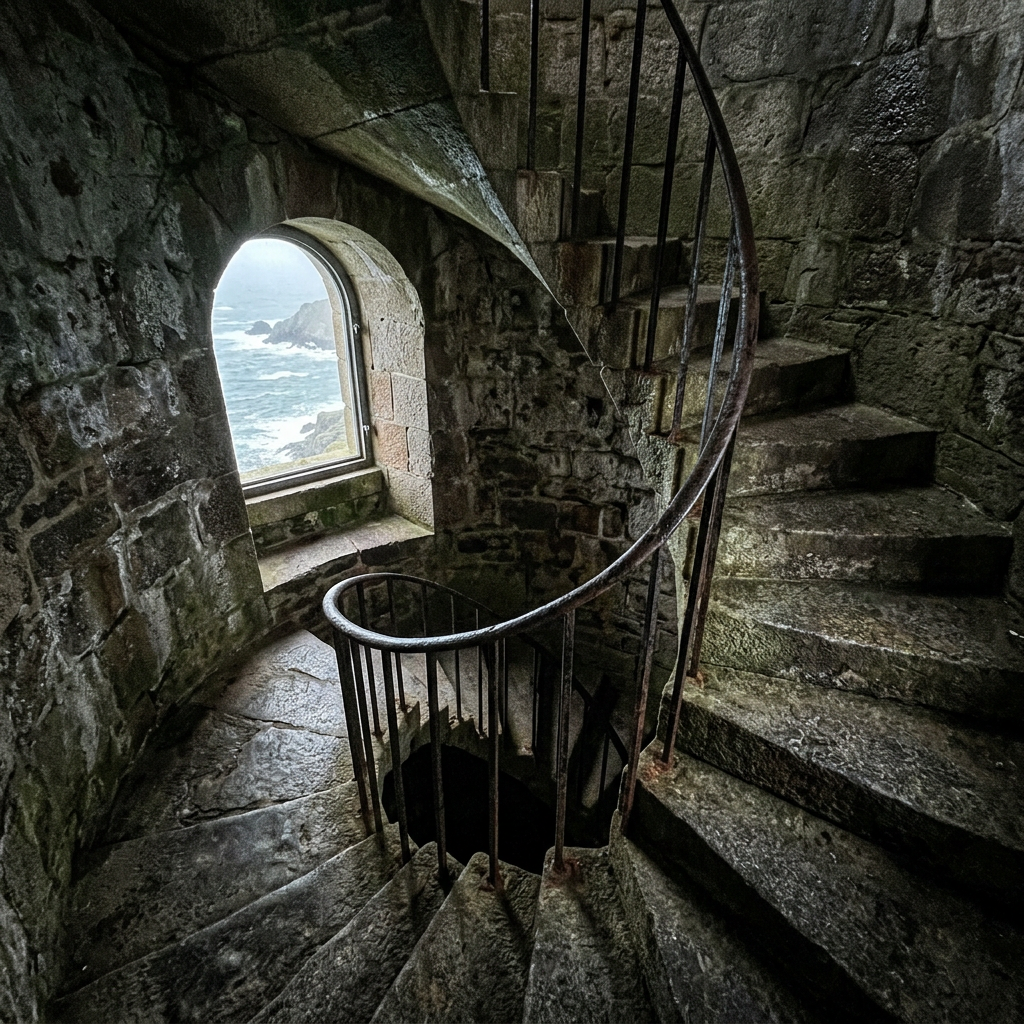
- Dawn: Climb the spiral stairs. Check the tar seals on the bellows. Oil the leather hinges on the keys.
- Midday: The Light Cycle. The sun is strongest, and the White is at its calmest. I practice new harmonies, experimenting with melodies that might cut through the static better.
- Dusk: The Heavy Cycle. I play the Long Call for fifteen minutes straight. My arms burn. My lungs ache. The darkness seems to press against the glass.
- Night: The Silence Cycle. I stop playing. I sit in the dark, listening to the wind. The ships know this is my rest time. If I fall asleep, I leave a single note on, a low drone, to signal that I am alive.
Every organist must also be a mechanic, a cook, and a log keeper. We are the last generalists. If a pipe cracks, we mend it with resin and wire. If our food runs low, we fish from the window using a net on a long pole. We live in a state of constant, careful awareness. The moment you become tired of the routine, you become a danger to yourself and to everyone who depends on that single, wailing note.
Why the Arena Outlasts Every Satellite and Screen
You might ask: Why bother with this ancient, inefficient device? Why not just use a simple beacon, a flashing light? Because the White does not distort sound the way it distorts light. A light can be swallowed, reflected, or duplicated by the atmospheric static. But a low, resonant tone — especially one that is live, that has the shimmer of a human finger pressing a key — is impossible to fake.
The organ, and the arena of stone in which it sits, outlasts every satellite and screen for one simple reason: it is analog. It is physical. It cannot be hacked, jammed, or overwritten by a software update. It is a direct conduit between a human being and another human being, connected by a column of vibrating air.
- Satellites died in the Silent Expansion. They were too delicate.
- Screens turned to white noise. Their pixels could not resolve the chaos.
- The human body remains. It sweats, it plays, it keeps time.
The lighthouse organ is a testament to the idea that the most advanced technology is not the one with the most circuits, but the one that breaks the least. Here, at the end of the world, we have stripped back everything. We have returned to the very basics: breath, muscle, and a deeply resonated note.
So when you feel lost, when the static of your own life becomes too loud, remember the organist. Remember that you do not need a perfect signal. You just need a sound that is real, played by a hand that is determined. That is how we navigate the undefined seas. That is how we keep the darkness at bay.
Leave a Reply