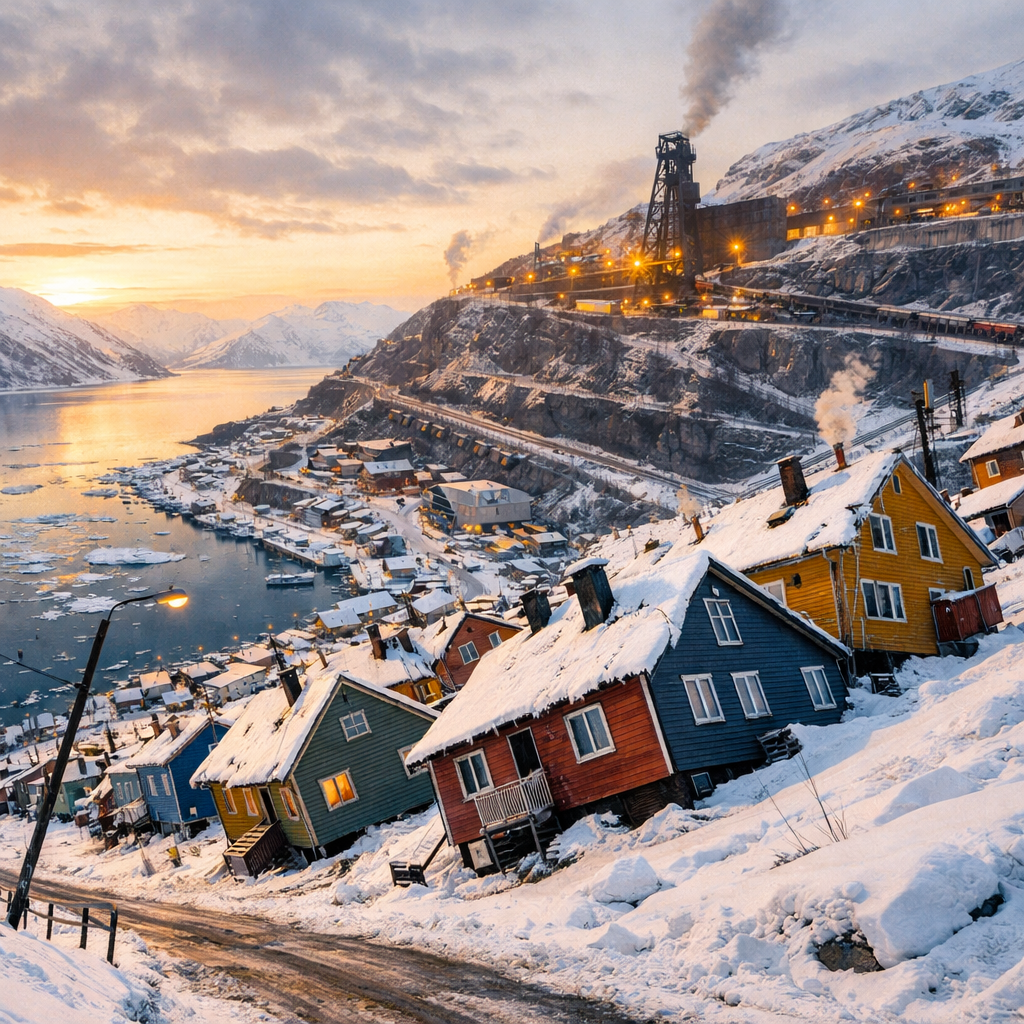
In the northernmost reaches of Sweden, where the Arctic Circle carves a line through pine forests and frozen lakes, lies Kiruna—a town that is slowly being devoured by its own success. For decades, this mining community has thrived on the rich veins of iron ore running beneath its streets. But now, the ground is giving way. Entire neighbourhoods are being relocated, buildings are sinking, and the face of the town is shifting. Yet, in the midst of this geological and social upheaval, there is one thing that remains remarkably undisturbed: a quiet, human certainty that some assets cannot be pulled from the earth or shaken by tremors.
The Shaking Earth Below Kiruna’s Streets
The ground beneath Kiruna is not solid. It is a patchwork of fractures, subsidence zones, and hollowed-out caverns left behind by decades of mining. As the Luossavaara-Kiirunavaara AB (LKAB) mine expands, the cracks in the earth have become literal fault lines for the town above. Streets once lined with century-old wooden houses now sit within a deformation zone—an area officially designated as unsafe.
- Houses crack and tilt at odd angles.
- Roads buckle and require constant repaving.
- The iconic Kiruna church is being moved, brick by brick, to a new location.
- Residents receive notices to vacate, sometimes with only years to spare.
This is not a slow decay; it is a deliberate, coordinated retreat from a landscape that can no longer support human life. The town is being pulled apart not by nature alone, but by an industry that once built it.
Iron Ore and the Illusion of Stability
Iron ore has always been Kiruna’s lifeblood. The mine is one of the largest underground iron ore operations in the world, and its economic output is staggering. For a small town, the mine represents stability—jobs, tax revenue, and global relevance. But that stability is an illusion built on hollow ground.
> “We live on a bubble of iron,” one former miner told me. “Beautiful when you’re on top, but the moment you dig too deep, everything collapses.”
The irony is sharp: the very resource that made Kiruna prosperous is now consuming it. The company that pays the town’s bills is also the force ordering its relocation. This paradox creates a strange tension—gratitude mixed with grief, pride shadowed by displacement.
| Aspect | Illusion | Reality |
|---|---|---|
| Job security | The mine will always be here | The mine is moving deeper, changing the town |
| Home | Your house is permanent | Your street is being swallowed |
| Community | Kiruna will always be Kiruna | Kiruna is being rebuilt elsewhere |
When the Town Sinks, the Markets Tremble
Kiruna’s sinking is not just a local tragedy. The iron ore extracted here feeds steel mills across Europe and beyond. When production is threatened by geological instability, global commodity markets feel the shudder.
Prices for iron ore have historically spiked during periods of supply disruption. Kiruna’s gradual subsidence has already led to:
- Increased costs for LKAB, which must reinforce tunnels and shift operations.
- Supply chain delays as ore extraction slows in affected zones.
- Volatility in steel futures as traders speculate on reduced output.
Yet, despite this, the mine remains operational. The earth may tremble, but the ore keeps flowing—because the demand for steel never sleeps. The true disturbance, then, is not in the markets but in the psyches of those who live directly above the source.
The Last Stable Asset Lives Above Ground
If you walk through Kiruna today, you’ll notice something peculiar. Amid the moving cranes and empty lots, some things remain untouched.
The last stable asset is not gold, nor a cryptocurrency, nor a stock portfolio. It is the quiet, enduring presence of the people who choose to stay—and the culture they carry with them.
- Local traditions like the Snow Festival and the annual market continue, even as venues shift.
- Community knowledge about Arctic survival, mining history, and adaptation is passed down.
- The human spirit remains the one investment that cannot be seized, sunk, or destabilised.
> “They can move my house, but they can’t move my memories,” says Elin, a third-generation Kiruna resident. “Those are underground too, but they don’t break.”
This intangible asset—what psychologists call psychological resilience—is the bedrock upon which a new Kiruna will be built. It is not visible on any balance sheet, but it is the most valuable resource the town still holds.
Beneath the Mine, a Miner’s Quiet Certainty
Deep underground, where the temperature hovers near freezing and the only light comes from a helmet lamp, the miners work in a world of absolute stability. Iron ore, after all, does not move. It has sat in the earth for millions of years, and it will sit there until drilled, blasted, and hauled away.
One miner, Lars, has worked the Kiruna seam for thirty years. He describes the silence below the town as “the only true constant in my life.” Above ground, his house was relocated twice. His children moved south for jobs. The supermarket he shopped at is now a grassy field. But in the tunnel, the rock remains the same.
- Shift patterns never changed.
- The smell of damp ore and diesel stayed familiar.
- The sound of the drilling hammer at 4 AM—unchanged.
“Down here,” he says, “I know exactly where I am. Up there, I’m a tourist in my own hometown.”
That quiet certainty—the knowledge that some things cannot be displaced—is the undisturbed asset. It is not a material possession. It is a mindset. And in a sinking town, it is the only ground that will never crack.
Conclusion
Kiruna is not just a town being moved. It is a living example of what happens when prosperity and geography collide. The iron ore beneath the streets will continue to be mined, the markets will adjust, and the houses will be rebuilt elsewhere. But the real treasure of Kiruna is not in the ground—it is in the unbroken spirit of the people who refuse to let their community cave in. In an age where everything feels temporary, they have discovered something permanent. And that, more than any mineral, is worth preserving.
Leave a Reply