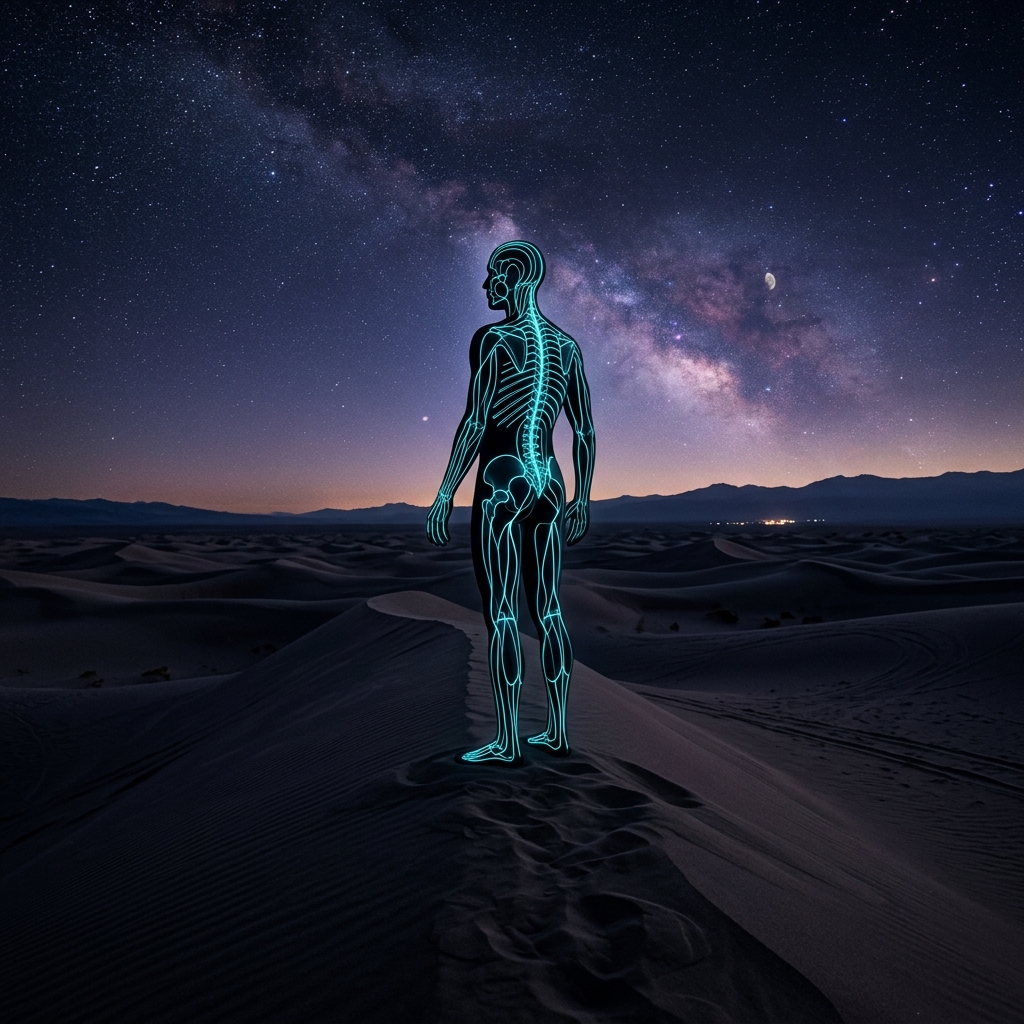
There is a place where the earth forgets its own shape. Deserts are not static; they are living, breathing entities that redraw their boundaries with every gust of wind. In such landscapes, where satellites falter and GPS coordinates become poetic suggestions, the only instrument capable of true navigation is the one you cannot update or replace: the human body. This is a story about what happens when the world’s cartography fails, and we are left with nothing but our own flesh to find the way.
When the Dunes Outrun the Satellites
Satellites see the desert from above, mapping it in crisp, geometric lines. Yet, these orbital eyes are blind to the desert’s most fundamental characteristic: impermanence. A dune that appears as a stable yellow triangle on a digital map may have migrated hundreds of meters overnight.
- The problem of scale: Satellites capture snapshots, not stories. They cannot see the ripple that will become a ridge by noon.
- The lag of data: By the time a map is printed, the landscape it depicts no longer exists. In the desert, the map is always a history book, not a guide.
- The ghost of coordinates: Latitude and longitude become meaningless when the reference points literally move.
In this shifting theater, a pilot or a trekker who trusts the screen over their own senses is already lost. The dunes outrun our technology because they obey a different clock—one measured in grains and gusts, not seconds and cycles.
The Body as the Last Reliable Map
When the horizon dissolves into a mirage and every compass needle spins in confusion, the body refuses to lie. It remembers what data forgets. Your proprioception—the sense of where your limbs are in space—becomes a live-feed of spatial truth.
> Key Insight: The body does not need to update its software. It learns the gradient of a slope in the strain of a calf, and the direction of a sandstorm in the sting of a cheek.
- Skin as sensor: The human dermis detects minute changes in wind pressure and temperature that no thermometer can log in real time.
- Breath as chronometer: The rhythm of inhalation and exhalation changes with altitude and exertion, marking time and distance more reliably than any wristwatch.
- Bones as compass: The skeleton’s balance system, the vestibular apparatus in the inner ear, tracks tilt and rotation long after the magnetic field goes haywire.
Here, the body is not a vessel to be carried across the sand; it is the finest map ever drawn, and it is always being redrawn with every step.
Charting Muscle Memory in Unrenderable Terrain
There is a kind of knowledge that cannot be digitized. It lives in the fascial layers, in the myelin sheaths of nerves, in the unconscious timing of a footfall. This is muscle memory, and on shifting ground, it becomes your most reliable cartographer.
- The gait adapts: After hours on loose sand, your hips adjust their rotation automatically. The body learns to splay the toes and soften the knee—a choreography that no algorithm can predict.
- The spine becomes a level: Walking over undulating dunes forces the vertebral column to micro-adjust constantly. This is not conscious; it is the spine reading the terrain through the soles of the feet.
- The hands speak: In steep descents, the arms extend involuntarily, seeking counterbalance. The fingers spread, searching for a touchstone in the air, as if the skin itself is tasting the void for solidity.
This terrain is unrenderable in a 3D model because it defies measurement. You cannot code the feeling of sand giving way under a heel, or the micro-spasm in a shoulder that prevents a fall. Only the body, in its silent, practiced wisdom, can map it.
Where AI Fails, Flesh Finds the Path
Artificial intelligence excels at pattern recognition—until the patterns break. The desert, being a place of stochastic chaos, breaks patterns as a rule. AI models trained on stable landscapes collapse when faced with a terrain that actively resists classification.
> Important Warning: Never let a machine decide your route through live sand. The cost of its error is your dehydration, your disorientation, your marrow.
- Context is not data: AI cannot feel the warning in a sudden drop in barometric pressure or the promise in a shift of wind that brings the scent of distant water. Flesh can.
- Decision by instinct: When a dune collapses underfoot and the sand begins to slide, you do not calculate vectors. You jump. That jump is a computation that happens in your spinal cord, bypassing the slow cortex of reason.
- The long game of survival: A machine can tell you where to go, but it cannot sustain you when the data runs out. The body’s capacity for suffering, for patience, for hope, is the ultimate navigation tool.
In the end, AI is a tool for the known. The body is a tool for the unknown, and the desert is a master of unknowns.
The Cartography of Skin and Breath
To survive when the desert shifts, you must learn a new kind of reading. This is not the reading of a map, but the reading of your own skin and breath.
- Skin reading: Notice where sand grains stick to your skin. They tell you about humidity and static charge. Pay attention to the pattern of sweat evaporation—it maps the local microclimates. A cool patch on your forearm might signal a shaded hollow ahead.
- Breath reading: When you breathe, the moisture in your exhaled air condenses on your lips. The time it takes for that moisture to evaporate is a measure of aridity. The sound of your own breathing, when reflected off a dune face, can tell you how close you are to a wall of sand.
- The bridge of gut feeling: That subtle unease in your stomach when you walk in a circle? That is your limbic system detecting a lack of progress. Trust it. Your brain is running a real-time, unconscious triangulation using the shadows and stars.
Conclusion: The Only Chart That Survives
When the satellites go dark and the digital maps dissolve into pixelated noise, you are left with one final cartographer. The body does not need a battery. It does not require a signal. It is a chartable territory of its own, always responsive, always honest.
The desert will continue to shift, to swallow roads and rearrange landmarks. But as long as you can feel the sand beneath your soles, as long as your lungs draw the dry air and your skin reads the wind, you are not lost. You are simply walking a map that is being drawn in the same moment you tread it. And that map—the one written in muscle, bone, and breath—will never let you down.
Leave a Reply