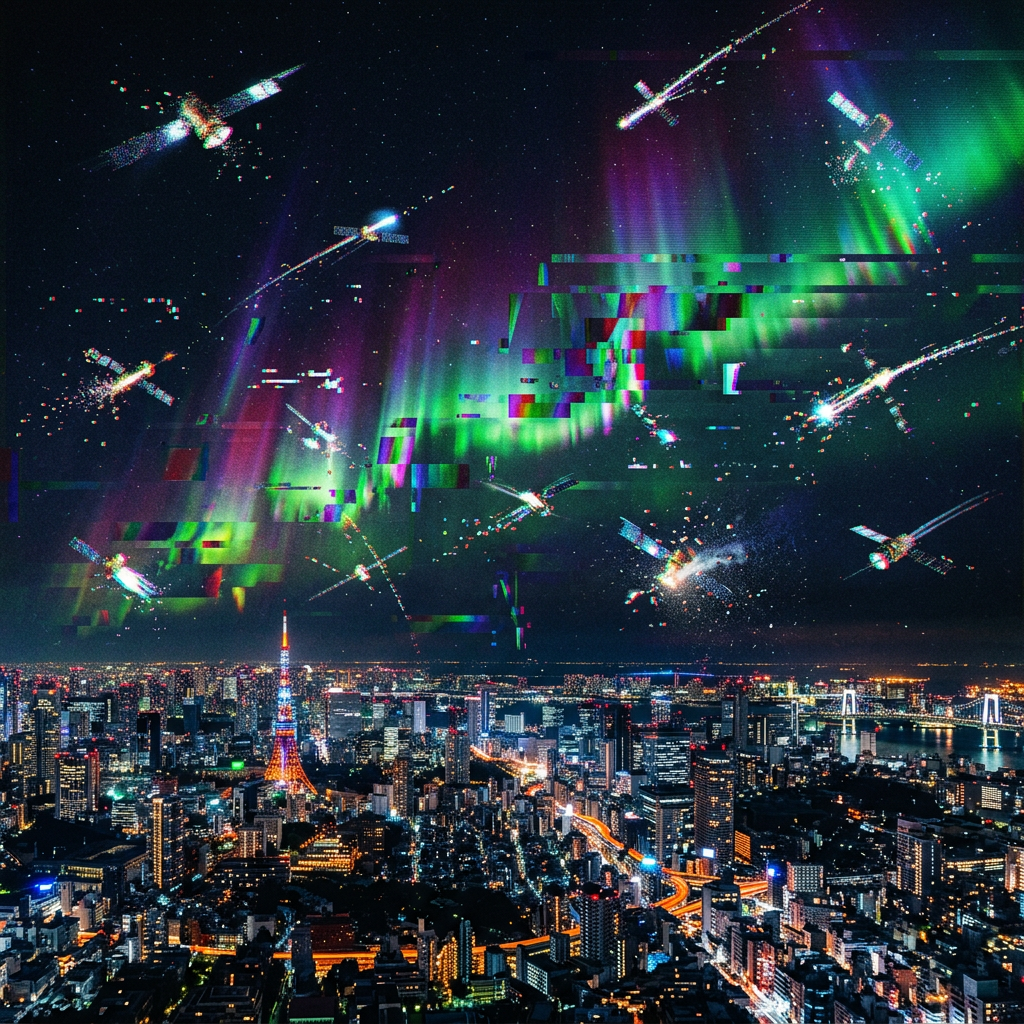
The Sky’s Steady Pulse Was the First to Flicker
For centuries, we looked up for answers. The sky, with its predictable cycles of sun, moon, and stars, was humanity’s first clock, our original navigator. Farmers planted by it, sailors charted courses by it, and cultures built mythologies around its reliable rhythm. It was the ultimate authority—a celestial metronome that never faltered.
But in an age of hyper-connectivity, that ancient pulse began to flicker. Not because the sun dimmed or the moon wandered off course, but because we wrapped the sky in layers of digital interpretation. We built satellites to beam down signals, algorithms to predict weather, and data streams to sync our every move. The sky’s natural rhythm became entangled with human engineering—and engineering, as we know, can fail.
The first sign of trouble was subtle: a ping lost, a timestamp skewed, a satellite drifting a few nanoseconds off course. Then came the cascading failures. Solar storms jammed communication bands. A glitch in a timing protocol threw financial markets into chaos. The GPS signals that guided ships, planes, and even your morning commute grew erratic. The sky, once our most trusted beacon, had become a maze of static and silence.
When Aurora Algorithms Began to Lie
The aurora borealis had always been a spectacle—a silent, harmless ballet of light. But when we started using its atmospheric disturbances to calibrate high-frequency trading systems and network synchronizers, we turned a natural phenomenon into a liability.
Imagine this: a stream of charged particles from a coronal mass ejection slams into Earth’s magnetosphere. The aurora dances brilliantly, but the algorithms designed to filter out “noise” misinterpret the event. They begin to lie—not out of malice, but out of flawed logic. Positional data becomes unreliable. Radio frequencies warble. The entire digital scaffolding that depends on a clear view of the skies begins to buckle.
- Signal drift causes navigation systems to show locations hundreds of meters off.
- Time-sync errors cripple stock exchanges, delaying trades by milliseconds that cost millions.
- Emergency communication bands fill with static, leaving first responders disconnected.
This was the moment of truth: the sky, wrapped in its digital cocoon, had lost its innocence. We could no longer trust what we saw above us without a filter—and those filters were now failing.
The Arena’s Signal Never Missed a Beat
When the skies failed, the world held its breath. Air traffic grounded. Banks froze. Media networks flickered off. But one domain remained oddly, defiantly steady: the arena. The playing field. The stadium. The local gym.
Why? Because the arena’s signal isn’t born from satellites or solar winds. It’s built on proximity, physics, and human presence. A basketball court needs no GPS to know where the three-point line is. A soccer field doesn’t require a satellite sync to track the game clock. The referee’s whistle cuts through radio silence. The crowd’s roar drowns out the static of a broken network.
Consider what kept the arena alive:
- Hardwired infrastructure: Scoreboards, sound systems, and lighting often run on local power and copper wires, not cloud-dependent wireless.
- Human-operated timing: The stopwatch in an official’s hand is more reliable than a network time protocol under solar duress.
- Analogue backups: Pen and paper for scores. A physical whistle. A manual scoreboard flip.
In a world gone dark, the arena didn’t just survive—it thrived. It became a sanctuary of real-time, unmediated experience. While the world stared at blank screens, fans stared at the court, the track, the field. The game continued, not because it ignored the crisis, but because it was designed to endure without the sky’s permission.
Interpreting the Game Clock, Not the Solar Wind
When the sky lies, you learn to read different signals. The true skill isn’t in predicting the solar wind; it’s in interpreting the game clock. This shift—from cosmic to local, from abstract data to tangible rhythm—is the core lesson of the failure.
Think of how a point guard reads the floor. They don’t look at a satellite feed for a defender’s position; they see the opponent’s eyes, the shift of their hips. A coach doesn’t need a wireless headset to sense a team’s momentum; they feel the energy on the bench, hear the cadence of the crowd, see the sweat on the players’ brows.
- Focus on immediate cues: The sound of a ball bouncing. The flash of a referee’s arm. The chalk dust on a batter’s hands.
- Embrace analogue logic: If the digital clock is frozen, count aloud. If the scoreboard is dark, keep it in your head.
- Trust human connection: A teammate’s shout is more reliable than a delayed text. A hand signal is clearer than a pixelated video feed.
These are not primitive techniques; they are resilient ones. They don’t depend on a clear sky or a functioning satellite. They work because they are grounded in the physics of the immediate moment—the same physics that a basketball, a bat, or a ball obeys without hesitation.
Humanity’s True Compass: The Last Reliable Rhythm
What remains when the satellites go silent? When the aurora algorithms lie and the digital sky falls? What’s left is humanity’s true compass: the steady, unbroken rhythm of shared experience.
The arena is more than a building; it’s a metaphor for everything we can trust when the world goes haywire. It’s the rhythm of a crowd clapping in unison. The beat of sneakers on hardwood. The deep, collective inhale before a free throw. These rhythms don’t require calibration. They don’t drift. They don’t lie.
- A heartbeat is the original clock. It keeps time when all others fail.
- A voice is the original signal. It carries meaning through any noise.
- A handshake, a cheer, a shared glance—these are the protocols of our oldest, most reliable network.
A Final Tip for the Unplugged
> When the sky fails and the networks go dark, don’t look up for answers. Look around. The compass you need is beating in the chest of the person next to you. The truest rhythm is the one we make together.
Conclusion
We once believed that the more data we collected from the heavens, the safer and wiser we’d become. But the sky, for all its majesty, is not a system we control. It is a wild, unpredictable force. When the aurora algorithms began to lie and the steady pulse of the digital sky flickered out, we discovered something profound: the arena shone true not because it had better technology, but because it never forgot its human core.
The game clock, the referee’s whistle, the roar of the crowd—these are not nostalgic relics. They are the foundation of a more resilient future. In a world increasingly dependent on fragile data streams, the arena reminds us that the most reliable signal is the one we generate ourselves, together, in real time. Let us not wait for the sky to fail again to remember that truth.
Leave a Reply