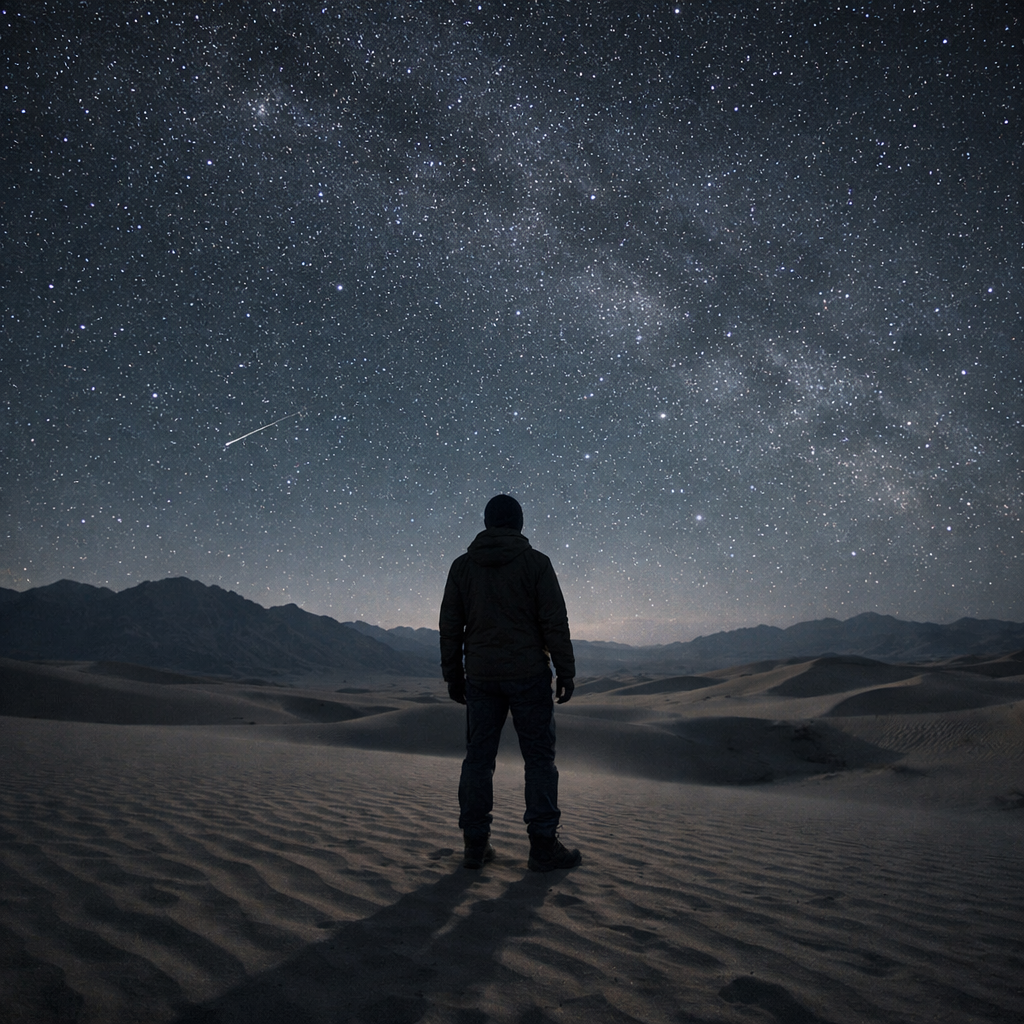
When the Constellations Begin to Lie
There is a certain comfort in looking up. For millennia, humans have anchored their nights to the celestial map—a familiar pattern of stars that promised constancy. We were taught that the North Star never wavers, that Orion always hunts, and that the Milky Way is a river of eternal truth. But what happens when that map begins to shift? When the stars you trusted start whispering contradictions? The first crack in the cosmic mirror feels like a betrayal of the universe itself. You stand in the dark, questioning not just the sky, but the very ground beneath your feet.
The Desert Sky That Lost Its Anchor
I remember a night in the high desert of New Mexico, far from any city light. The sky was a riot of diamond dust. I had come to find clarity, to let the ancient patterns realign a confused mind. Yet as the hours passed, a strange unease settled in. I had memorized the constellations as a child—Ursa Major, Cassiopeia, the Summer Triangle. But that night, the stars seemed to flicker with uncertainty. The Pleiades felt crowded, the Big Dipper oddly tilted. My internal compass spun.
This is the moment when external validation fails. You realize that:
- The maps you were given were drawn by other hands, for other skies.
- The stories attached to the stars are beautiful, but they are not your story.
- The certainty you sought in the heavens was a borrowed light.
The desert sky, once a refuge, became a mirror of my own disorientation. The stars were still there, but their meaning had dissolved. They were beautiful, but they were lying—not through malice, but through the silence of their indifference.
Why the Stars Can No Longer Guide Us
In a world of light pollution, digital navigation, and disconnected routines, the old celestial pact is broken. We no longer read the sky for weather, seasons, or direction. Instead, we scroll through star charts on our phones, overlaying ancient myths onto a screen. The result is a profound detachment:
- We mistake familiarity for truth. Just because a star pattern has a name doesn’t mean it holds your answer.
- We confuse beauty with guidance. A stunning night sky can be breathtaking, yet utterly silent about your next step.
- We assume constancy in a universe that is, by nature, dynamic and expanding.
The stars are not sentient. They do not conspire. But when we project our hopes onto them, we invest them with a power they never claimed. When they fail to deliver, the disappointment feels cosmic. The lie is not in the star, but in the expectation that it will steer us when we cannot steer ourselves.
The Steady Truth in Human Motion
If the sky is untrustworthy, where do we turn? The answer is simpler and more radical than gazing upward: look inward, and then move. Your body is the original compass. It does not need star charts or GPS to know its own truth. Consider this:
- Breath is a rhythm older than any galaxy. When the mind spins, the inhale and exhale are an unbroken tide.
- Pulse is a drumbeat that doesn’t consult the calendar. It knows when you are afraid, excited, or alive.
- Balance—the act of standing, walking, running—is a constant negotiation with gravity, a motion that carries you forward even when you cannot see the next step.
> Important Tip: When you feel lost, do not freeze. Move your body. Walk in a circle. Stretch your arms. Dance. The motion itself creates a new anchor—not in the sky, but in the living, breathing, moving present.
The body does not lie. It may ache, it may tremble, but it never fabricates a constellation. It tells you exactly where you are, right now. That is the only coordinate you need to begin.
Trusting the Body When the Cosmos Fails
To trust your own motion is an act of radical self-reliance. It means:
- Releasing the need for a third-party guide (stars, gurus, maps) to validate your path.
- Accepting that feeling lost is not a failure, but a signal to recalibrate through action.
- Understanding that movement—even small, aimless steps—generates momentum that can reveal a new direction.
Here is a simple practice for those nights when the stars have nothing to say:
- Stand still. Feel your feet on the ground. Notice where your weight falls.
- Breathe deeply. Three slow breaths. Let the exhale be longer than the inhale.
- Move one step. Any direction. Left, right, forward, backward. It does not matter.
- Pause. Notice how your body feels now. Has anything shifted?
- Repeat. Each step is a vote of confidence in your own navigation.
> Quote: “The stars are not lost. They are indifferent. But you are not indifferent to yourself. Your motion is the only truth that heeds your call.”
The cosmos will continue its ancient dance, indifferent to our small dramas. The constellations will still appear each night, beautiful and silent. But when you stop looking up for answers and start trusting the simple, steady, human truth of your own movement, something remarkable happens: you become your own North Star. You carry the map within your bones. And no celestial lie can ever take that away.
Conclusion
The sky is a canvas, not a command. To trust the stars is to trust reflection; to trust your motion is to trust creation. When the constellations begin to lie—and they will, because they were never meant to carry your weight—remember the desert night, the spinning compass, and the quiet power of a single step. Trust your motion. It has carried you this far. It will carry you home.
Leave a Reply