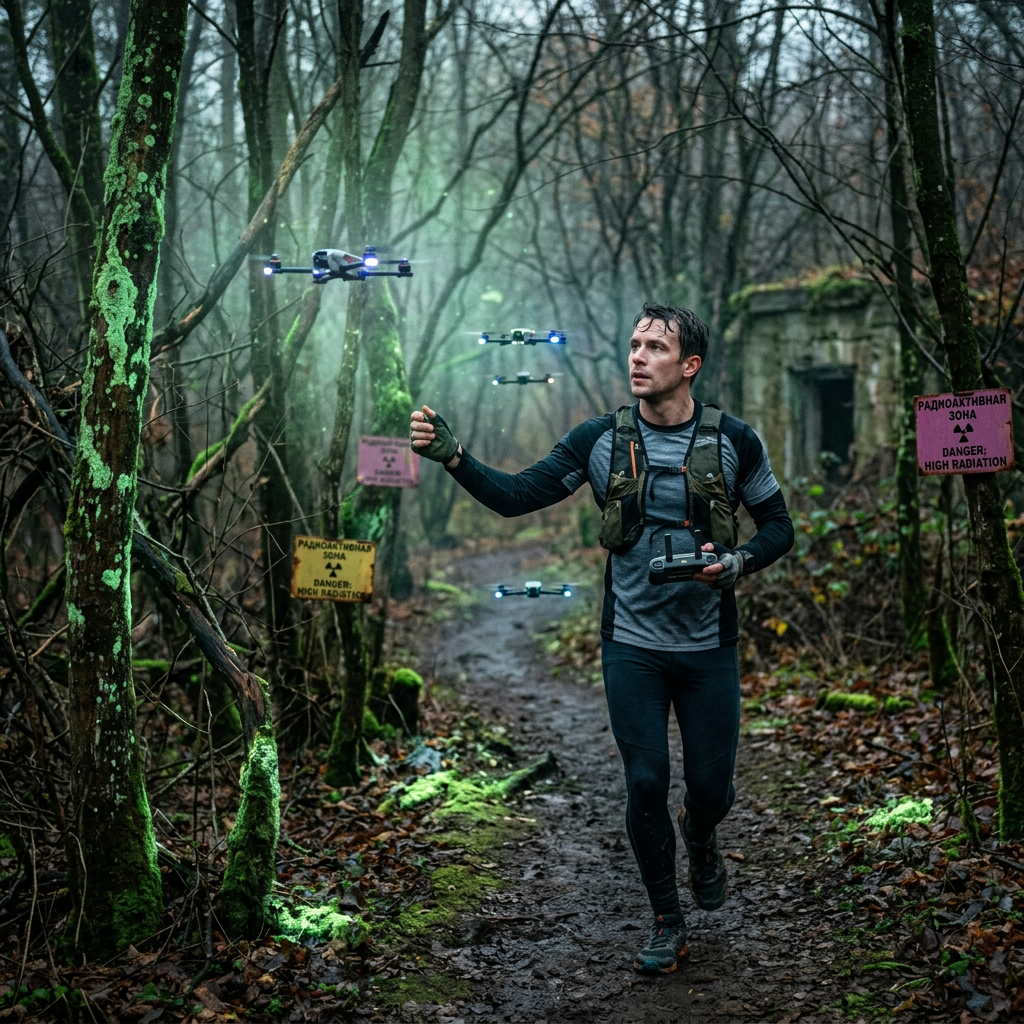
The Ghost Logic of the Exclusion Zone
Deep in the radioactive forests of Chernobyl, where Geiger counters chatter like nervous insects and the ruins of Pripyat crumble under a silent sky, an unlikely human drama unfolds. It’s not a drama of scientists in hazmat suits, but one of extreme athletes — ultra-marathoners, parkour traceurs, and elite adventurers — who have found the Zone to be the ultimate, living puzzle. While state-of-the-art drones and satellite algorithms map the contamination, these athletes move through the landscape with an uncanny grace, often completing pathfinding missions that leave AI systems baffled. The Exclusion Zone, a 2,600-square-kilometer (1,000-square-mile) scar on the map, is not just a monument to nuclear failure; it is proving to be a crucible where human intuition still beats raw computational power.
When Decision Trees Forget Their Purpose
Algorithms are designed for efficiency. They calculate the shortest, safest path between two points, avoiding hotspots of Cesium-137 and Strontium-90 based on spectral data. But the Zone defies clean data. Here, the ground is a chaotic tapestry of collapsed concrete, rusted rebar, and tangled vegetation that constantly shifts. A thicket may be “safe” on a map, but a fallen tree can force a three-kilometer detour over unstable rubble. The problem is that algorithms optimize for ideal conditions.
Consider the task of navigating to the abandoned “Duga-3” radar array. A drone’s route-planning algorithm will:
- Prioritize flat, open terrain to conserve battery life.
- Avoid areas of high radiation based on fixed isotope maps.
- Maintain a clear line of sight for its return signal.
But an athlete, running this route, understands something an algorithm cannot: the fallibility of real-world physics. They know:
- That “flat” field is a bog in disguise, ready to swallow a drone’s signal or a runner’s foot.
- That the “low-radiation” path is exposed to a kilometer of sniper-like wind, which transforms a 45-minute run into a brutal hour of survival.
- That the “safe” route has no handholds, no shade, and no place to pause.
The algorithm’s decision tree is clean. The athlete’s is a chaotic spiral of sensory feedback.
Why Human Bodies Still Outthink Code
The human brain is a prediction machine, not a probability calculator. When an athlete enters the Zone, they are not just processing visual data; they are integrating a torrent of somatic information. A runner will feel the subtle shift in soil compaction that signals a hidden sinkhole, a sensation no radar map can capture. A parkour athlete will see a vertical wall not as an “obstacle” but as a sequence of micro-movements — a toehold here, a weight shift there — that bypasses a 100-meter detour.
> The key isn’t brute force or raw speed. It’s perception. An athlete’s brain is constantly recalibrating a “budget of risk” based on real-time feedback: Is that branch decaying? Does the wind pattern force me to breathe more shallowly (and thus absorb less radioactive dust)? Can I hold that ledge without the rusted concrete shearing off?
This is where the algorithm fails catastrophically. The algorithm sees the Zone as a static set of coordinates. The athlete sees it as a temporal dynamic system. They think in terms of momentum — the energy cost of stopping, the risk of a sudden gust, the body’s own heat signature as a variable. The algorithm wants to minimize distance; the athlete wants to minimize unforeseen work. This is a subtle but massive difference.
Herding Drones Through Radioactive Ruins
In a fascinating twist, athletes are now being used to “herd” automated survey drones through the Zone’s most hazardous sectors. The traditional method — sending a wheeled robot first — fails constantly because of the impassable, decaying debris. Instead, an athlete will run a lead route, carrying a small signal repeater and dropping “breadcrumbs” (RFID tags with micro-spectrometer readings). The drone then follows the athlete’s path, not a pre-computed map.
Why does this work better?
- The athlete adapts to micro-obstructions in real-time, creating a living corridor the drone can safely navigate.
- The runner’s body absorbs the Zone’s static electricity and erratic magnetic fields, acting as a passive grounding system for sensitive drone electronics.
- The athlete’s route is not “optimal” in a straight-line sense; it is robust. It contains safe havens — a sheltered drainage ditch, a concrete slab that blocks the wind — which serve as emergency landing spots for the drone if its battery dips.
The athlete is not just a guide. They are a biological calibration tool for a rigid system.
Athletes and the Last Physics of the Zone
The Chernobyl Exclusion Zone is a place where the laws of physics remain, but the context of those laws has shattered. It is a low-probability, high-consequence environment. Algorithms, trained on the predictable physics of a modern city, are perpetually out of their depth. The athlete, by contrast, operates on a principle of adaptive resilience.
They understand that in a dead zone, the most dangerous thing is not the radiation alone — it is the false sense of certainty a map provides. The athlete’s gift is their willingness to trust the moment of feedback over the memory of the data. They run not with a route, but with a strategy of constant recalibration. This is why, in the silent, rotting landscape of Pripyat, a human on two legs still outsmarts a machine with a satellite link.
Conclusion
The lesson from Chernobyl is not that technology is useless. It is that intelligence must be embodied. The athlete in the Zone teaches us that the most powerful navigation system is not a chip running a shortest-path algorithm, but a system that can forget the plan, rewrite the goal, and trust a shudder in the muscle over a clean line on a screen. In a world increasingly run by code, the athlete’s shadow moving through the radioactive dust is a reminder: the best algorithm is often the one that can break its own rules.
Leave a Reply