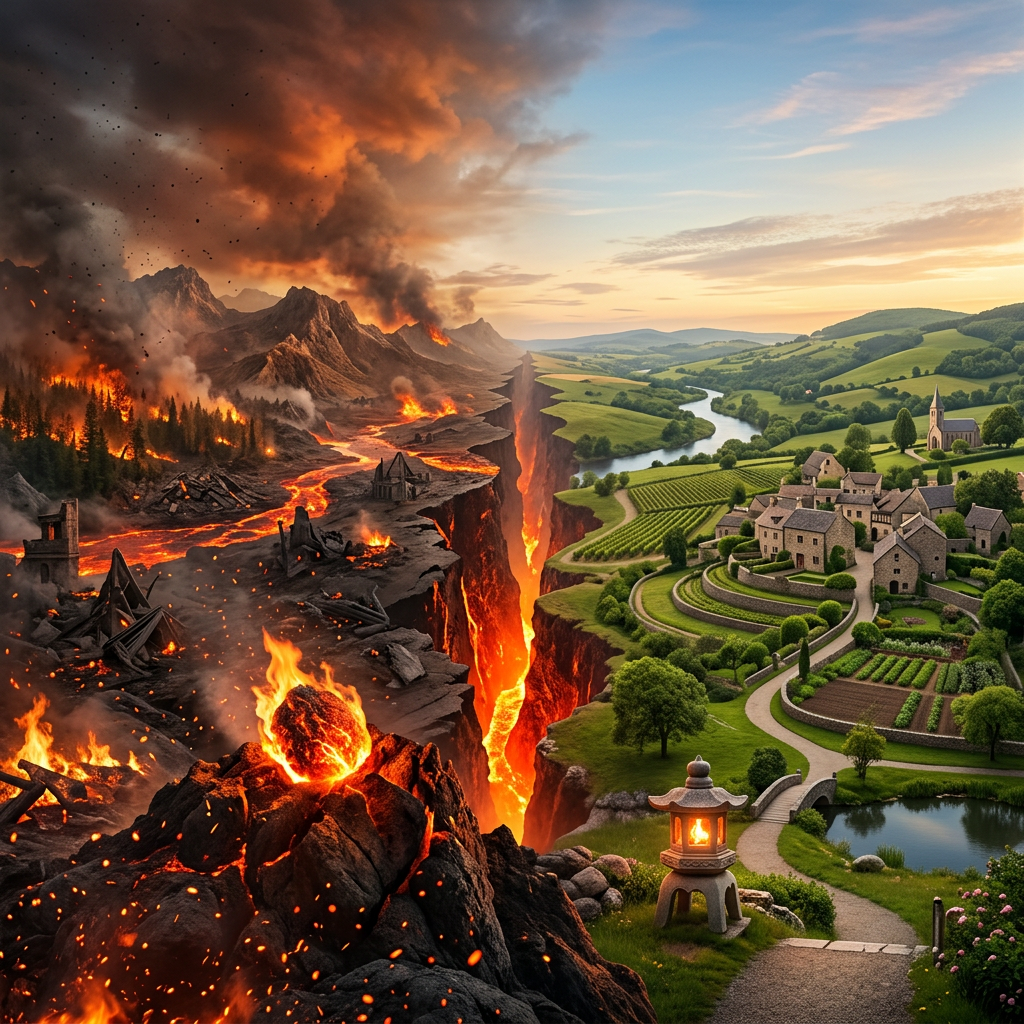
Imagine a world where the roll of a die, the flip of a coin, or the shuffle of a deck no longer holds any sway. A world stripped of the very concept of randomness, where every outcome is a matter of preordained purpose rather than blind luck. This is the stark reality presented in the tale of The Final Ember, a narrative that asks a profound question: what happens when fate is no longer a gamble?
This article explores the journey from a world governed by chance to one defined by absolute certainty, tracing the path of the final cleansing.
The Final Ember Ignites a World Without Luck
The story begins not with a bang, but with a whisper—a dying spark that refuses to be extinguished. This “ember” is the last remnant of a primal fire that once allowed for the chaotic beauty of randomness. For eons, humanity thrived on the interplay of luck: the uncertain outcome of a harvest, the chance meeting of lovers, the unpredictable turn of a battle. The Final Ember represents the moment this system ends. When it ignites, it sets in motion a global cleansing, not of fire and brimstone, but of probabilistic uncertainty.
- The Old World: Governed by chance, probability, and the wild card of random events.
- The Catalyst: The awakening of the Final Ember, which begins to burn away the fabric of luck.
- The New World: A realm of deterministic outcomes, where every event has a singular, unalterable cause.
Elias of Húsavík Holds the Pulse of Fate
In the quiet, windswept town of Húsavík, Iceland, a fisherman named Elias discovers he is no ordinary man. While mending his nets, he begins to see the end results of every action. He does not predict the future; he witnesses the only possible outcome. When a storm brews, he knows exactly which ships will sink. When a child falls, he knows the precise bone that will break. This is not clairvoyance—it is the burden of holding the Pulse of Fate.
Elias’s condition is described through a peculiar set of symptoms:
> “He could no longer be surprised by the weather, nor delighted by a lucky find. Every sunrise felt like a memory, not a beginning. The pulse of fate beat within his chest, a constant drumbeat of things that must be.”
His role is not to choose, but to observe and confirm. He becomes the living compass for the cleansing fire.
The Prophecy of Ash: Cleansing the Nations
The cleansing is not a gentle transition. The Prophecy of Ash speaks of a great purge that will wash over the nations, dissolving the structures built on luck. This includes:
- Casinos and Lotteries: The first to fall, as their very logic becomes nonsensical.
- Stock Markets: Their volatility flattens into a quiet, predictable line.
- Sports and Games: Without chance, victory is merely a formality of skill and predetermined outcome.
- Romance and Serendipity: Chance meetings cease; every relationship is an inevitability.
The cleansing is described as a gentle, falling ash that smothers the fires of uncertainty. It does not destroy, but solidifies. Nations that once celebrated the whims of fortune find themselves bound by the chains of cause and effect. The key tip from the prophecy is simple:
> Embrace the certainty. To fight the ash is to burn with the ember.
Miracle‑Logic Fire Sweeps Across the Earth
The most fascinating aspect of this transformation is the Miracle-Logic Fire. This is not a literal flame, but a conceptual one—a logic so absolute that it redefines reality. Where once a “miracle” was a break from natural law, now it is the strictest form of that law. Every event that was previously attributed to divine intervention or random chance is now recognized as a necessary, calculable step in a universal equation.
This fire burns through the illusions of free will and luck by implementing three core tenets:
- Deterministic Causality: Every effect has one and only one cause.
- Predictable Outcomes: With enough data, any future event can be known with 100% accuracy.
- The Absence of Probability: The words “maybe,” “perhaps,” and “likely” vanish from all languages.
Dawn of Certainty: The End of Chance
In the final act, the world arrives at the Dawn of Certainty. Elias of Húsavík, having guided the ember, now watches as the last flickers of randomness die out. The nations are “clean,” meaning they are cleansed of the need to hope, to gamble, to pray for a different result.
The conclusion is both liberating and terrifying. The agony of losing a bet is gone, but so is the thrill of winning one. The sorrow of a broken heart remains, but it is a known quantity—a pain with a predetermined end. The price for a world without chance is a world without surprise.
> “In the end,” Elias whispered, watching the final ember cool, “we did not find certainty. We simply ran out of options.”
Conclusion
The Final Ember presents a chilling thought experiment about the human condition. We often romanticize the idea of a predictable and safe world, yet the story warns us that the essence of life—its joy, its sorrow, its meaning—may be intrinsically tied to the uncertainty of chance. The cleansing of the nations was a purification from the tyranny of luck, but it also cleansed the world of the very spark that makes it vibrant. In our quest to eliminate randomness, we must ask ourselves: what is a life that can never be surprised, for better or for worse?
Leave a Reply