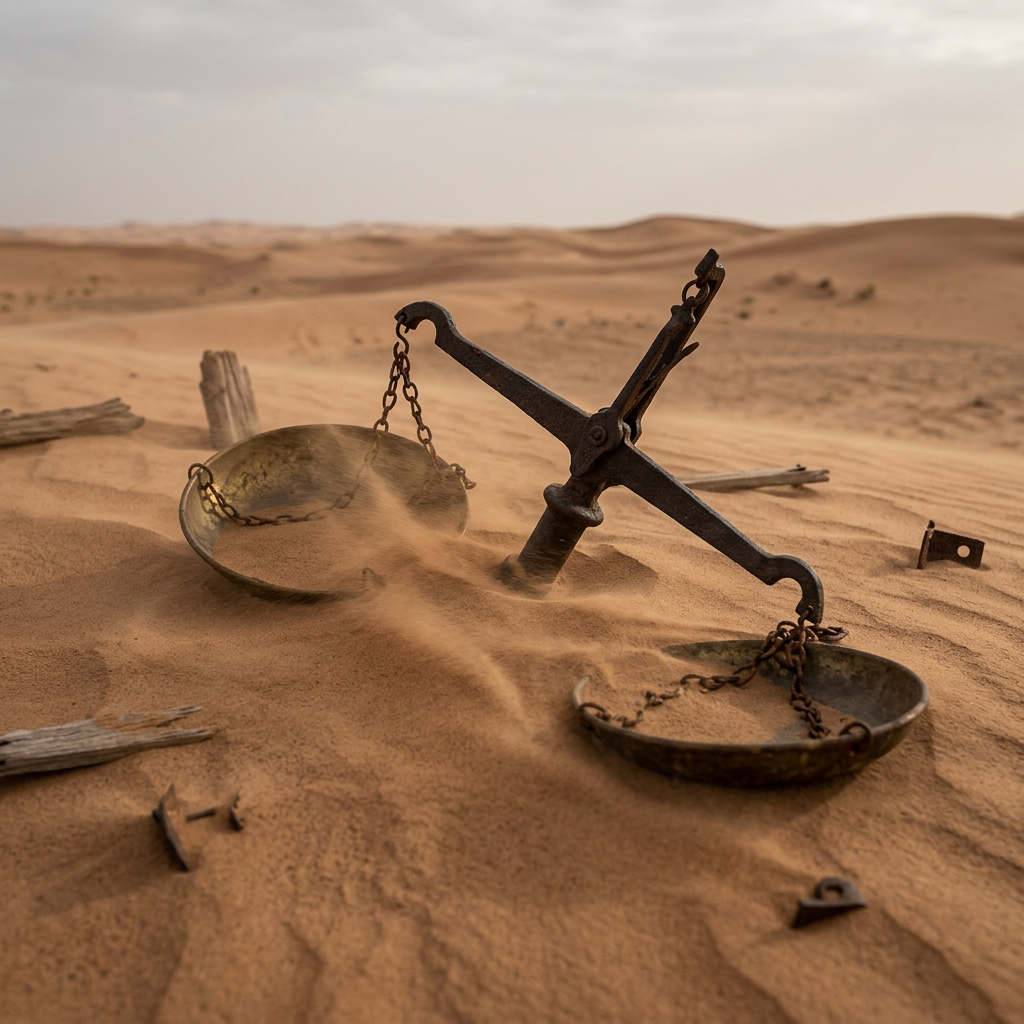
The Steel-Dust Omen: Judgment Descends on Birao
There are places in the world where the air itself feels old—woven from layers of forgotten bargains and whispered lies. Birao, a sprawling market-town at the crossroads of three trade routes, was such a place. For decades, its prosperity was built not on honest toil, but on the careful, practiced art of deceit. Its merchants sold promises that dissolved like morning mist, and their coin was heavy with the weight of broken oaths. Then came the sign: a low, metallic hum that vibrated through the stones of the old plaza, carrying with it a fine, grey powder that tasted of rust and regret. The Iron Wind was coming, and it would not be denied.
Idris Recounts the Iron Wind’s First Scourge
Old Idris, the spice-seller whose stall had stood at the eastern gate for fifty years, tells the story with a tremor in his voice. He says the first gust did not howl—it sang. It was a sound like a thousand blades being sharpened on a single whetstone.
> “It came at dawn, just as the liars were opening their ledgers. The air turned the color of tarnished silver. The wind didn’t blow; it scoured. It stripped the gilt from the false traders’ signs, peeled the varnish from their counterfeit goods. But it left my humble peppers and saffron untouched. That was the first lesson.”
From his account, the event was not random destruction. It was a precise, almost surgical act. The Iron Wind targeted objects of manipulation and fraud. It sought out:
- False scales and doctored weights: They were twisted into ribbons of scrap.
- Contracts written in disappearing ink: The wind tore them into confetti.
- Gemstones painted to hide flaws: The paint was flayed away, revealing the dull rock beneath.
- Silk imported as “rare mountain weave” but made from worm-ridden cloth: The fabric frayed into nothing.
It was as if the wind had a memory, and that memory was of every small, cruel cheat ever perpetrated in Birao’s market squares.
Merchants of Deceit: The Scattering Begins
The effect on the merchant class was immediate and catastrophic. The “Deceit-Merchants,” as they were soon called, did not all fall at once. They scattered like startled crows.
The most flagrant operators—those known for selling water-logged grain and claiming it was premium harvest—found their storehouses collapsing into piles of flaking, corroded metal. They fled first, their carts laden with what goods they could salvage, though the wind seemed to follow them, whispering through the axles. Others attempted to bargain with the phenomenon. They offered bribes of gold and silver, throwing coin into the wind as if it were a greedy spirit. The wind, in turn, flung the coins back, embedding them into the walls of their own homes as mocking decoration.
A second wave of merchants, the subtler ones—the whisperers who spread rumors to drive down a rival’s prices, the loan sharks who used hidden clauses to steal a man’s land—fared no better. The Iron Wind did not destroy their shops. Instead, it sealed their doors with a crust of rust, trapping them inside with their ledgers and their lies. They emerged days later, gaunt and trembling, their reputations dust.
Chaff in the Blade-Storm: The Deceivers’ Flight
The final exodus was a sight that many in Birao still talk about. It was less a retreat and more of a rout. The wind, now a constant, unnerving presence, learned to predict their movements. If a deceiver tried to hide his goods in a false-bottomed crate:
- The crate splintered, spilling his shame onto the street.
- If he tried to bribe a gate guard to leave early, the guard’s keys would fuse to his belt.
- If he tried to slip away under cover of night, the wind would kick up a dust devil that followed him until dawn, illuminating his path for all to see.
These merchants became chaff—weightless, purposeless, tossed by a force they could not understand. They abandoned their grand houses and fine carriages, fleeing on foot or on half-lamed donkeys. They left behind everything except the clothes on their backs, and even those were often found to be stitched with false seams. The road out of Birao was littered with their abandoned wealth: a golden goblet here, a bolt of “exotic” silk there. No one from the old town dared pick them up, for fear the wind’s judgment might fall on them next.
Peace Forged in Wind: Birao After the Scouring
Months later, the Iron Wind has not ceased entirely, but it has changed. It still hums through the rebuilt streets, but now its touch is gentle. It shimmers in the air like a protective veil. Those who remained—the honest traders, the craftsmen who labored by the sweat of their brow, the farmers who brought their own crops to market—found their fortunes rising.
The scouring brought an unexpected peace. Without the Deceit-Merchants, trade slowed but became fair. A man’s word now holds value again. A simple handshake is enough to seal a deal. The new economy of Birao is built on a single, unbreakable principle:
> What is shown is what is sold. What is promised is what is delivered.
The wind serves as a constant reminder. It polishes the brass of a truthful merchant’s scales, making them gleam. It gently ruffles the pages of an honest ledger. It no longer scours; it attends. Birao is no longer rich in stolen treasures, but it is wealthy in a far more precious commodity: trust. The Iron Wind came as a judgment, but it stayed as a guardian. And the town, scarred but wise, knows it is better to have a watchful wind than a pocket full of lies.
Leave a Reply