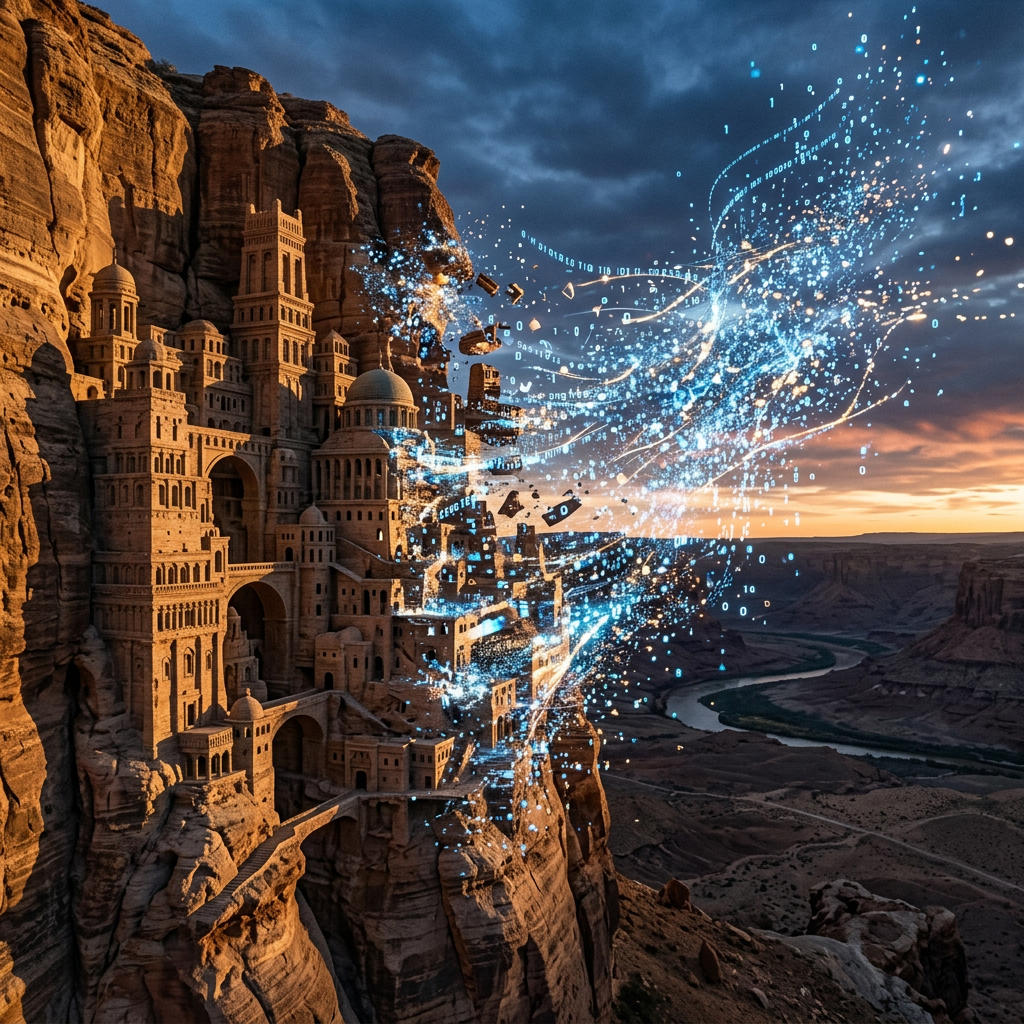
Imagine a world where the greatest monument of human civilization isn’t carved from stone, but from code. Petra, the ancient Nabataean city hewn into rose-red cliffs, has long stood as a testament to resilience—a city that survived earthquakes, invasions, and the slow erosion of time. But today, a new threat looms, not of sand and wind, but of digital decay. As we build our lives, our memories, and even our identities on brittle software platforms, we face a paradox: the stone crumbles, yet the muscle of human effort—unyielding, adaptive, and raw—still stands. This article explores the strange collapse of our digital Petra, the corrosion of preservation technology itself, and what truly endures when both stone and screen turn to dust.
When AI Eats Stone: The Digital Corrosion of Petra
The original Petra was a fortress of geology. Its rose-tinted facades were carved into the mountain, not built upon it, making them inseparable from the earth. Today, we are building a new Petra: a digital cityscape of databases, social networks, and AI-curated archives. But unlike sandstone, code is fragile. It depends on constant updates, electricity, and human maintenance.
Artificial intelligence, once hailed as the ultimate curator, is now accelerating the corrosion. Consider these realities:
- Algorithmic amnesia: AI models are trained on current data; they “forget” older, less relevant information. A photograph uploaded today might be considered “outdated” tomorrow.
- Synthetic preservation: AI can “restore” Petra’s ruins digitally, but these restorations are often fictionalized—generating textures and colors that never existed, turning history into a holographic lie.
- Vaporware archives: Entire libraries of human knowledge are now stored in proprietary formats. If the company collapses, so does the record.
The result? A digital Petra that looks flawless on the surface but is hollow inside—a city of memory that, like AI-generated art, is beautiful yet unrooted.
The Failing Code: Why Preservation Software Breeds Ruin
We have fallen in love with the promise that software can save everything. We scan manuscripts, 3D-map ruins, and upload every photo to the cloud. But there is a dark irony: preservation software itself breeds ruin.
Why? Because it introduces a layer of dependency:
- Format rot: A PDF from 1998 is unreadable on today’s devices. An MP3 from 2001 sounds distorted. The software that “saves” a memory often becomes the very barrier to accessing it.
- Update tyranny: To keep a digital archive alive, you must constantly chase updates. Each update risks breaking compatibility, corrupting files, or losing metadata.
- Centralized fragility: Most preservation tools rely on servers owned by corporations or governments. A single legal dispute, server crash, or political decision can erase entire histories.
> Tip: Never trust any single digital format for irreplaceable data. Export physical copies and plain-text backups. Redundancy is the true preservation, not the software.
The code we trusted to hold the world together is now the very force that crumbles it.
A City of Dust: Listening to Granular Collapse
To understand what is being lost, we must listen to the sound of collapse. Petra’s stone decay is slow, granular—a whisper of sand over centuries. Digital decay, by contrast, is sudden and violent. It is:
- The silent deletion of a Tumblr account with ten years of diaries.
- The corrupted JPEG of a grandparent’s only childhood photograph.
- The broken link to a PhD thesis that existed only in a university database.
Every day, millions of “Petras” are lost—not in a dramatic earthquake, but in the quiet, silent click of an expired SSL certificate or a forgotten password.
> Important quote: “The most profound ruins of the 21st century will not be made of stone, but of lost encryption keys and unreadable file formats.” — Digital Archivist, Anonymous
To listen to this collapse is to hear the sound of a civilization that built its memory on borrowed infrastructure. When the cloud rains, it drowns our past.
The Last Stable Architecture: Muscle in an Age of Decay
What, then, remains when both stone and screen fail? The answer is surprisingly simple, yet profound: human muscle—the physical, biological, and instinctive labor of the body.
Consider the following contrasts:
| Stone Architecture | Digital Architecture | Physical Muscle |
|---|---|---|
| Carves into geology | Carves into code | Carves into reflex |
| Needs wind and rain | Needs electricity | Needs sweat and practice |
| Protects from invaders | Protects from hackers | Protects from forgetting |
The “muscle” here is not just strength, but embodied knowledge—skills that live outside of any screen:
- Dance, music, and oral storytelling adapt and survive without hardware.
- Manual craftsmanship (basket weaving, stone carving, blacksmithing) is passed through touch, not downloads.
- Physical exercise and self-defense train the body as a living archive of movement.
> Key Insight: The only architecture that cannot be corrupted by a virus or deleted by a server is the one written in our own sinew and bone. Muscle stands while stone falls.
Standing on Sinew: What Outlasts the Sand and the Screen
In the end, Petra teaches us a humbling lesson: the most enduring monuments are not the ones we build, but the ones we become. When the sandstone facade finally crumbles under the wind, and when the last server farm blinks into silence, what remains?
- Human connection: A story told from mother to child, passed through breath, not bandwidth.
- Physical resilience: The ability to run, lift, build, and heal without a computer.
- Adaptive memory: The neural pathways that can learn a new language, a new trade, a new way of living—without a manual.
We are not two separate beings—a digital self and a physical self. We are a single, organic system whose strength lies in its ability to let go of what crumbles. The screen may fade; the muscle remains.
> Final thought: Do not confuse the map with the mountain, nor the file with the flesh. Stand on sinew, not on sandstone, and you will outlast every ruin.
Conclusion
“When Petra Crumbles: Muscle Stands While Stone Falls” is more than a reflection on ancient ruins—it is a call to re-evaluate where we place our trust. We have grown obsessed with building digital monuments that are already decaying. The true preservation of our species lies not in databases, but in discipline; not in archives, but in action. As you walk through your own life, remember: the code may fail, the cloud may empty, and the stone may turn to dust—but the body, the breath, and the bond between humans remain the last stable architecture. Build your strength, not your files. That is what will endure.
Leave a Reply