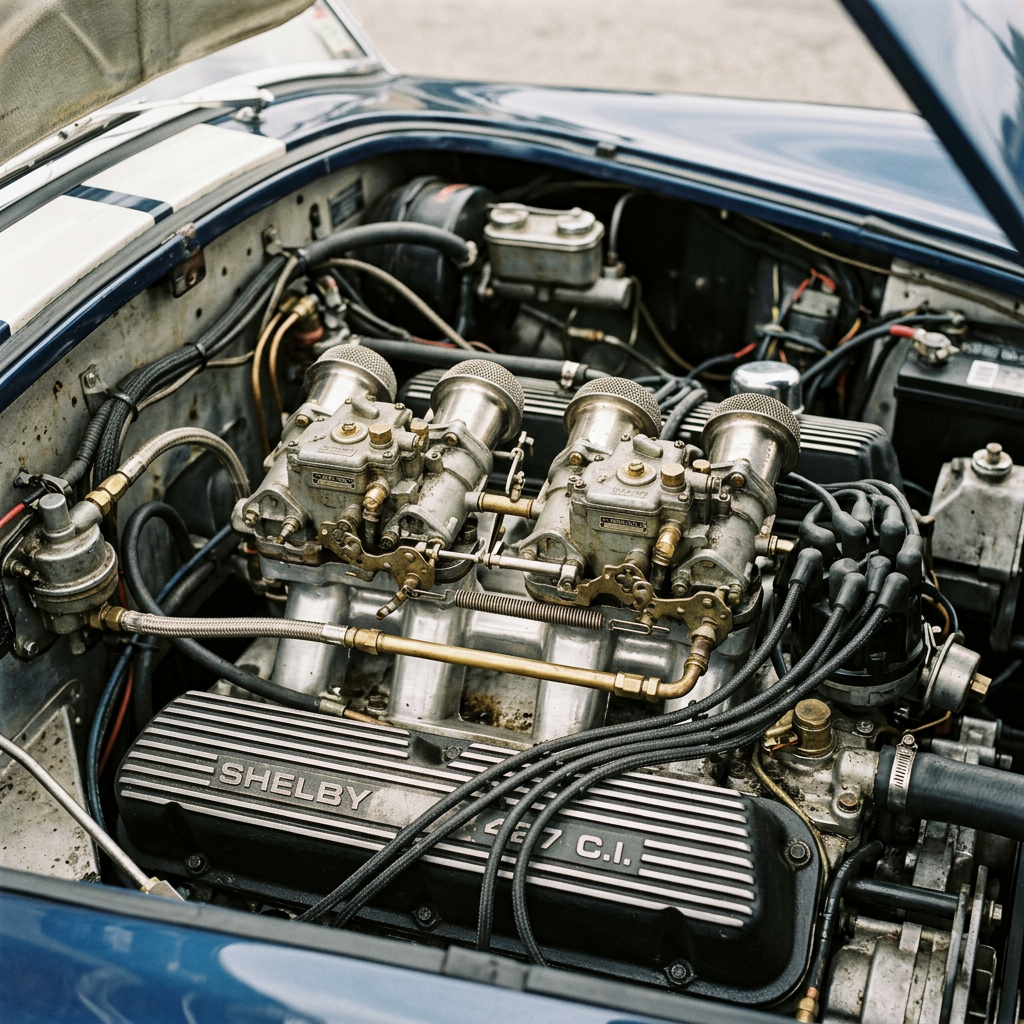
There was a time when the roar of an engine was not just noise, but a conversation. It was a dialogue between a driver and a machine, mediated by nothing more than a cable, a spring, and the weight of a foot. Before the reign of the microchip, before the digital throttle maps and traction control algorithms, there was a pure, unadulterated connection. This is a story about that lost connection—a tribute to the era when speed obeyed only the human hand.
The Archive Where Ghosts Still Race
In forgotten garages and dusty barns, the archives of this lost art still exist. They are not books, but machines: carburetors with their intricate jets and venturis, distributors with their mechanical advance curves, and the delicate, finned aluminum of a throttle body untouched by a stepper motor. These are the ghosts of a bygone era, and they still whisper tales of a more direct communion.
- The Mechanical Heart: Every part was a physical testament to cause and effect. The push of a pedal wasn’t a request sent to a computer; it was a direct command that opened a plate, drew in air, and mixed it with fuel in a carefully calibrated explosion.
- The Analog Soul: There was no “drive-by-wire” lag. The delay between thought and motion was only the time it took for your right foot to depress the pedal and the butterfly valve to rotate a few degrees. This latency was measured in milliseconds of raw physics, not processor cycles.
- The Sound of Truth: A misadjusted carburetor didn’t throw a code; it stumbled, it coughed, it told you its problem in a staccato language of harsh tones and rough idles. Mechanics were not software engineers; they were listeners.
When Throttle Was Trust, Not Code
The modern driver relies on a staggering amount of invisible trust. You trust that the ECU won’t freak out on a rainy day. You trust that the stability control will save you from a frozen patch of asphalt. You trust that the drive-by-wire system will correctly interpret your frantic input. But in the age of pure analog, trust was placed in something far more fragile and far more rewarding: your own skill.
> “A car is like a woman. If you don’t understand her, she will leave you by the side of the road. But if you listen, she will teach you everything.” — An old master mechanic, speaking of a carbureted Alfa Romeo.
Driving a car from that era was a constant act of negotiation. The throttle wasn’t just a go-faster pedal; it was a tool for weight transfer, for steering with the rear axle, for pre-loading the suspension before a corner. The pedals became an extension of your nervous system. You didn’t just drive the car; you conducted it, like an orchestra where every movement had a consequence.
The Last Lap Before the Simulation
The final great stand of this philosophy can be found in the raw-edged sports cars of the late 1990s and early 2000s—just before the digital wall came down. Cars like the original Mazda MX-5, the air-cooled Porsche 911, and the Alfa Romeo 4C (with its optional, no-power-steering setup) represented the “last lap” of a race that had been running for a century. They were the final masters of a lost art.
These machines were not the fastest. They were not the safest. But they were the most alive.
- The Human-Link: A cable that physically connected your right foot to the engine’s intake. A direct, unbreakable strand of steel that made you feel the slight hiccup of a rich mixture or the crisp snap of a perfectly tuned unit.
- The Unfiltered Feedback: No electronic dampening. The road surface, the camber change, the slip angle—all of it was transmitted through the steering wheel, through the seat, through the throttle pedal. The car was a seismograph, and you were the geologist trying to read the earthquakes of the asphalt.
- The Ritual of the Start: Cold starts required a dance with the choke. A quick pump of the throttle to prime the carburetor, a twist of the key, and a careful modulation of the pedal to coax a sluggish engine to life. It was a daily ritual of respect.
Velocity That Kneeled to Human Hands
What does it feel like to command a car that has no safety net? It feels like sovereignty. When you press the pedal, you are not making a request. You are issuing a decree. The car has no choice but to obey, for better or worse. If you are clumsy, the car will be clumsy. If you are smooth, the car will flow like water. The machine becomes a mirror for your soul.
This is the fundamental truth of the analog era: your right foot was a direct conduit to the engine’s soul. The speed was not a function of a digital map; it was a function of your will, your judgment, and the precise angle of your ankle. It was a dance of pure physics.
- The Art of the Heel-Toe: A complex footwork maneuver that blipped the throttle while braking, matching engine speed to wheel speed for a seamless downshift. It was a skill that took months to learn and a lifetime to perfect. It was tactile, auditory, and deeply satisfying.
- The Feel of the Clutch: The engagement point wasn’t a binary switch. It was a broad, fuzzy zone of slip and grab. You felt the friction plate through the sole of your shoe, and you modulated the launch not by watching a tachometer, but by feeling the vibration.
- The Braking Point: Without ABS, braking was a negotiation with the tires. You had to feel the very edge of adhesion, that tiny moment before the wheels locked, and back off just a hair. It was a tactile conversation at the threshold of grip.
Resurrection in the Fog of the Isle
Yet, the story does not end with the triumph of the microchip. There is a resurrection happening, a quiet rebellion in the garages and on the misty roads of the Isle of Man, in the hills of California, and on the winding passes of the Alps. Enthusiasts are not just restoring these cars; they are seeking them out.
They are looking for a connection that modern cars, for all their speed and safety, can never provide. They drive them in the fog, where traction is unpredictable, and the only computer is the one between their ears. They drive them on the “Isle”—a metaphorical place of pure driving, where the digital veil is lifted.
> “The modern car is a computer you travel in. The old car is a machine you have a conversation with. I prefer the conversation, even if it is sometimes an argument.” — An anonymous driver in the fog of the Pacific Coast Highway.
This is why the old cars remain relevant. This is why the sound of a Weber carburetor being tuned is a symphony to the ears of a true enthusiast. Because when the speed obeys only your hand, when the throttle is your voice and the engine is the reply, you are not just driving. You are alive. You are free. And you are the last master of a ghost that still races.
Leave a Reply